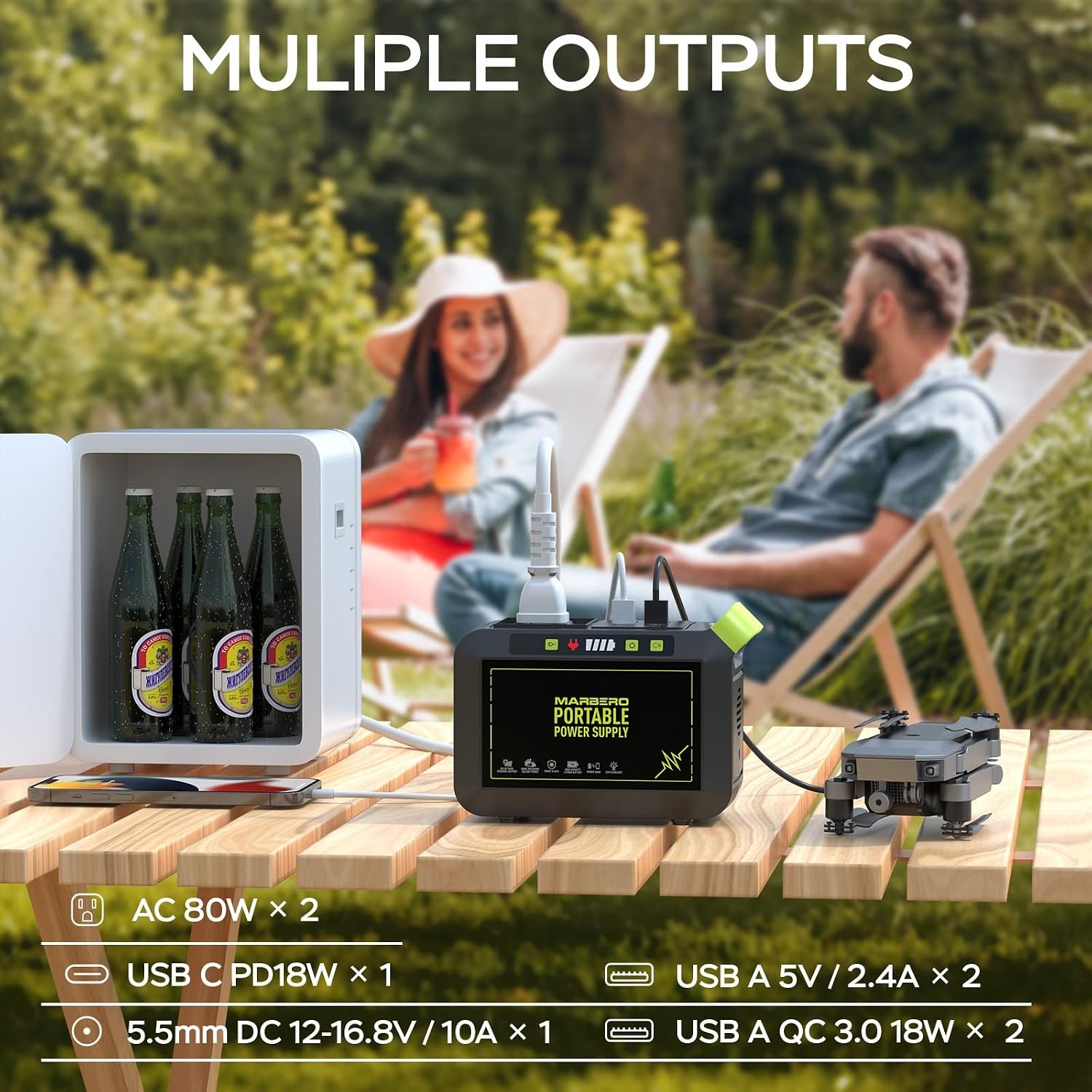
A power station — think of it as a very large rechargeable battery with standard wall outlets and USB ports built in — can keep the lights on, charge your phone, and run a small fan or CPAP machine when the grid goes down. For apartment dwellers, where a gas generator is completely off the table (no outdoor space, no ventilation, no storage), a compact battery power station is often the only viable backup power option. The catch is that the market is flooded with units that look similar on the box but perform very differently in practice. This guide focuses specifically on models under $300, explains what those specs actually mean for a real 72-hour emergency kit, and gives you a clear framework for choosing the one that fits your situation — whether you’re building your first kit or upgrading from a basic battery bank.
| EDITOR'S PICKAnker Portable Power Station SO… | Mid-tierJackery Portable Power Station… | Budget pickMARBERO Portable Power Station… | |
|---|---|---|---|
| Battery capacity | 288Wh | 292Wh | 88Wh |
| Battery type | LiFePO4 | LiFePO4 | Lithium |
| AC output | 300W | — | 120W peak |
| Max input | 140W | — | — |
| Solar input | ✓ | Optional | Optional |
| Price | $249.98 | $199.00 | $71.99 |
| See on Amazon → | See on Amazon → | See on Amazon → |
Why the Sub-$300 Category Is Trickier Than It Looks
If you’ve browsed Amazon or a big-box retailer recently, you’ve probably noticed that power station listings are a wall of numbers: watt-hours (Wh), watts (W), and peak watts. Here’s the plain-language translation:
- Watt-hours (Wh) is the fuel tank. A 300 Wh unit holds enough energy to run a 30-watt device for 10 hours.
- Watts (W) is the engine. This is the maximum power the unit can deliver at one time. A 200W output limit means you can’t plug in a 300W device.
- Peak watts is a short-duration surge rating — relevant for starting motors (like a blender or small pump), not for continuous loads.
The core problem in the sub-$300 tier is that manufacturers frequently optimize for one number at the expense of the others — or they pad the headline Wh figure with cells that deliver poor real-world efficiency. Wirecutter’s portable power station coverage notes that actual usable capacity often runs 10–15% below the rated figure once you account for inverter conversion losses. That gap matters when you’re planning a 72-hour scenario.
The other hidden variable is battery chemistry. Most units in this price range use Lithium-Ion (Li-Ion) cells, which are energy-dense but degrade faster and are more sensitive to heat. A growing number of units — including some now available under $300 — use Lithium Iron Phosphate (LiFePO4 or LFP) cells, which are heavier, slightly less energy-dense, but dramatically longer-lived (often rated 2,000–3,500 charge cycles vs. 500–800 for standard Li-Ion). For an emergency kit that might sit on a shelf for two years between uses, that cycle life difference is material.
By the Numbers: What a 72-Hour Apartment Kit Actually Needs
| Device | Typical wattage | 72-hour draw (8 hrs/night use) |
|---|---|---|
| LED lantern or strip light | 5–15 W | 120–360 Wh |
| Smartphone charging (2 phones) | 10–20 W | 15–30 Wh total |
| Small fan (12-in box fan) | 30–50 W | 240–400 Wh |
| CPAP (no heat, no humidifier) | 30–60 W | 240–480 Wh |
| Mini-fridge (compact, 12V) | 40–60 W | 960–1,440 Wh |
The takeaway: lighting and phone charging are well within a 200–300 Wh unit’s range for a full 72 hours. Running a CPAP overnight for three nights pushes you into the 250–500 Wh range depending on settings. A full-size fan or mini-fridge is beyond what sub-$300 units can sustain for three days — those loads require a larger system. FEMA’s emergency supply recommendations at ready.gov emphasize communication and medical devices as the priority loads for battery backup, which aligns with the 200–300 Wh sweet spot.
The Candidates Worth Comparing
Goal Zero Yeti 200X (~$250–$280 street price as of mid-2026)
The Yeti 200X has become a reliable reference point in this tier. Published specs put it at 187 Wh of usable capacity, with a 200W AC inverter and multiple USB-A and USB-C ports including one 60W USB-C PD port. It uses Li-Ion cells — not LFP — so cycle life is rated at roughly 500 full cycles before the battery degrades to 80% capacity.
What makes it worth attention is the ecosystem: the Yeti 200X is compatible with Goal Zero’s Boulder and Nomad solar panels via the Anderson Powerpole input port, and it uses their standard 8mm barrel connector for their smaller panels. If you already own any Goal Zero solar gear, the compatibility is seamless. Owners consistently report that the build quality feels durable and the interface is clean, with a clear battery percentage display.
The tradeoff is capacity-per-dollar. At roughly $260–$280, you’re paying partly for the brand ecosystem and the compact, well-finished form factor. If you need maximum Wh for the price and don’t have existing Goal Zero solar panels, there are alternatives that deliver more capacity at the same spend.
Best for: Goal Zero solar panel owners, apartment dwellers who prioritize compact size and a polished interface, and anyone likely to use this as both an emergency unit and an everyday travel or camping battery.
Jackery Explorer 300 Plus (~$230–$260 street price as of mid-2026)
Jackery’s Explorer 300 Plus is the most significant upgrade the company has made to the budget tier in recent years. The headline spec is LFP battery chemistry at this price point — rated at 3,000 charge cycles to 80% capacity. Published specs list 288 Wh of capacity, a 300W AC inverter (600W surge), and a USB-C port rated at 100W PD.
Popular Mechanics’ coverage of portable power stations flags the LFP chemistry as a meaningful differentiator for users who plan to store a unit long-term or recharge it frequently — both of which describe emergency kit use cases almost exactly. Owners in aggregated reviews consistently note that the unit handles being stored at partial charge and then topped off without the degradation issues that plague standard Li-Ion units left on shelves.
The tradeoff: the Jackery solar ecosystem uses a proprietary connector (their SolarSaga connector format), so if you’re pairing this with third-party panels, you’ll need an adapter — and voltage compatibility is worth checking before you buy. The unit’s MPPT solar charge controller is rated to accept panels from 12–30V. Most 50–100W portable panels fall in that range, but verify before pairing.
Best for: Apartment dwellers building a first 72-hour kit who want the best combination of capacity, longevity, and price — particularly if a CPAP or medical device is in the load plan.
Anker SOLIX C300 (~$200–$240 street price as of mid-2026)
Anker’s entry into the dedicated power station market has been aggressive on specs-per-dollar. The SOLIX C300 is rated at 288 Wh and uses LFP cells, with a 300W AC inverter and USB-C PD ports up to 100W. It also features a dual-charging mode (AC + solar simultaneously) that Anker rates for faster recharge times — relevant if you want to pair it with a small balcony or window-mounted solar panel.
Consumer Reports’ portable power station ratings note that Anker’s build quality has improved substantially in the SOLIX line compared to earlier budget iterations. Owners report that the display interface is clear and the app connectivity (via Bluetooth) gives more granular battery health data than most units in this price range offer.
The honest tradeoff is brand maturity in this specific product category. Anker is a dominant brand in charging accessories, but their power station lineup is newer than Goal Zero’s or Jackery’s. The long-term ownership picture — firmware support, warranty fulfillment, replacement parts — is less proven. For a device you’re buying as an emergency backup and hoping not to need, that uncertainty is worth naming.
Best for: Budget-conscious buyers who want LFP chemistry and maximum capacity for the dollar, and who are comfortable with a newer entrant in the category.
The Specs That Actually Matter vs. the Ones That Don’t
Matters:
- Usable Wh (not rated Wh — subtract ~10–15% for inverter losses)
- Battery chemistry (LFP = longer shelf life and more cycles; critical for emergency storage)
- Solar input voltage window (if you’re pairing with a panel — check that your panel’s Voc falls inside the station’s accepted range)
- AC inverter wattage (must exceed the peak draw of your highest-wattage device)
- Warranty and company longevity (a two-year warranty from a company that may not exist is worth less than a one-year warranty from an established brand)
Doesn’t matter as much as it sounds:
- Peak/surge watts — unless you’re running a motor-start load, the continuous watt rating is what constrains real use
- Number of output ports — more ports look impressive; what matters is whether the right port type (USB-C PD, AC, 12V DC) is available for your devices
- App connectivity — nice to have, not load-bearing for emergency use
Decision Framework: If X, Then Y
If your primary load is a CPAP and you store this kit for years between uses: The Jackery Explorer 300 Plus or Anker SOLIX C300’s LFP chemistry is the non-negotiable call. Don’t buy a standard Li-Ion unit for a CPAP backup that will sit on a shelf — you’ll find a degraded battery exactly when you need it most.
If you already own Goal Zero solar panels: The Yeti 200X’s connector compatibility makes it the obvious pairing. You’re paying a modest premium for seamless integration, and for long-term kit coherence, that’s usually worth it.
If you’re building from scratch with no existing gear and want maximum capacity per dollar: The Anker SOLIX C300 is the value pick at this writing, followed closely by the Jackery 300 Plus. Run the Wh-per-dollar math: at $220 for 288 Wh usable (estimated), the Anker delivers roughly 1.3 Wh per dollar — better than the Yeti 200X at comparable street prices.
If you’re not sure what you need: Start with the Jackery 300 Plus. It threads the needle on capacity, LFP longevity, brand maturity, and price better than anything else in the tier right now. Pair it with any 60–100W portable solar panel that outputs 18–25V and you have a genuinely functional system for under $400 total.
One number to keep in mind as you shop: a fully charged 300 Wh unit, used only for phone charging and LED lighting across 72 hours, will likely end the scenario with 40–60% capacity remaining. That margin is your buffer for unexpected loads — a medical device, a neighbor’s phone, a weather radio that needs power at 3 a.m. Build to the expected load, then buy one tier up if you can afford it. The gap between a $230 unit and a $280 unit is almost always worth it when the scenario is real.