A portable power station is essentially a big rechargeable battery in a box — one that can power your phone, a lamp, a fan, or even a small TV through a standard outlet the same way your wall does. The compact tier covered here runs from roughly 88 watt-hours (Wh) up to about 300Wh. To put those numbers in human terms: a watt-hour is the energy needed to run a one-watt device for one hour, and a modern smartphone holds about 15–17Wh, so even the smallest units in this tier can recharge a phone several times over. For apartment dwellers building a 72-hour emergency kit, suburban families bridging short outages, or overlanders who need a compact backup alongside a larger station, this size class punches well above its footprint. This article walks through the real tradeoffs — not just the spec-sheet numbers, but the use-case fits and documented owner-reported quirks that determine whether a unit actually earns its shelf space in your kit.
| EDITOR'S PICKAnker Portable Power Station SO… | Mid-tierJackery Portable Power Station… | Budget pickMARBERO Portable Power Station… | |
|---|---|---|---|
| Capacity | 288Wh | 292Wh | 88Wh |
| Battery type | LiFePO4 | LiFePO4 | Lithium |
| AC output | 300W | — | 120W peak |
| Input charging | 140W | — | — |
| Price | $249.98 | $199.00 | $71.99 |
| See on Amazon → | See on Amazon → | See on Amazon → |
The Capacity Math You Actually Need
Before comparing specific models, it helps to internalize one conversion: usable watt-hours ≠ rated watt-hours. Most lithium-based power stations deliver roughly 80–90% of their rated capacity under real conditions, factoring in conversion losses, temperature, and battery chemistry. A unit rated at 256Wh typically delivers about 205–230Wh to your devices. That gap matters when you’re planning against a specific load.
By the numbers — what common devices draw from a 256–300Wh station:
| Device | Typical draw | Estimated runtime from ~256Wh (at 85% efficiency) |
|---|---|---|
| Smartphone (15Wh battery) | — | ~14 full charges |
| USB box fan (low setting) | 10–15W | 14–20 hours |
| 32” LED TV | ~30–40W | 5–7 hours |
| CPAP machine (no heat) | ~30–40W | 5–7 hours |
| Mini fridge (cycling average) | ~40–60W | 3–5 hours |
These ranges align with the published-spec math and reflect aggregated owner-reported benchmarks across verified purchaser reviews. FEMA’s Ready.gov emergency kit guidance — published under the title “Build A Kit” at ready.gov — consistently identifies communication and lighting as first priorities in any supply kit, and this capacity tier handles both without difficulty.
Four Units Worth Knowing, and What Separates Them
The four units below span the full compact tier. Each is covered in its own H3 subsection with a tier marker so you can jump to the decision level that fits your situation.
MARBERO 88Wh — The Entry Point With a Gotcha
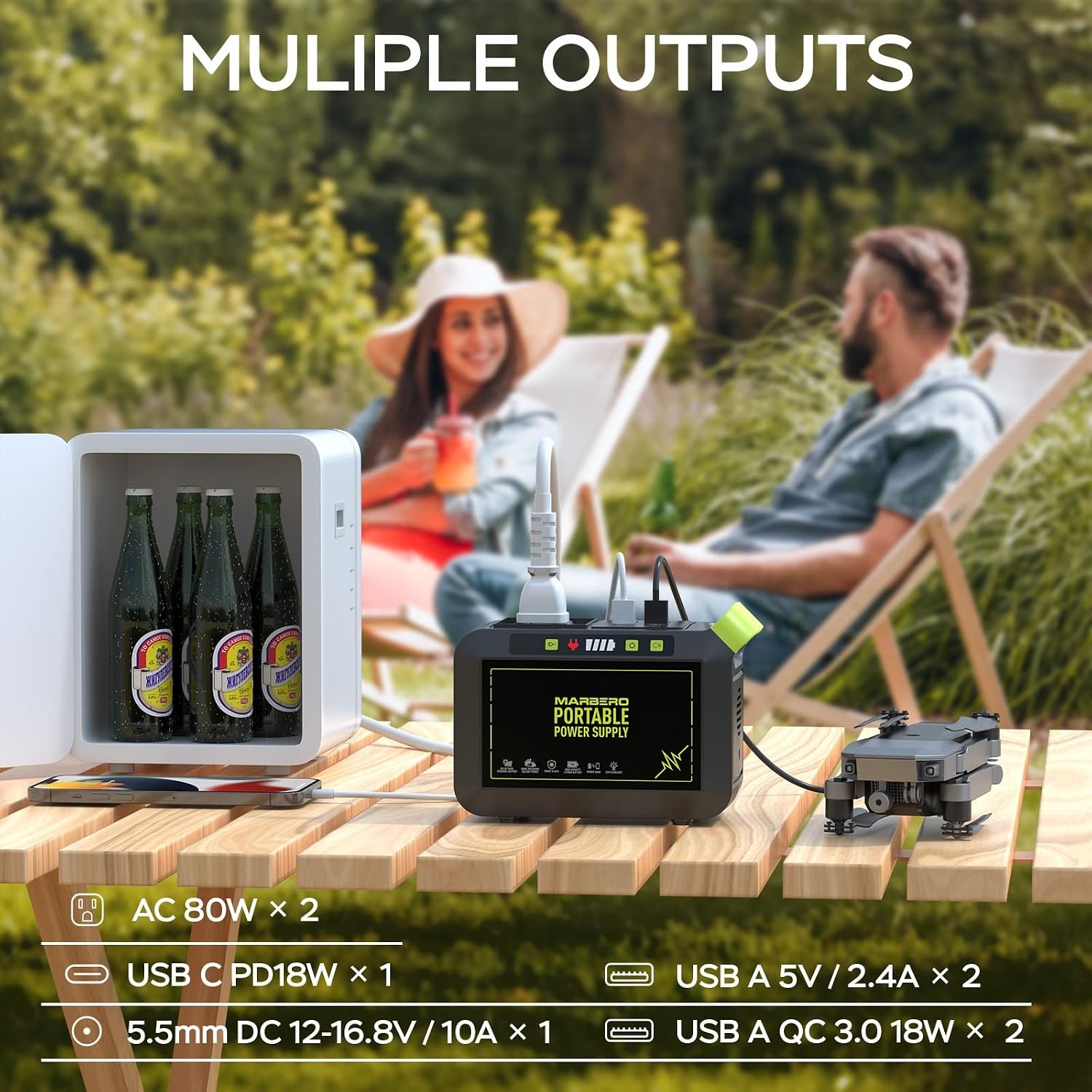
The MARBERO 88Wh is the logical first step for anyone who wants emergency power in the smallest possible footprint — it’s roughly the size of a hardcover novel. Published specs place it at 88Wh with a 110W AC inverter. Some firmware versions deliver pure sine wave output; others use modified sine wave. Confirm before powering sensitive gear.
Phone charging math works out clearly: at roughly 88Wh before conversion losses, expect 4–5 full smartphone charges before the unit is depleted, not the 6–8 that some product listings suggest. Marketing claims of 6–8 charges assume ideal conditions and older, smaller phone batteries. Plan around 4–5 to be safe.
The quirk that genuinely matters in emergency use: this unit slow-charges itself and shows no visible indicator movement for several hours during a recharge cycle. Verified purchaser accounts describe waiting three or more hours before a single LED segment advanced, leading some owners to conclude the unit was broken or not charging. This is a documented design characteristic of how the battery management system (BMS) — the internal circuit that protects the cells — handles low-current recharging, not a defect. The mitigation is simple: run a full charge cycle at home before you need the unit in an emergency so you know what normal looks like.
Wirecutter, in its Best Portable Power Stations review published by New York Times Wirecutter, consistently frames sub-100Wh units as “phone-and-light” stations rather than appliance runners — and that framing is exactly right for the MARBERO 88Wh. It earns its place as a dedicated communication-and-lighting station for one or two people.
MARBERO
$71.99
In stock on Amazon
Check price on AmazonHOWEASY — Real-World Solar Pairing for Low-Draw Devices
The HOWEASY units in this tier — typically landing in the 80–100Wh range — have generated a useful and specific benchmark from owner reports: one confirmed purchaser ran a USB fan continuously at level one in moderate-light solar conditions, and at level two in direct sunlight, essentially keeping pace with consumption using a modest solar panel. That real-world finding is valuable for emergency planning.
What it demonstrates: with a compatible solar panel producing 20–30W in good conditions, a unit in this class can sustain a low-draw USB device more or less indefinitely in daylight. REI Co-op Learning Center, in its Expert Advice article on solar chargers, notes that real-world solar output typically runs 70–80% of rated panel wattage under field conditions — so a nominally rated 40W panel delivers roughly 28–32W on a clear day. Pair that against a 15W fan load and you have a neutral or positive power budget.
The practical lesson here extends beyond any single brand: match panel output to device draw, not just to station capacity. A 256Wh station paired with a 20W panel and a 30W load will drain slowly regardless of rated capacity. The HOWEASY owner’s confirmation gives this math a real-world anchor.
MARBERO
$71.99
In stock on Amazon
Check price on AmazonALLWEI 256Wh — The Mid-Tier Workhorse
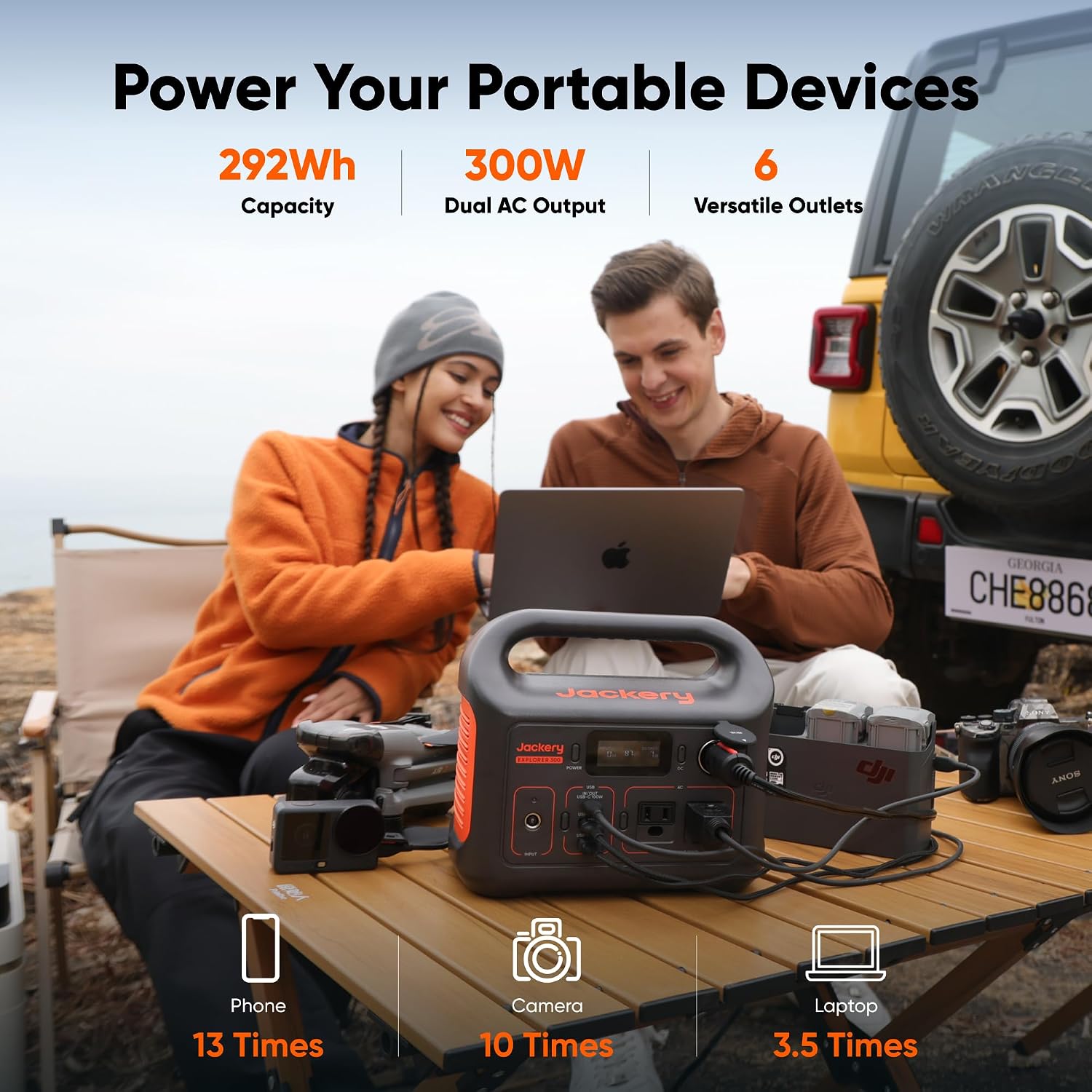
The ALLWEI 256Wh sits at the sweet spot for families who need more than phone-charging redundancy but can’t justify — or store — a 500Wh-plus station. Verified owner accounts of six continuous hours of TV runtime from a full charge check out against the published-spec math: a 30–35W TV draw against approximately 218Wh of usable capacity lands squarely in that window.
Published specs on the ALLWEI 256Wh list a 300W AC inverter — enough to run a box fan, a small TV, LED lighting, and charge multiple devices simultaneously without tripping the inverter’s protection circuit. At this capacity, a realistic full overnight lighting-and-communication load during an outage is achievable: a small LED lamp at 5W running eight hours draws 40Wh, leaving 178Wh for phone charges and a portable radio. That’s meaningful margin.
The tradeoff versus stepping up to a premium compact station is straightforward: the ALLWEI trades app connectivity, optimized MPPT solar charging, and brand ecosystem integration for a lower price point. Popular Mechanics, in its explainer “How Portable Power Stations Work,” notes that MPPT charge controllers — which extract 20–30% more power from solar panels under real-world conditions than older PWM controllers — are increasingly standard at the 256Wh tier. Confirm whether any unit you evaluate includes MPPT before pairing it with a solar panel.
If you’re not building toward a larger solar array and just need a standalone outage buffer, the ALLWEI 256Wh’s tradeoffs are reasonable.
Jackery
$199.00
In stock on Amazon
Check price on AmazonAnker SOLIX C300 and BLUETTI Elite 30 V2 — The Premium End of Compact
These two units represent what happens when premium build quality moves into the compact form factor. They serve different decision profiles and are worth examining separately.
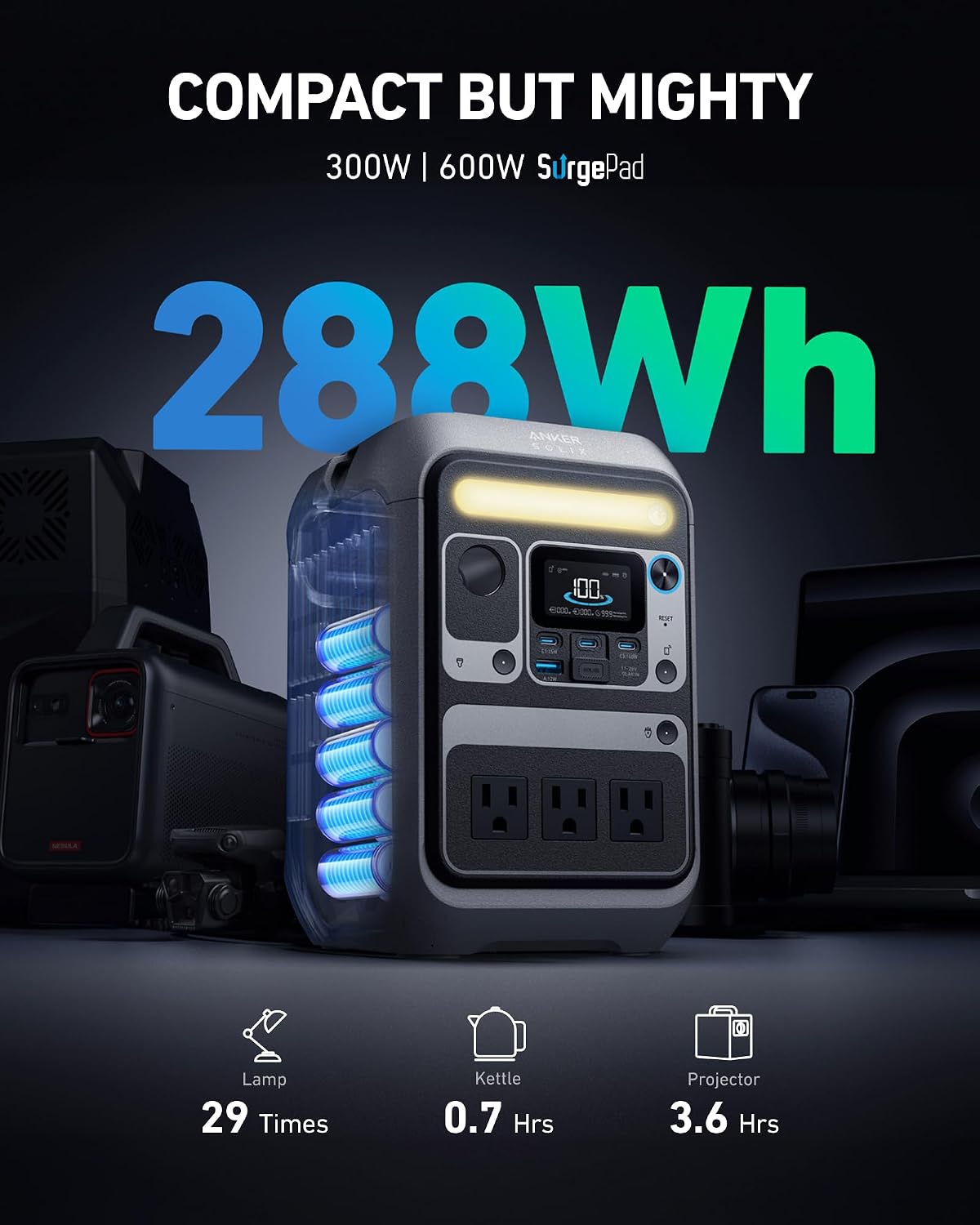
Anker SOLIX C300 (288Wh): Owner reviews consistently highlight something that sounds mundane but matters operationally: it ships with a desktop-style power cord and provides three real AC outlets. Owners repeatedly note that it feels like a real appliance rather than a gadget — the kind of distinction that matters when you’re handing it to a family member during a stressful outage and asking them to plug in a lamp or a CPAP machine. Popular Mechanics’ coverage of portable power station design identifies interface friction as one of the most underrated factors in real-world emergency use. Anker rates the C300 at 300W AC output, and its published charging spec — full AC recharge in approximately 38 minutes via HyperFlash technology — is class-leading for this form factor.
BLUETTI Elite 30 V2: This unit occupies a different lane: it’s the unit to consider if you’re running sensitive electronics and need confirmed pure sine wave output with UPS (uninterruptible power supply) functionality. One technically specific verified purchaser — running a home server — confirmed pure sine wave output and described the 10ms UPS switchover as reliable for sensitive electronics. To translate that specification: pure sine wave means the AC power the unit delivers mimics the smooth waveform of grid power, which matters for CPAP machines, medical equipment, and computers that can be damaged or perform poorly on the modified sine wave output common in cheaper inverters. A 10ms switchover means the unit detects a power loss and switches to battery fast enough that most sensitive electronics never register a gap.
If your emergency kit includes a CPAP, medical device, or any equipment whose manual warns against modified inverters, the BLUETTI Elite 30 V2’s UPS capability is not a luxury feature. It is the appropriate tool.
Anker
$249.98
In stock on Amazon
Check price on AmazonSolar Compatibility: The Connector Problem Nobody Warns You About
Pairing any of these units with a solar panel for off-grid recharging is the logical next step in emergency preparedness — but it’s also where buyers consistently encounter problems that aren’t visible in product listings. REI Co-op Learning Center’s Expert Advice on solar chargers recommends always verifying three specifications before pairing any panel to a station: input voltage range, maximum input wattage, and connector type. Those three checks resolve the majority of compatibility issues.
Connector mismatch is the most common problem. Most compact stations use Anderson Powerpole, MC4, or proprietary barrel connectors for solar input. A panel with MC4 connectors will not plug directly into a unit expecting a DC barrel plug without an adapter. Confirm connector type before purchasing either component.
Voltage window is the second issue. Every solar input port has a maximum input voltage. Sending more than that — easy to do by connecting panels in series — risks damaging the BMS. Confirm that your panel’s output voltage at full sun falls within the station’s rated solar input voltage range.
MPPT vs. PWM charging affects how quickly you can recharge from partial sunlight. As noted by Popular Mechanics in its portable power station coverage, MPPT controllers extract roughly 20–30% more power from panels under real-world conditions than older PWM controllers. Most units at the 256Wh-plus tier now include MPPT; many sub-100Wh units do not. This distinction matters most when you’re relying on solar recharge during a multi-day outage.
Print that three-item checklist — voltage range, wattage limit, connector type — and tape it to your station’s storage bag.
If X, Then Y: Decision Rules for This Tier
-
If your primary need is 72-hour communication and lighting for one or two people in an apartment with no car access: the MARBERO 88Wh covers it. Run a full charge cycle before you need it and familiarize yourself with the slow-charging behavior.
-
If you want to pair with solar and run a low-draw USB device off renewable power: the HOWEASY class demonstrates that a 20–30W panel can sustain a 10–15W load at or near equilibrium in direct sunlight. Match your panel output to your device draw, not just to your station’s rated capacity.
-
If you need to run a fan or TV during a multi-hour outage and want a documented real-world benchmark: the ALLWEI 256Wh’s six-hour TV runtime is verified against published specs and owner accounts. It is the proof point for this capacity tier.
-
If appliance feel and fast recharge matter — especially if you’ll be sharing the unit with family members who are not gear-oriented: the Anker SOLIX C300’s desktop cord, three outlets, and ~38-minute recharge are worth the price premium.
-
If you’re running a CPAP, medical device, home server, or any sensitive electronics and need confirmed pure sine wave with fast UPS switchover: the BLUETTI Elite 30 V2 is the only unit in this compact tier with a verified owner confirming reliable 10ms switchover performance.
-
If you want to pair any unit with solar: budget 30 minutes to match connector type, input voltage window, and MPPT compatibility before purchasing a panel. A mismatched purchase at the 256Wh tier is a $60–$100 mistake; a voltage mismatch can damage the station’s BMS.
Frequently Asked Questions
How many phone charges can an 88Wh power station actually deliver before it runs out? An 88Wh unit realistically delivers 4–5 full charges for a modern smartphone (15–17Wh battery), accounting for conversion losses. Marketing claims of 6–8 charges assume ideal conditions and older, smaller phone batteries. Plan around 4–5.
Why does my small power station appear to not be charging even when plugged in? This is the documented slow-charging behavior of several sub-100Wh units, including the MARBERO 88Wh. The BMS trickle-charges the cells at low current, and the indicator LEDs may not visibly advance for two to three hours. It is a design characteristic, not a defect. Let it charge for 4–6 hours before concluding there is a problem.
Can a 256Wh or 288Wh station run a mini fridge or box fan for a meaningful amount of time? A box fan on low (10–15W) can run 14–20 hours. A mini fridge cycling on an average draw of 50W delivers roughly 4–5 hours of runtime — enough to bridge a short outage. A 256Wh station is a bridge, not a replacement for grid power over multiple days.
What does pure sine wave output mean and why does it matter for sensitive electronics? Pure sine wave means the AC electricity from the inverter mimics the smooth waveform of grid power. Modified sine wave — common in less expensive units — uses a stepped approximation that can cause motors to run hotter, audible hum in audio equipment, and potential damage to CPAP machines, medical equipment, and some laptop power supplies. If your device manual warns against use with modified inverters, you need a pure sine wave unit.
How do I know if my compact power station is compatible with a solar panel? Check three specifications: the station’s solar input voltage range (your panel’s output voltage at full sun must fall within this range), the station’s maximum solar input wattage (do not exceed it), and the connector type on both devices. REI Co-op Learning Center’s Expert Advice on solar chargers and your station’s manual are the correct starting points. When in doubt, contact the manufacturer with your panel’s full specifications before purchasing.