CPAP, Mini Fridge, or TENS Unit: Matching Your Medical and Essential Devices to the Right Power Station
A portable power station is essentially a large rechargeable battery with wall-outlet plugs built in — the kind of device you can charge at home and then use to run your medical equipment when the grid goes down, when you’re camping, or during an extended power outage. They range from small units the size of a lunchbox to rolling units that weigh 30 pounds and store enough energy to run serious appliances. If you depend on a CPAP machine to breathe safely at night, need to keep insulin refrigerated, or use a TENS unit for pain management, the right power station isn’t just a convenience purchase — it’s a medical continuity decision. This guide cuts through the marketing watt-hour numbers and helps you match your specific device’s real draw to a station that will actually cover you.
After that, the math gets specific fast, and if you’ve already been shopping stations and wondering why a 1,000Wh unit supposedly can’t run your refrigerator through a weekend outage, you’re in exactly the right place.
| EDITOR'S PICKBLUETTI AC200L Portable Power S… | Mid-tierEF ECOFLOW Portable Power Stati… | Budget pickJackery Portable Power Station… | |
|---|---|---|---|
| Capacity | 2048Wh | 1024Wh | 292Wh |
| AC Output | 2400W | 1800W | — |
| Expandable | 8192Wh | — | — |
| USB-C Output | — | 100W | — |
| RV Outlet | 30A | — | — |
| Price | $899.00 | $449.00 | $199.00 |
| See on Amazon → | See on Amazon → | See on Amazon → |
The Number That Actually Matters: Running Watts vs. Rated Capacity
Power stations are sold by watt-hours (Wh) — the total energy they hold — but your devices are rated in watts, which is how fast they consume that energy. The runtime formula is straightforward:
Usable watt-hours ÷ device wattage = hours of runtime
The catch is that neither number in that equation is as clean as it looks on a spec sheet.
On the station side: Consumer Reports’ portable power station buying guide consistently flags that most stations only deliver 80–90% of their rated capacity due to internal conversion losses. A station marketed as 1,000Wh realistically delivers 800–900Wh to your devices. Some brands are more honest about this than others, but you should build the 10–20% haircut into every calculation.
On the device side: Manufacturers publish maximum watt ratings, not typical operating wattage. Your CPAP at pressure setting 8 draws far less than the 60W maximum on its label. Your refrigerator compressor cycles on and off — it might draw 150W when running but average only 50–70W over an hour. The gap between peak rating and average draw is where most runtime confusion lives.
By the numbers — typical real-world device loads:
| Device | Manufacturer-rated max (W) | Typical average draw (W) |
|---|---|---|
| CPAP (no humidifier) | 30–60 | 15–30 |
| CPAP (with heated humidifier) | 60–120 | 40–80 |
| Mini fridge (1.7–3.2 cu ft) | 60–85 | 25–45 |
| Full-size refrigerator (Energy Star) | 100–200 | 50–80 |
| TENS unit | 3–10 | 3–6 |
| Portable nebulizer | 50–100 | 50–100 |
These averages are drawn from published device documentation and aggregated review data, not a single source — treat them as planning estimates, then verify against your device’s actual label wattage.
CPAP: The Humidifier Is the Entire Variable
CPAP therapy (Continuous Positive Airway Pressure — a machine that delivers pressurized air through a mask to keep your airway open during sleep) is the single most frequently cited medical use case in portable power station reviews, and the humidifier attachment is where most runtime estimates collapse.
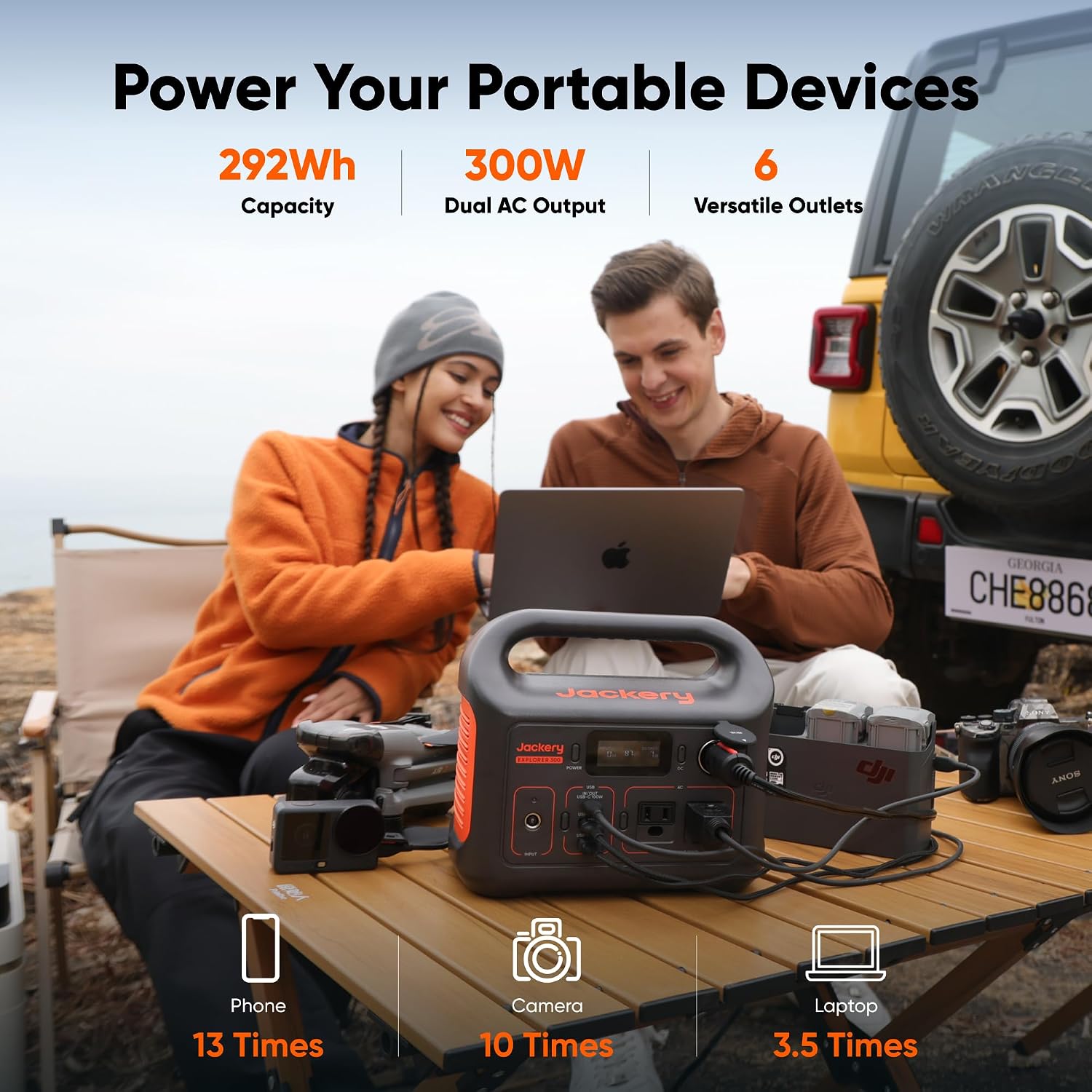
Without a humidifier, a CPAP running at a moderate pressure setting (7–12 cm H₂O, which covers the majority of prescriptions) draws roughly 15–30 watts. A 300Wh station like the Jackery Explorer 300 delivers roughly 270Wh usably — which at 20W average means about 13 hours of runtime. That’s comfortably more than a full night. Owners who have run this configuration on multi-week camping trips consistently report success, and the pattern holds across review aggregates for that station class.
Add a heated humidifier and the math changes sharply. The humidifier alone adds 30–50W, pushing total draw to 50–80W. At 65W average, that same 270Wh station now delivers roughly 4 hours — not enough for a full night. ResMed’s published power consumption documentation for their AirSense series confirms that humidifier heat level is the dominant variable in CPAP power draw, not pressure setting.
The replication rule for that successful camping configuration: No heated humidifier, or humidifier set to its lowest level (1 out of 5 on most ResMed/Philips units). At level 1, humidity draw drops to roughly 10–15W additional, keeping total consumption under 40W and preserving a 300Wh station’s ability to deliver a full 7–8 hour night.
For users who need full humidity — either for medical comfort or because their physician has specifically prescribed it — the right planning floor is a 500Wh+ station. The Jackery Explorer 500 or BLUETTI EB70S class gives you 450–600Wh usable, delivering a reliable 6–9 hours even at 60–70W draw, with margin remaining for mask heating and a phone charge.
A critical detail: pure sine wave output. Most CPAP machines require pure sine wave AC power — the same smooth electrical wave your wall outlet provides. Modified sine wave power (found in cheaper inverters and some budget stations) can cause CPAP motors to run hotter, create audible noise, and in some cases trigger error codes or void warranties. Wirecutter’s portable power station coverage explicitly flags this for CPAP users, and it’s a non-negotiable spec to confirm before purchase. Every station named in this guide produces pure sine wave output — but budget units under $150 may not. Check the spec sheet before buying.
Refrigerators: Why 1,000Wh Isn’t Enough for a Full Day
This is the counterintuitive finding that surprises even experienced buyers. Owners of the Anker SOLIX C1000 — a 1,056Wh station with a 1,800W inverter — who purchased multiple units specifically for refrigerator and freezer backup consistently report that a single C1000 cannot sustain a standard Energy Star refrigerator alone through a multi-day outage. The math explains why.
A full-size refrigerator’s compressor draws 100–200W at startup (the “surge” load) and 50–80W during its run cycle, but it cycles frequently — especially if the door is opened, the ambient temperature is warm, or the fridge is not well-insulated. In practice, a refrigerator running in a 75°F home averages 60–75W across a 24-hour period. Popular Mechanics’ refrigerator runtime testing documentation from 2025 puts average Energy Star consumption at roughly 1.5–2.0 kWh per day for a mid-size (18–20 cubic foot) unit.
At 1.5 kWh/day, a 1,056Wh station (roughly 900Wh usable) lasts only about 14–15 hours — not even a full day. The owners who bought seven Anker SOLIX C1000 units for whole-house refrigerator and freezer backup weren’t being excessive; they were doing the math correctly.
For refrigerator backup specifically, the decision frame is:
- Mini fridge (1.7–3.2 cu ft) for medication or critical items only: A 300–500Wh station can cover 24–36 hours. This is the medically practical solution for insulin storage.
- Full-size refrigerator for 24–72 hours: Plan for 2,000Wh+ usable capacity (BLUETTI AC200L class or Anker SOLIX C2000 with expansion battery), or pair a 1,000Wh station with a solar panel for daytime recharge.
- Ongoing backup (3+ days): Expandable station systems with bolt-on battery packs are the only realistic answer. Reviewers of both the BLUETTI AC200L and the Anker SOLIX C2000 consistently cite expandability as their primary purchase driver — and if you have a serious medical dependency on refrigeration, expandability should be your first-tier filter, not an afterthought.
TENS Units, Nebulizers, and Lower-Stakes Devices
At the other end of the draw spectrum, TENS units (small devices that deliver mild electrical pulses for pain management) consume so little power — typically 3–10W — that nearly any power station handles them trivially. Even the smallest MARBERO 88Wh units can run a TENS unit for 8–20+ hours. The concern with tiny stations is not TENS units; it’s that owners who rely on them sometimes also need a fan, a lamp, and a phone charger simultaneously. The MARBERO-class reviewer who ran a fan for one hour before depletion is a useful floor: at 60W, a fan alone will drain an 88Wh unit in roughly 1.2 hours. The lesson isn’t that small stations are useless — it’s that they have a single-device lane.
Portable nebulizers (medication delivery devices that convert liquid drugs into inhalable mist, used for asthma and COPD) draw 50–100W and run for 10–20 minutes per treatment session. A 300Wh station handles multiple days of nebulizer use with ease. The concern here is reliability of the AC output — again, pure sine wave matters.
Decision Rules: If X, Then Y
Here’s the practitioner-level decision frame, stated plainly:
If you run a CPAP without a humidifier or at humidity level 1: A 300Wh pure-sine-wave station covers you for 1–3 nights depending on pressure setting. Add a 100W solar panel and you’re indefinitely self-sufficient in good sun.
If you run a CPAP with a humidifier at level 3+: Start at 500Wh minimum. For multi-night or ongoing backup, budget for 1,000Wh and pair with solar.
If you need to refrigerate medication (insulin, biologics) in a mini fridge: A 300–500Wh station covers a 48-hour outage comfortably. Add a small solar panel for 72+ hour coverage.
If you need to keep a full-size refrigerator running through a multi-day outage: A 1,000Wh station is not your answer. You need 2,000Wh+ with solar input, or an expandable platform where you can add battery capacity. Buy the expandable platform from day one — retrofitting is always more expensive.
If your use case is a TENS unit, phone, or other low-draw device: Almost any station works. Optimize for portability and price, not capacity.
If the outage timeline is unknown or you have multiple medical dependencies: The Jackery Explorer 2000 v2, BLUETTI AC200L, and Anker SOLIX C2000 class — all expandable, all 2,000Wh+ base — are the right starting points. Owners running full off-grid electrical loads on these platforms report sustained performance across weeks, not just days. FEMA’s power outage preparedness guidance recommends planning for a minimum of 72 hours of self-sufficiency; for medical device users, that floor should be your baseline, not your target.
Frequently Asked Questions
How many watt-hours do I need to run a CPAP for one night without a humidifier vs. with one? Without a humidifier: plan for 150–250Wh for an 8-hour night (20–30W average). A 300Wh station covers you with margin. With a humidifier at moderate settings: plan for 400–600Wh. A 500Wh station is your minimum; 1,000Wh gives you two nights without recharging.
Can a 300Wh power station actually run a CPAP all night? Yes — without a humidifier, or with the humidifier at its lowest setting. Owners running this configuration on camping trips consistently report full-night performance. With a humidifier at mid-to-high settings, a 300Wh station will likely run out before morning.
Why can’t a 1,000Wh station run my full-size refrigerator for more than a few hours? Because a full-size refrigerator consumes 1.5–2.0 kWh (1,500–2,000Wh) per day, and a 1,000Wh station only delivers 800–900Wh usably. You get roughly half a day, not a full one. A mini fridge for medication storage changes the math entirely — those run 25–45W average and are very manageable on a 300–500Wh station.
What does “pure sine wave” mean and does my CPAP require it? Your wall outlet delivers AC power in a smooth, continuous wave. Pure sine wave inverters replicate this. Modified sine wave inverters produce a choppy approximation that some sensitive electronics — including most CPAP machines — handle poorly. Check your CPAP manual; most major brands explicitly require pure sine wave input. Never assume a budget station delivers it — verify the spec sheet.
How do I calculate how long a power station will run my specific device? Find your device’s wattage (on the label or in the manual). Multiply the station’s Wh rating by 0.85 (to account for conversion loss). Divide by device wattage. That’s your estimated runtime in hours. Example: 500Wh station × 0.85 = 425Wh usable ÷ 25W CPAP = 17 hours.
Should I buy a larger station or add solar panels for multi-day medical device backup? Both — but in sequence. First, buy a station large enough to cover one full night without any recharge. Then add solar to extend that indefinitely. For medical users, the expandable platform question matters most: choose a station whose manufacturer sells bolt-on expansion batteries, so you can grow capacity without replacing the base unit.