When a hurricane warning pops up on your phone at midnight, or an ice storm knocks your power out before dawn, the last thing you want is to be standing in your kitchen wondering whether you have enough food to get through the next three days. Emergency food comes in three main forms: calorie bars (dense, compact bricks that pack a day’s worth of energy into a foil pouch), MREs (Meals Ready-to-Eat — self-contained military-style meals with an optional flameless chemical heater), and freeze-dried pouches (lightweight backpacking-style bags where you add water to rehydrate a full meal). Each solves the same problem — keeping you fed when normal food isn’t available — but they solve it in different ways, with different tradeoffs in taste, prep effort, shelf life, and cost. If you’re building a 72-hour kit, or rethinking one you already have, this breakdown will help you make the right call for your specific situation.
| EDITOR'S PICKWornick Sopacko | Mid-tierEmergency Food Ration Bars | Budget pickGrizzly Gear Emergency Food Rat… | |
|---|---|---|---|
| Format | MRE meals | Bars | Bar |
| Calories | — | — | 3600 |
| Days of supply | — | — | 3 days |
| Count | — | 12 | — |
| Flavor | — | Chocolate | Vanilla |
| Inspection date | 2025 or 2026 | — | — |
| Price | $94.99 | $37.99 | $21.99 |
| See on Amazon → | See on Amazon → | See on Amazon → |
The Core Tradeoff: Convenience vs. Morale vs. Flexibility
Think of these three categories as sitting on a spectrum. Calorie bars are at the pure-convenience end: no prep, no water, no heat, just eat. Freeze-dried pouches are at the flexibility end: great variety, excellent taste when done right, but you need water. MREs live in the middle — self-contained and heatable without a stove, but bulkier and heavier per calorie than either alternative.
Here’s how the numbers shake out across a single adult’s 72-hour window:
By the numbers — one adult, 72 hours at ~2,000 cal/day:
| Format | Avg. calories per unit | Units needed (72 hrs) | Approx. weight (lbs) | Water required |
|---|---|---|---|---|
| Calorie bar (e.g., Grizzly Gear, Emergency Food Ration) | ~400 cal/bar, ~2,400/pack | 2–3 packs | 1.3–2.0 | None |
| Civilian MRE (full case) | ~1,200 cal/meal | 5–6 meals | 6–9 | Optional for heater |
| Freeze-dried pouches (e.g., Peak Refuel) | ~500–700 cal/pouch (labeled 2-serving) | 8–10 pouches | 3–5 | 16–20 oz per pouch |
FEMA’s emergency preparedness guidance, published in Are You Ready? An In-depth Guide to Citizen Preparedness and available through ready.gov, recommends a minimum three-day food and water supply for household kits. The USDA Food and Nutrition Service disaster nutrition guidance flags that stress, physical exertion, and cold environments all push real caloric needs well above 2,000 calories per day for active adults. If you’re hauling gear, clearing debris, or managing kids and elderly family members, plan for 2,400–2,800 calories per person per day.
Head-to-Head: Three Formats, Three Scenarios
The comparison below is organized by format, with each section closing at the tier marker that best describes where that format belongs in a purchasing decision.
Calorie Bars: The Honest Case For and Against
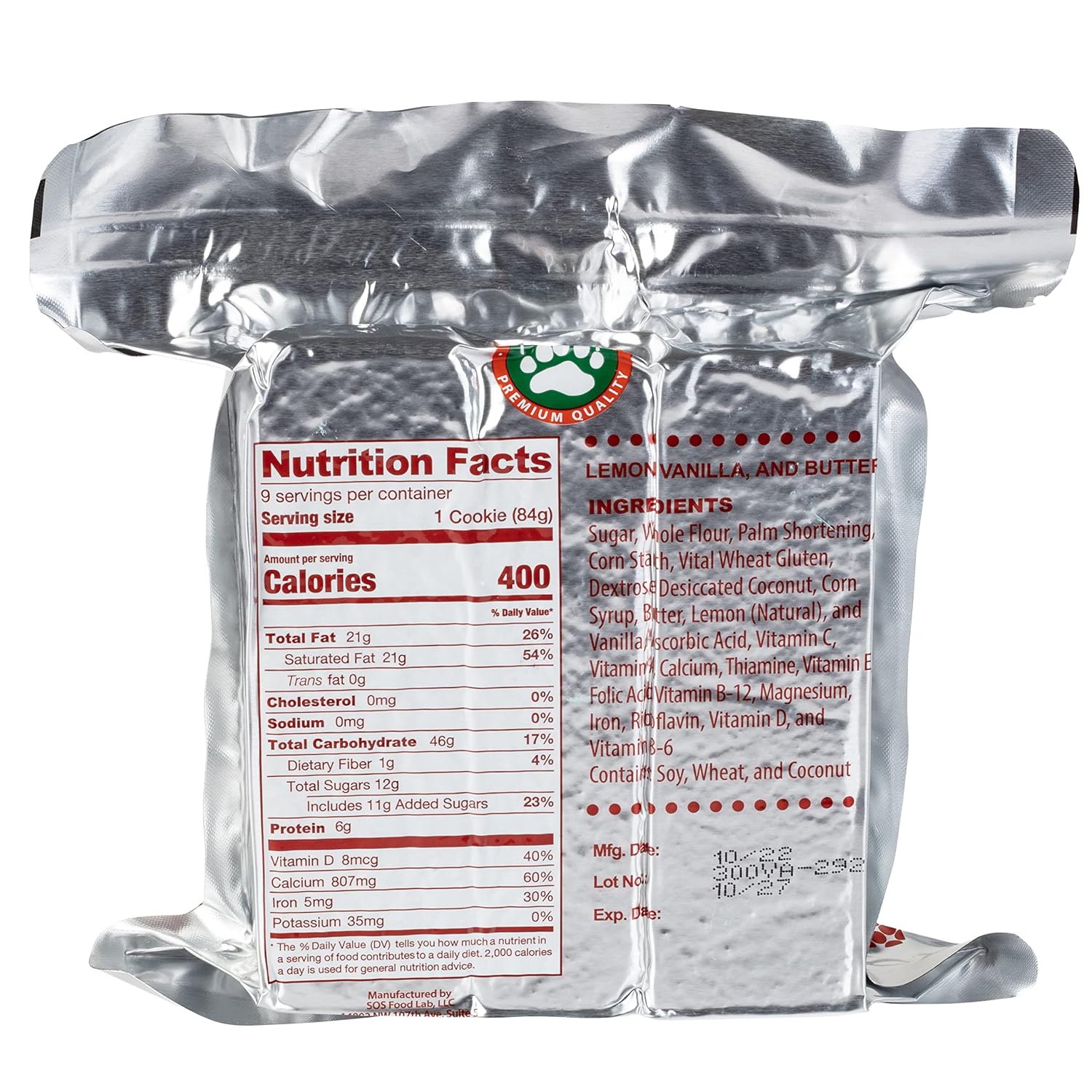
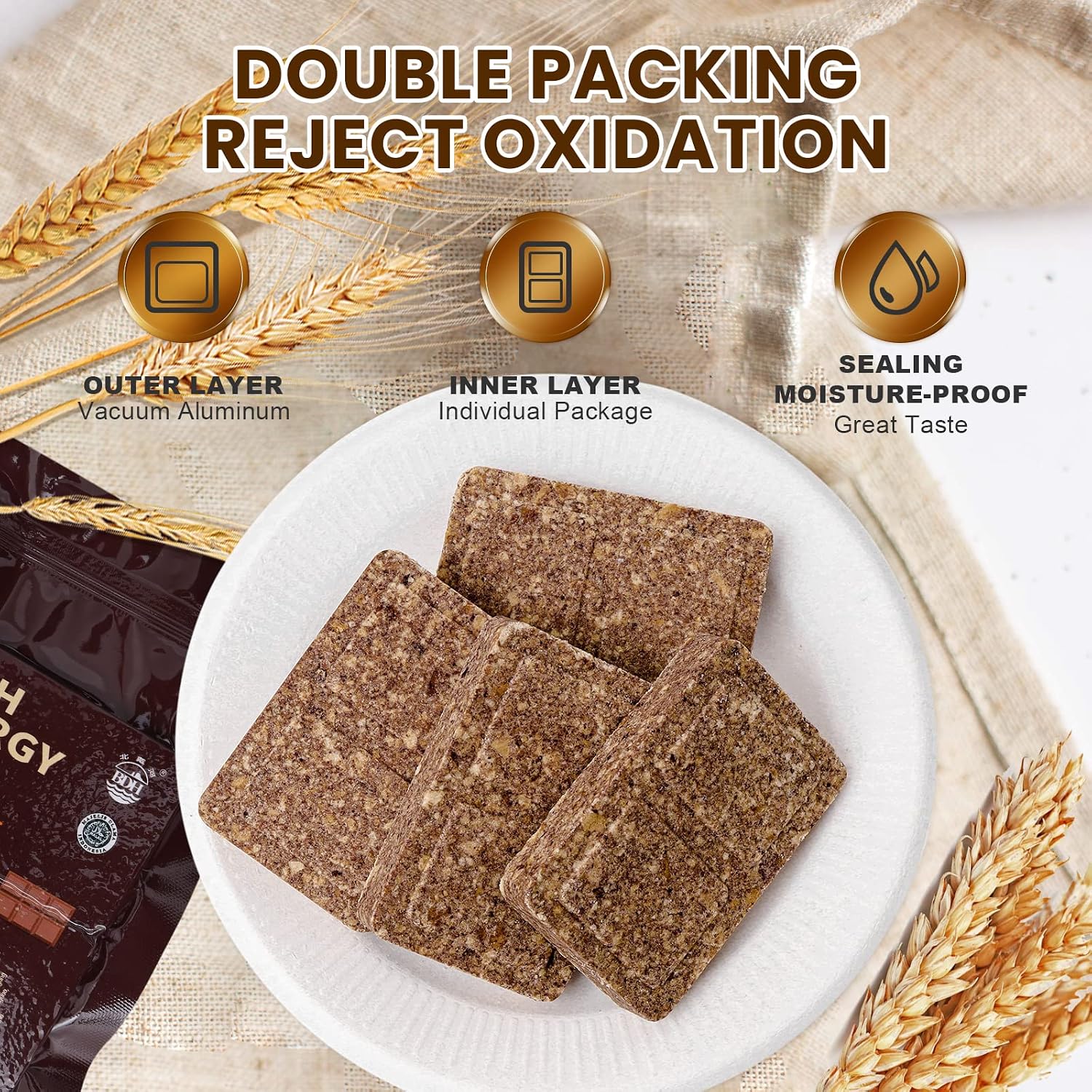
Grizzly Gear calorie bars and Emergency Food Ration bars are the two products owners bring up most in this category, and the aggregate picture from owner reviews is useful: both deliver on their core promise of compact, long-shelf-life (5-year rated) calories that require zero preparation. Reviewers are largely positive on taste — notably, the chocolate flavor variant of Emergency Food Ration bars earns consistent praise as the standout option in the lineup, and several owners specifically recommend prioritizing it when stocking up.
Packaging quality on Emergency Food Ration products draws detailed inspection notes from owners: the vacuum-sealed foil packaging appears to hold its seal consistently, but more than one owner recommends physically inspecting each incoming shipment, checking for seal integrity and any softness that might indicate a compromised barrier. That’s useful due diligence advice regardless of brand.
Here’s the nuance that the most helpful Grizzly Gear reviews surface, and it’s a point worth amplifying rather than glossing over: menu fatigue is a real risk when calorie bars are your only food. One owner put it plainly — bars are excellent as a supplement or anchor in a mixed kit, not as a standalone 72-hour diet. Eating the same dense, sweet block every few hours for three days while also managing a stressful situation is a morale drain that real-world users document consistently. The practical recommendation that emerges from those reviews: use calorie bars as your calorie floor — insurance that you won’t go hungry — while building variety into your kit with at least one other food format.
REI Expert Advice on emergency food storage makes a related point: palatability and satisfaction directly affect decision-making capacity under stress, which means food you’ll actually eat has measurable practical value beyond simple caloric math.
Best fit: Vehicle emergency kits, go-bags, and any space-constrained setup where zero-prep and weight are the primary constraints. In a home pantry stocked for more than 24 hours, treat bars as the backup, not the centerpiece.
Grizzly
$21.99
In stock on Amazon
Check price on AmazonMREs: Reading Date Codes and the Real Value of a Hot Meal
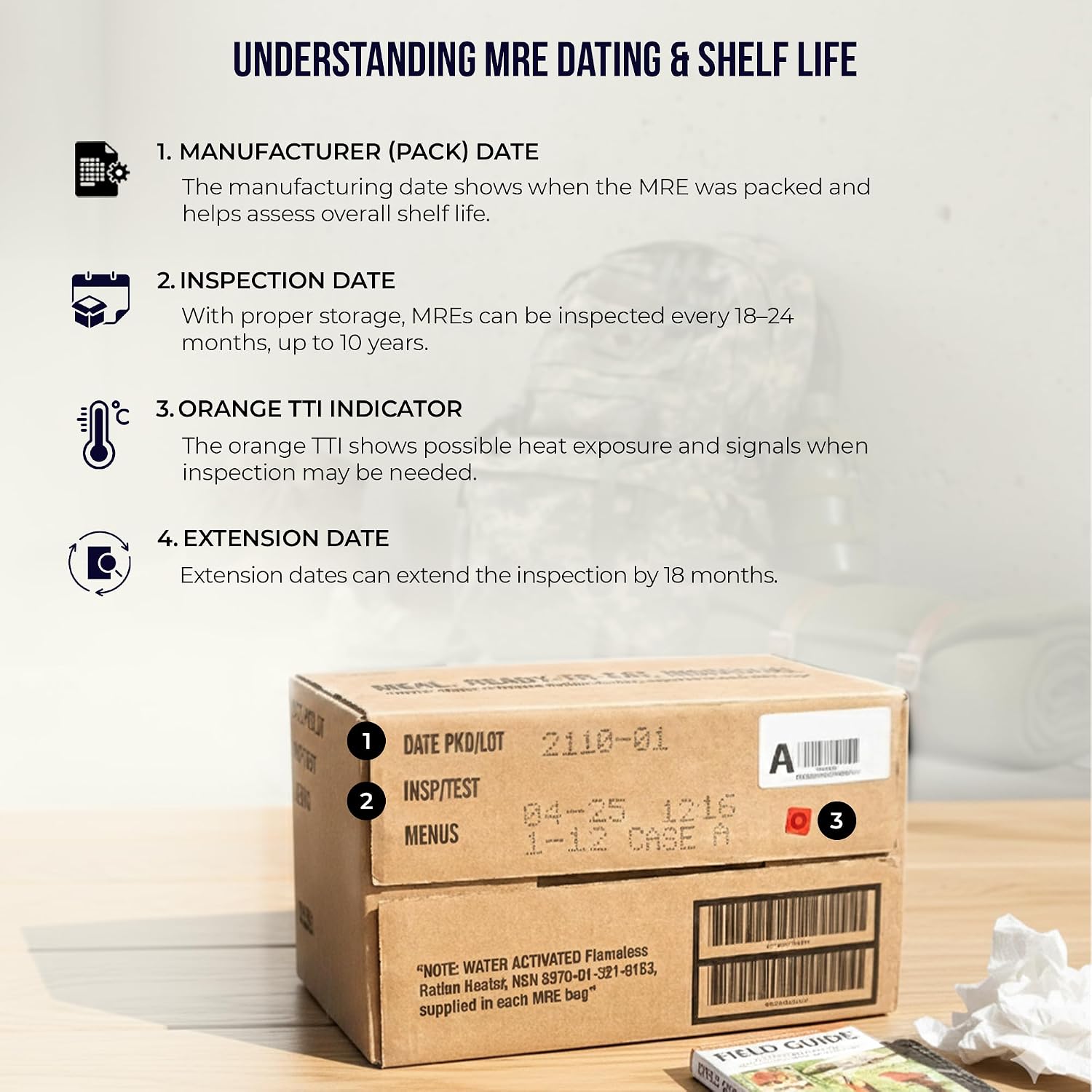
Civilian MRE cases — typically 12-meal cases sold through preparedness retailers — differ from military-issue MREs primarily in sourcing and date-tracking. The single most consistent behavior owners report when their shipment arrives: they immediately check the Julian date code. If you’ve never encountered this format, here’s how it works. A Julian date code appears stamped on the case or individual meal pouch, typically as a 4- or 5-digit number. The first one or two digits represent the year; the remaining three digits represent the day of the year (1–365). So a code reading 5042 means the 42nd day of 2025 — February 11, 2025. A code reading 24310 means the 310th day of 2024 — November 5, 2024.
Why does this matter? U.S. Army Natick Laboratories shelf-life research — referenced in FEMA and ready.gov preparedness documentation — indicates that MREs stored at 60°F can remain palatable for up to 130 months, roughly 10 years. At 80°F that window drops to around 60 months. At 100°F, it compresses to 12–22 months. A case that sat in a hot warehouse or the back of a delivery truck for a summer can lose years of usable life without any visible exterior damage. Knowing the production date lets you make an informed decision about rotation priority.
On flameless heaters: recent owner reviews across civilian MRE cases show a notably positive pattern — heaters in current production batches are reported as functional with very high reliability. The morale value of a hot meal is a theme multiple owners raise without being prompted, and it’s worth taking seriously. In a 72-hour disruption that involves stress, cold, disrupted sleep, and uncertainty, a hot meal is not a luxury — it is a measurable psychological stabilizer.
Best fit: Cold-weather scenarios, disrupted heating, or households with children or elderly members who will struggle with cold food. If your scenario is a warm-weather power outage and you’re comfortable with cold food, the weight-to-calorie math favors other formats.
Emergency
$37.99
In stock on Amazon
Check price on AmazonFreeze-Dried Pouches: Taste Wins, But Read the Serving Size Fine Print
Peak Refuel occupies a specific position in the freeze-dried pouch market: among preparedness-focused buyers, it’s consistently the most praised on taste. Owner reviews are genuinely effusive — the flavor quality and texture after rehydration draws comparisons to real meals rather than “survival food,” which is not a term most products in this category earn. Outside Online’s emergency food coverage confirms that freeze-dried pouches represent the strongest format for taste quality and meal variety among the three main emergency food types.
But those same enthusiastic reviewers surface a consistent and important caveat: the labeled serving count doesn’t match how hungry adults actually eat. The pattern is clear enough to treat as a planning assumption: a pouch labeled as two servings functions as one meal for a hungry adult. One reviewer stated this explicitly and the surrounding reviews corroborate it. For a 72-hour food plan, this means doubling your pouch count relative to what the packaging math suggests. A “12-serving” box of Peak Refuel pouches is realistically a 6-meal supply for one active adult, not 12.
On the water question, two scenarios are worth knowing:
-
Cold water works — it takes significantly longer (20–30 minutes) and the texture is denser, but the result is edible and nutritionally complete. Outside Online’s emergency food reporting confirms that freeze-dried pouches will fully rehydrate in cold water given sufficient time.
-
Room-temperature water for biscuit-style pouches — at least one owner documented this specifically and reported excellent results. In a partial-grid scenario where you have tap water but no heat source, this is genuinely useful to know and worth testing with your specific pouches before you need them under pressure.
The water dependency is the real planning constraint. Each pouch requires 16–20 ounces of clean water for rehydration. For a family of four eating freeze-dried meals as their primary food source over 72 hours, that’s roughly 1.5 to 2 additional gallons per day just for food prep, on top of drinking water needs.
Best fit: Households with reliable access to clean stored or filtered water, picky eaters, families with children, and any kit where taste quality is a meaningful morale factor.
Wornick
$94.99
In stock on Amazon
Check price on AmazonBuilding the Optimal 72-Hour Stack
For most households building a first or second-generation 72-hour kit, the strongest approach isn’t a single format — it’s a deliberate combination that covers different failure modes.
A practical stack for one adult:
- Calorie bars (1–2 packs): Zero-dependency calorie floor. No water, no prep, works in any scenario.
- 2–3 MRE meals: Hot-meal option, high caloric density, self-contained. Rotate by Julian date.
- 4–6 freeze-dried pouches: Variety, taste quality, and morale maintenance — assuming water supply is confirmed.
This combination addresses the menu fatigue problem that single-format kits run into, keeps total weight manageable (roughly 8–12 lbs for one adult’s 72-hour food supply), and ensures that at least one food option works regardless of whether you have water, heat, or neither.
FEMA’s Are You Ready? preparedness guide and REI Expert Advice on emergency food storage both converge on the same practical point: food you’ll actually eat during a stressful event is more valuable than food optimized purely for shelf life or calorie density. The preparedness community’s own review data confirms this — the owners who describe their emergency food as something they’d genuinely reach for are the ones who built variety into their kits from the start.
Frequently Asked Questions
How do I read the Julian date code on an MRE to know how old it is? The Julian date code is a 4–5 digit number stamped on the case or pouch. The first 1–2 digits are the year (e.g., “24” = 2024, “5” = 2025). The last three digits are the day of the year, from 001 (January 1) to 365 (December 31). So “25090” means the 90th day of 2025 — March 31, 2025. Use this date and your storage temperature to estimate remaining shelf life using U.S. Army Natick Laboratories guidance referenced in FEMA preparedness documentation.
Can I use calorie bars as my only food for 72 hours? Technically yes — the caloric math works. But owner experience strongly suggests that relying on bars exclusively creates menu fatigue that compounds stress. Bars work best as a supplement or calorie floor alongside other food formats. If bars must be your only option, the chocolate flavor variants consistently rate highest for palatability.
Do freeze-dried pouches really work with cold or room-temperature water? Yes, with caveats. Cold water rehydration works but takes 20–30 minutes and yields a denser texture. Room-temperature water, documented by Peak Refuel owners on biscuit-style pouches specifically, produces good results. Neither matches hot water, but both are genuinely functional in a no-heat scenario, as confirmed by Outside Online’s emergency food reporting.
How many calories per day do adults need in a high-stress emergency? The USDA Food and Nutrition Service disaster nutrition guidance uses 2,000 calories per day as a baseline, but notes that stress, physical exertion, cold, and caregiving responsibilities push real-world needs to 2,400–2,800 calories for active adults. Plan conservatively and err toward more.
What is the realistic serving count in a Peak Refuel two-serving pouch? Based on the consistent pattern in owner reviews, plan on one pouch per hungry adult per meal. The labeled two-serving count does not reflect how adults eat during physical or stressful conditions. Adjust your purchase quantity accordingly.
Do all flameless heaters in civilian MRE cases actually work? Current production batches show high functional reliability based on owner reports. Heater performance degrades with age and improper storage — another reason to check Julian date codes on arrival and store cases in a cool, dry environment. Owners who receive fresh-dated cases report essentially universal heater functionality.