Most people don’t think about their water supply until the tap runs dry — a burst main, an ice storm, a boil-water notice that shows up at 11 p.m. The rule of thumb from FEMA’s “Food and Water in an Emergency” guidance is one gallon of water per person per day, minimum, for drinking and basic sanitation. For a family of four over 72 hours — the planning window most emergency kits are built around — that’s 12 gallons. Storing that much water is realistic for some households and completely impractical for others. That gap is exactly why a layered approach — meaning you combine a few different water solutions rather than betting everything on one method — turns a fragile plan into a resilient one.
This article walks through three tools that show up constantly in real preparedness builds: Datrex emergency water packets (pre-sealed, ready-to-drink pouches), Potable Aqua iodine purification tablets (a chemical treatment system), and portable filters like the LifeStraw Original and Sawyer Mini. Each has a distinct job in a 72-hour plan. Understanding where each one excels — and where it breaks — lets you stop guessing and start making intentional choices.
What Each Solution Actually Does (and Doesn’t Do)
The three categories serve fundamentally different functions, which is why “which one should I buy?” is usually the wrong question.
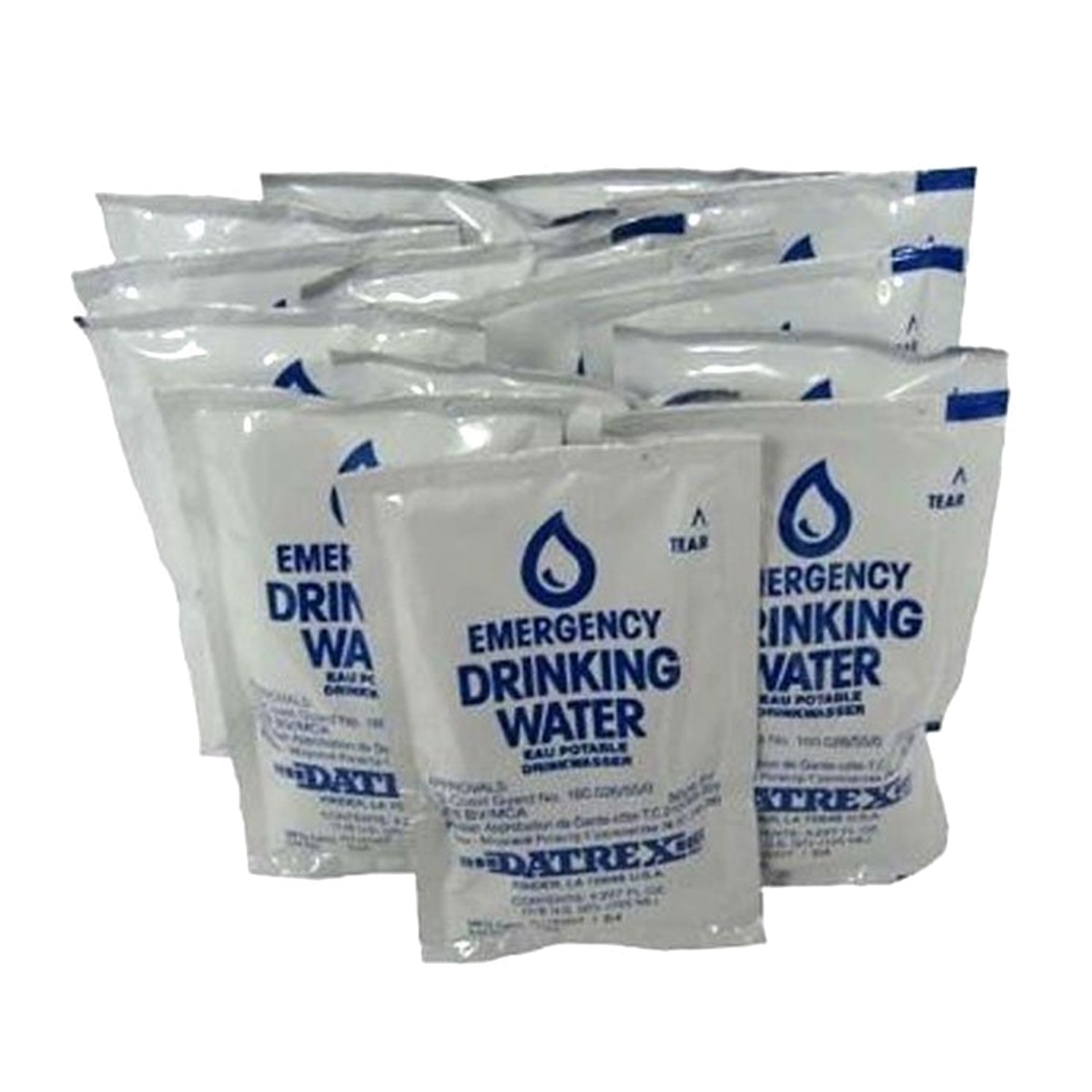
Datrex packets are sealed, U.S. Coast Guard–approved 4.227 fl oz pouches of treated, sterile water with a five-year shelf life. They require zero preparation — no boiling, no chemicals, no filtration. The value proposition is certainty: you know exactly what’s in the pouch and you know it’s safe. The limitation is quantity. A standard 64-pouch case delivers roughly 1.9 gallons total — enough for one adult for about two days at minimum intake, but not enough for cooking, hygiene, or a family. Datrex markets these as survival rations for boats and emergency kits, and that framing is accurate. What the marketing copy doesn’t emphasize — but experienced users do — is the dual-use case for wound irrigation. The pinprick-and-squeeze method (puncture a small hole, use the pouch as a controlled-flow irrigator) makes these packets genuinely useful in every first-aid kit in the house, not just your go-bag. One verified reviewer across multiple preparedness forums noted explicitly that they keep Datrex in each of their household first-aid kits for exactly this reason. Sterile water for wound cleaning is a real clinical need, and pre-packaged pouches solve it cleanly.
Potable Aqua iodine tablets treat raw water from any source — a stream, a bathtub filled before the storm hit, a rain barrel — and render it microbiologically safe to drink. The system works in two steps: an iodine tablet kills pathogens (30-minute contact time at room temperature), and a second PA Plus neutralizer tablet reduces the characteristic iodine aftertaste. One unusually thorough reviewer documented the full four-step process — sediment pre-filtering through a bandana, iodine tablet, wait, neutralizer tablet — with photographs, and described the resulting taste as “tolerable.” That’s an honest word. Not great, not undrinkable, but not something you’d choose if you had an alternative. Tablets are compact (50 tablets per bottle, treating up to 25 liters), lightweight, and inexpensive. They’re the right answer when your water source is available but contaminated, and when you need to treat volume rather than carry it.
Portable filters — specifically the LifeStraw Original and the Sawyer Mini — mechanically remove bacteria and protozoa by pushing water through a hollow-fiber membrane. No chemicals, no taste impact, no wait time. LifeStraw Original owners consistently emphasize the zero-setup, zero-pump, zero-chemical appeal: you put one end in the water and drink through the other end. It’s that simple, which is genuinely valuable in a high-stress situation. The constraint is that the original LifeStraw only filters water as you drink it — it doesn’t fill a container for other people or for cooking. The Sawyer Mini solves this. Owners who paired the Sawyer Mini with a CNOC Vecto collapsible bladder describe the combination as substantially more practical than using the included squeeze pouch alone — you can squeeze-filter water into a pot, a bottle, or a hydration reservoir, which means one person can filter for the whole group and you can cook with filtered water.
The 72-Hour Math: What You Actually Need
Here’s where the comparison gets concrete. Run the numbers for a two-adult household:
By the numbers — 72-hour water requirement (2 adults, minimum intake only):
- FEMA minimum: 1 gal/person/day → 6 gallons total
- Datrex 64-pack coverage: ~1.9 gallons (fills ~32% of need alone)
- Potable Aqua 50-tab bottle: treats up to ~6.6 gallons (fills 100%+ — if you have raw water to treat)
- Sawyer Mini rated capacity: 100,000 gallons lifetime (not the constraint for 72 hours)
The math reveals the real tradeoff: tablets and filters require a raw water source to work. Packets require nothing but storage space. In an urban apartment where the only water source is your building’s supply — which may be off entirely — Datrex packets or pre-stored gallon jugs are the only option that functions independently. In a suburban home with a bathtub, a rain barrel, or a nearby stream, tablets and a filter become viable and cover far more volume per dollar.
REI Co-op’s expert advice article on backcountry water treatment notes that chemical treatment (iodine or chlorine dioxide) is best viewed as a backup or complement to filtration, not a standalone primary system — a framing that maps well onto 72-hour urban preparedness. Per Ready.gov’s water preparedness guidance, FEMA recommends storing at least a three-day supply of water before relying on treatment methods, which validates the layered logic: store what you can, treat what you find.
Building the Layered Plan
A layered water plan stacks three capabilities: stored safe water (zero dependency), chemical treatment (high-volume backup, source-dependent), and mechanical filtration (highest capacity, taste-neutral, source-dependent).
Layer 1 — Stored water: Datrex packets for go-bags, vehicle kits, and every first-aid kit. They’re inert, shelf-stable for five years, and serve double duty for wound irrigation. For home storage, commercial gallon jugs or a WaterBOB bathtub bladder (which holds up to 100 gallons from your tub before the water goes off) supplement the packets significantly.
Layer 2 — Chemical treatment: Potable Aqua tablets as a backup for any available raw water source. Two bottles covers a household for well over a week if water is available but unsafe. The iodine system is not ideal for pregnant individuals or those with thyroid conditions — Potable Aqua’s own directions for use acknowledge this, and chlorine dioxide tablets (Aquatabs or MSR AquaTabs) are a clinically safer alternative in those cases, though they’re a separate product category.
Layer 3 — Mechanical filtration: A LifeStraw Original per person for individual drinking in a grab-and-go scenario, plus a Sawyer Mini with a CNOC Vecto bladder for group filtering and cooking water. The Sawyer Mini’s backflush syringe keeps the membrane clear, maintaining flow rate over multiple uses — a point Sawyer’s published specifications emphasize as the key maintenance requirement. Ignore the backflush and flow rate degrades significantly.
If X, then Y decision rule:
- If you’re in an apartment with no reliable backup water source: Weight Layer 1 heavily. Datrex packets plus pre-filled water containers are your primary system, not a supplement.
- If you’re in a suburban home near any natural water source: Layer 2 and 3 do more work. Invest in a Sawyer Mini + Vecto combo and two bottles of Potable Aqua; use Datrex only in first-aid kits and vehicle bags.
- If you’re an overlander or remote traveler: A Sawyer Mini or LifeStraw in the kit is table stakes. Add Potable Aqua as a backup for filter failure or freezing conditions. Skip Datrex as a primary solution — the volume-to-weight ratio doesn’t favor it for vehicle builds where you can carry a water container.
- If you have a family of four or more: No single-layer solution covers you. The math demands at least Layer 1 (stored) plus Layer 3 (filtration) to approach adequate volume.
Frequently Asked Questions
Can Datrex emergency water packets be used for wound irrigation and first aid, not just drinking?
Yes — and this is one of the most underappreciated uses in the product’s category. The packets are sealed and sterile, which makes them appropriate for wound irrigation using the pinprick-and-squeeze method: puncture a small hole with a safety pin or needle tip and use the packet as a directional squirt to flush debris from a wound. Multiple experienced preparedness reviewers explicitly store Datrex in their household first-aid kits for exactly this reason, not just in their emergency water supply. It’s a legitimate dual-use case the marketing doesn’t foreground but the user community has independently discovered.
How bad is the iodine taste from Potable Aqua tablets, and does the PA Plus neutralizer actually fix it?
The iodine aftertaste is real. One meticulous reviewer who documented the full four-step process described it as “tolerable” — which is about right. It’s medicinal and slightly chemical, noticeable but not gagging. The PA Plus neutralizer tablet (sodium thiosulfate) chemically reduces the iodine concentration after treatment is complete, which meaningfully reduces — not eliminates — the taste. Most users find the neutralized result acceptable for a 72-hour situation. Flavored drink mix packets (single-serve electrolyte powder, for instance) are a common workaround reviewers mention for making treated water more palatable.
Do Potable Aqua tablets work in very cold water, or does low temperature slow purification?
Temperature matters significantly. Potable Aqua’s directions for use specify a 30-minute contact time at room temperature. In cold water (below 40°F / 4°C), the same documentation recommends doubling the contact time to 60 minutes, and in very cold or turbid (cloudy, sediment-heavy) water, effectiveness is further reduced. This is a real limitation for winter emergency scenarios — if water is near freezing, you need to wait longer and consider pre-warming the water slightly if possible. Chlorine dioxide tablets (a separate product) have better cold-water performance specs, which is worth noting if your emergency scenarios include winter conditions.
Can a LifeStraw be used to filter water into a container for other people, or only for direct drinking?
The LifeStraw Original is a direct-drinking filter only — one end in the source, the other in your mouth. It does not gravity-filter into a container or allow you to fill a bottle for someone else. The LifeStraw Flex and LifeStraw Peak Series (separate products with adapters) add that capability, as does the Sawyer Mini, which is why the Sawyer Mini + collapsible bladder combination is generally the more versatile choice for family or group preparedness. If you need to cook with filtered water or filter for multiple people from a single device, the Sawyer Mini is the more practical pick.
How long do Potable Aqua iodine tablets remain effective after the bottle is opened?
Potable Aqua’s published guidance indicates the tablets should be used within one year of opening the bottle. The iodine oxidizes when exposed to air and light, degrading effectiveness over time. Tightly resealing the bottle immediately after removing tablets — and storing it in a cool, dark location — slows degradation. An unopened bottle carries a longer shelf life (typically four years from manufacture date). If your bottle has been open and rattling around a kit for two or three years, it’s worth replacing rather than trusting.
Is it worth storing all three water solutions, or is a good filter alone sufficient for 72-hour preparedness?
A filter alone is not sufficient unless you have a guaranteed access to raw water to filter. If your emergency involves a water main break, a contamination event affecting all local sources, or an evacuation with no known water source en route, a filter with nothing to filter is inert equipment. The layered approach exists precisely because no single solution covers all scenarios. Stored water (packets or gallon jugs) covers you when there’s nothing to treat or filter. Tablets cover high-volume treatment when you have raw water. Filtration covers taste-neutral, chemical-free treatment for ongoing use. The cost difference between having one solution and having all three is modest — a full Datrex case, two bottles of Potable Aqua, and a Sawyer Mini together represent a fraction of what most preparedness enthusiasts spend on food storage or power equipment — and the redundancy is disproportionately valuable in the first 72 hours, when uncertainty is highest and decisions matter most.