If a crisis cut off your tap water tomorrow — a burst main, a flood, a prolonged power outage — how confident are you that your household could drink safely for the next 72 hours? Water purification (the process of making raw or questionable water safe to drink) is one of the most practical gaps in most emergency kits, and it’s also one of the easiest to fill badly. People buy a single product, put it in a drawer, and assume the problem is solved. It usually isn’t. The real strategy is layering: pairing chemical treatments (like iodine or chlorine tablets), portable mechanical filters (small devices that physically strain out pathogens as water passes through), and gravity-fed systems (larger bags or tanks that purify water in bulk without pumping) so that each method covers the others’ weaknesses. This guide walks through each layer, names the tradeoffs explicitly, and ends with a decision framework you can apply to your specific situation — whether you’re stocking a go-bag, outfitting a suburban home, or prepping a vehicle for remote backcountry travel.
Layer One: Chemical Tablets — Your Chemical Fallback Layer
Chemical purification tablets are the simplest, lightest, and most packable option in the stack. Potable Aqua iodine-based tablets and chlorine dioxide alternatives are the two main types. They work by releasing a disinfectant into the water that kills bacteria, viruses, and most protozoa (tiny parasitic organisms like Giardia and Cryptosporidium, though chlorine dioxide handles the latter more reliably than iodine).
Reviewers who use Potable Aqua tablets consistently frame them as exactly what they are: a chemical fallback layer, not a first-choice daily driver. One recurring pattern in aggregated user reviews is a deliberate pre-filter step — running visibly cloudy water through a bandana or a portable filter before dropping in the tablet — because turbidity (cloudiness from sediment) dramatically reduces chemical efficacy. FEMA’s “Food and Water in an Emergency” guidance makes the same point directly: let sediment settle or strain water through a clean cloth before chemical treatment.
The tradeoff to name explicitly: iodine tablets leave a distinct flavor, the wait time is 30 minutes minimum (longer in cold water), and long-term iodine use carries health considerations for people with thyroid conditions. Chlorine dioxide tablets address the flavor issue somewhat and are broader-spectrum, but wait times extend to 4 hours for full Cryptosporidium kill — a real constraint in a fast-moving situation.
Where tablets win: weight and cost per unit, indefinite storage in sealed packaging, and dead-simple use when you have no other equipment. They belong in every go-bag and every vehicle emergency kit as the backstop.
Layer Two: Portable Filters — The Zero-Setup Workhorse
Portable mechanical filters physically remove pathogens by forcing water through a hollow fiber membrane (a bundle of microscopic tubes with pores small enough to trap bacteria and protozoa). They add no chemicals, change no taste, and in most conditions require no wait time.
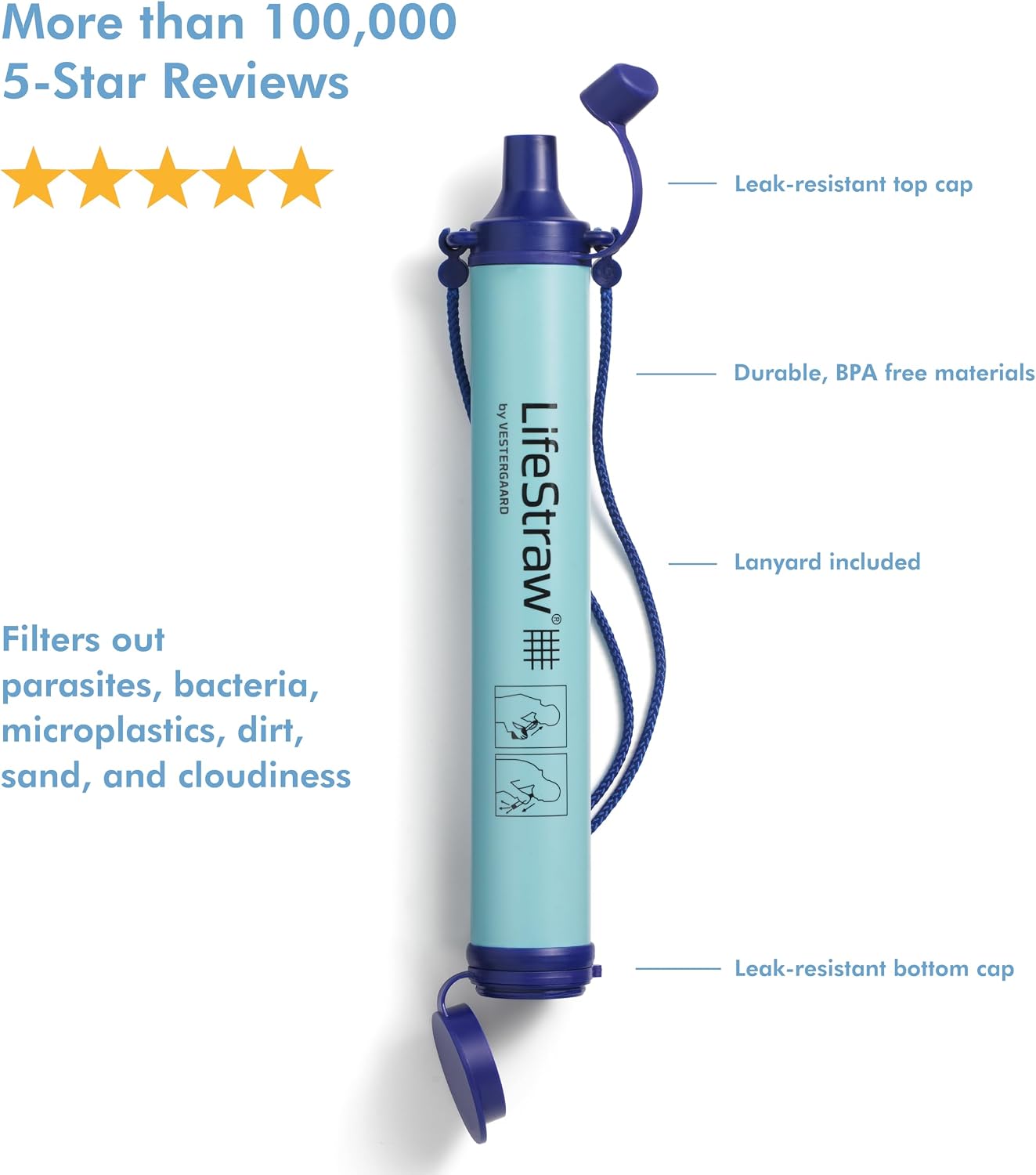
LifeStraw and Sawyer Mini are the two products that dominate this category, and owners’ experiences pull them apart in useful ways.
LifeStraw owners consistently highlight zero-setup simplicity — you stick one end in water and drink. That’s it. It’s the right tool for a single person who needs a personal filter that’s always clipped to a pack.
Sawyer Mini owners tell a more nuanced story. On its own, the Mini shares the same core simplicity. But reviewers who pair it with the CNOC Vecto collapsible water bladder describe what amounts to a different product entirely. The Vecto’s wide opening makes filling from shallow sources easy, and its flexible walls create gravity-feed pressure through the Sawyer Mini without pumping. That combination shifts the Mini from a “drink directly” straw-style filter into a gravity-drip system capable of filtering liters for a group — a meaningful volume upgrade that changes the product’s utility from personal to small-group coverage.
REI’s expert-advice resource on water treatment notes that hollow fiber filters like the Sawyer Mini are rated to filter up to 100,000 gallons with proper maintenance — a spec-sheet figure that reviewers generally validate in practice, with the consistent caveat that backflushing (forcing clean water backward through the filter to clear debris) is required to maintain flow rate.
The tradeoff: standard hollow fiber filters do not remove viruses (which are smaller than bacterial pores), heavy metals, or chemical contaminants. In a wilderness setting with clean source water, that’s rarely a concern. In an urban emergency with compromised infrastructure, it can be — which is where combining filters with tablets becomes the right call.
Layer Three: Gravity Systems — Whole-Household Volume
Gravity-fed purification systems are the layer that turns “survival water” into “normal household water.” You fill a reservoir at the top, water drips through a filter element, and clean water collects in a container below — no pumping, no electricity, no chemicals.
Big Berkey owners are notable for how they describe their unit: not as emergency gear, but as their daily primary water source. That framing matters. When a system is already integrated into daily life, it’s tested, maintained, and full — not sitting dry in a closet when you need it. Owners frequently note improved taste as the reason they switched to daily use, and several mention their dogs drinking from it as an informal quality endorsement.
The Big Berkey uses Black Berkey filter elements rated to remove bacteria, protozoa, viruses, chlorine, pharmaceuticals, heavy metals, and — with the optional PF-2 fluoride reduction elements added — fluoride and some microplastics. Published specs from New Millennium Concepts (Berkey’s manufacturer) rate the standard Black Berkey elements for these categories; independent lab testing referenced by consumer review outlets has generally confirmed performance on bacteria, protozoa, and chlorine reduction, with some nuance around microplastics depending on particle size.
Katadyn BeFree gravity bag users flag a completely different standout feature: speed. The BeFree 6L gravity system, per aggregated reviewer reports, can fill a Nalgene bottle (roughly 1 liter) in under 20 seconds — a differentiator that competing gravity bags simply don’t match at the same price point. For a system designed to move volume in the field, that throughput advantage is real.
By the Numbers
| System | Rated Throughput | Best Use Case | Virus Coverage |
|---|---|---|---|
| Potable Aqua (iodine) | Unlimited (consumable) | Backup / go-bag | Yes (most strains) |
| Sawyer Mini + Vecto | Up to 100,000 gal (lifetime) | Personal to small group | No |
| Katadyn BeFree 6L | ~2L/min peak flow | Field / vehicle | No |
| Big Berkey (2 elements) | ~3.5 gal/hr | Home base / daily use | Yes |
Building the Stack: If X, Then Y
The goal isn’t to pick one method. It’s to identify which combination fits your specific threat model, group size, and portability requirements. Here’s the decision framework:
If you’re stocking a 72-hour go-bag for one or two people: Sawyer Mini paired with a CNOC Vecto bladder handles your filter layer; add a sleeve of Potable Aqua tablets as the chemical backstop for urban water sources where viral contamination is possible. Total weight under 4 oz. This is the minimum viable stack.
If you’re building a whole-house emergency system for a family of four: A Big Berkey as the daily-use base covers volume, taste, and broad-spectrum filtration including viruses. Keep Sawyer Minis as portable backups in each family member’s bag. Potable Aqua stays in the kit for scenarios where the Berkey isn’t accessible. The Katadyn BeFree 6L is worth considering if your household also camps or overlanders — it bridges the gap between pack-portable and base-camp volume.
If you’re an overlander or remote traveler: The Katadyn BeFree 6L’s speed and packability make it the primary field filter. Pair it with Sawyer Mini backups and Potable Aqua tablets for viral coverage in international or high-risk water environments. Ready.gov’s water safety guidance specifically recommends combining filtration with chemical treatment when source water quality is unknown — a belt-and-suspenders approach that experienced field travelers consistently validate.
If you’re building toward a premium preparedness system: The layered stack looks like this: Big Berkey at home base, Katadyn BeFree or LifeStraw Mission in the vehicle or cache, Sawyer Mini in each go-bag, Potable Aqua in every first-aid kit. Each layer is independently operable. No single failure point takes down the whole system.
One underappreciated note on Datrex water packets: reviewers who keep them in first-aid kits report a consistent dual-use behavior — splitting packets between wound flushing (sterile water is useful for cleaning injuries when tap water isn’t available) and drinking supply. Datrex packets are U.S. Coast Guard-approved with a five-year shelf life per manufacturer labeling. They’re not a filtration system, but as a sealed, shelf-stable water reserve they slot cleanly into the overall stack — particularly for vehicle kits where liquid volume is manageable and a zero-setup water source has real value.
Frequently Asked Questions
Can Potable Aqua tablets be used after filtering through a LifeStraw or Sawyer for extra safety? Yes, and in high-risk water environments (urban infrastructure failure, international travel, flood water) this is the recommended approach. The CDC’s “Making Water Safe in an Emergency” guidance supports combining filtration and chemical treatment for added protection. Filter first to reduce turbidity, then add tablets — the order matters because sediment reduces chemical efficacy.
How long do Datrex packets really last, and can you use them for wound care? Manufacturer labeling specifies a five-year shelf life for Datrex emergency water packets, and the packets are U.S. Coast Guard-approved for that claim. On wound care: reviewers do report using them for wound flushing, and sterile sealed water is a reasonable field substitute for saline rinse when nothing else is available — but the packets aren’t labeled or marketed as medical-grade sterile saline. Use your judgment based on the injury severity and available alternatives.
Does the Big Berkey remove fluoride and microplastics, or just chlorine taste? The standard Black Berkey elements are rated by the manufacturer to remove chlorine, heavy metals, bacteria, protozoa, viruses, and a range of chemicals including pharmaceuticals. Fluoride reduction requires the optional PF-2 add-on elements. Microplastics removal depends on particle size — New Millennium Concepts’ published specs indicate removal of particles above a certain threshold, but this is an evolving area of testing across all filter types, and no gravity filter currently carries a blanket “removes all microplastics” claim with independent verification.
How many people can the Katadyn BeFree 6L gravity system realistically supply per day? FEMA’s emergency planning baseline is one gallon (roughly 3.8 liters) per person per day for drinking and sanitation. At the BeFree’s peak flow rate of approximately 2 liters per minute, the 6L bag can theoretically filter a day’s supply for one person in about 10–12 minutes of active flow time. In practice, reviewers note that flow rate slows as the filter loads — plan for two to four people as the realistic daily-supply range before the filter needs backflushing or the workflow becomes a part-time job.
Is the Sawyer Mini backflush mandatory after every use? Not after every use, but regularly. Sawyer’s published maintenance guidance recommends backflushing whenever flow rate slows noticeably, and after any use with particularly turbid water. Reviewers who skip backflushing for extended periods consistently report permanently reduced flow rates that can’t be fully restored. The Sawyer cleaning plunger is included in the kit — use it. Think of it as routine maintenance rather than an optional step.
Can you store a gravity filter like the Katadyn BeFree in a car without damaging it? The primary risk is freezing. Katadyn’s care instructions specify that the BeFree filter must not be allowed to freeze while wet — ice crystals can crack the hollow fiber membrane and destroy filtration effectiveness without any visible external damage. For vehicle storage in cold climates, either store the filter dry (blow it out thoroughly before storage) or keep it in a climate-controlled area of the vehicle. In warm climates, heat and UV exposure are less of a concern for the filter element itself, but verify the storage bag seals are intact and the filter is dry before long-term vehicle storage.