Expandable Power Stations for Whole-Home Backup: When One Battery Is Never Enough
A portable power station is essentially a giant rechargeable battery with standard household outlets built in — plug your appliances into it the way you would a wall outlet, and it runs them until the stored energy runs out. They’re the anchor of most modern home backup setups. The problem most buyers run into is a straightforward physics issue: a single unit, especially the popular 1,000-watt-hour (Wh) entry-level models, simply doesn’t hold enough energy to get a full household through more than a few hours of real use. The good news is that the three brands dominating this space — Anker, BLUETTI, and Jackery — have all built modular expansion systems that let you add capacity over time, rather than replacing your original unit. This guide breaks down exactly how those ecosystems work, what real owners report about runtime, and how to match your setup to your actual load.
If you already own one unit, tested it on a real outage, and came away thinking I need more — you’re in the right place. That experience is nearly universal, and these brands designed their expansion systems specifically around it.
Why One 1,000Wh Unit Is Almost Never Enough for Overnight Backup
The math here is unforgiving once you work through it, and the U.S. Department of Energy’s Appliance Energy Use Chart gives you the raw numbers to do it yourself. A standard Energy Star-rated full-size refrigerator draws roughly 100–200 watts while its compressor is running, but it cycles — typically running 8–12 hours per day total. Over a 24-hour period, that refrigerator will consume somewhere between 1.0 and 1.5 kWh (1,000–1,500Wh). A 1,000Wh power station, even at 90% efficiency, gives you approximately 900 usable watt-hours. That’s enough to run the refrigerator alone overnight — but barely, with no margin for compressor surge, lighting, phone charging, or a CPAP machine.
This is exactly what a buyer who purchased seven Anker SOLIX C1000 units (plus three BP1000 expansion batteries) documented in their long-form ownership review: a single C1000 cannot reliably run a standard Energy Star refrigerator through an overnight outage as a standalone unit once you account for real-world cycling and surge draws. Their solution — scaling to multiple linked units — reflects a pattern that shows up repeatedly across owner communities for all three major brands.
Consumer Reports’ 2025 portable power station overview flags the same issue: buyers consistently underestimate their actual load until they run a real test during an outage or planned drill, then scale up.
The “Start With Two, End Up With Seven” Pattern
The progression is almost predictable. You buy one unit for peace of mind. The first real outage teaches you your actual load. You buy a second unit or an expansion battery. That holds, until the next longer outage or until you add a chest freezer to the list of things you want to protect. The cycle repeats.
One SOLIX C1000 owner who ended up at the seven-unit configuration described the decision as purely pragmatic: they run a home office with a NAS (network-attached storage server), a refrigerator, a chest freezer, and medical equipment. Each priority had its own dedicated unit or linked pair. The redundancy also meant that if one unit had a fault, the others kept running.
A separate C1000 Gen 2 owner documented what’s possible at the upper end: running an air fryer (1,400–1,700W), microwave (1,000–1,200W), a 1,850W electric space heater, a full-size refrigerator, and a 5 cubic foot chest freezer simultaneously for 14 hours, with recharge completed in under an hour via both 120V AC wall input and a gas generator running in parallel. That’s a legitimate whole-kitchen backup scenario — but it required the expanded capacity of multiple linked units to sustain it.
Ecosystem Breakdown: BLUETTI, Anker, and Jackery Compared
The three brands have taken meaningfully different approaches to expansion, and they are not cross-compatible — expansion batteries are locked to their respective ecosystems by proprietary connectors and communication protocols.
BLUETTI: Deep Expansion Capacity, Proven Over Time
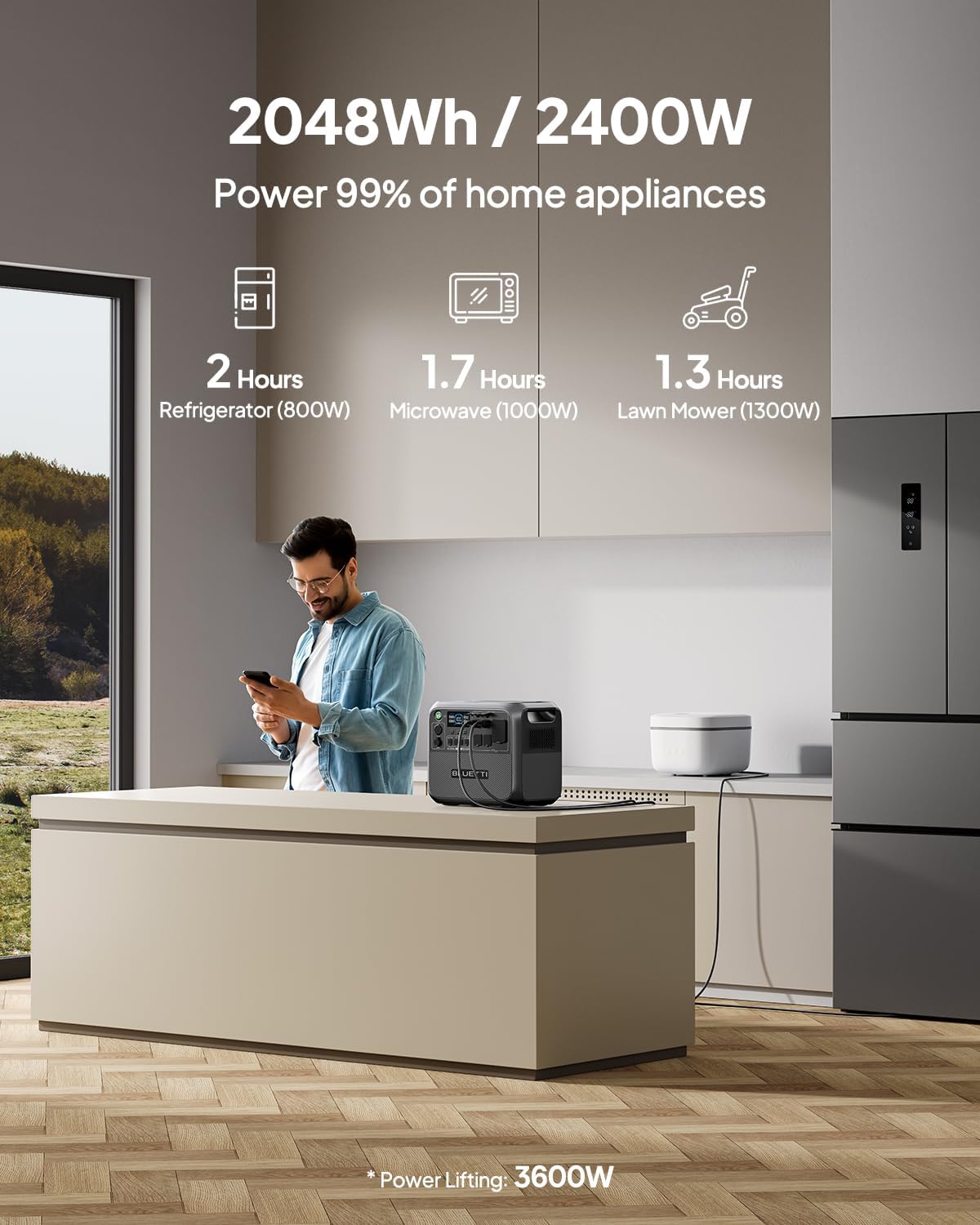
The BLUETTI AC200L is the anchor of their mid-tier expansion system. Its native capacity is 2,048Wh. Add two B300 batteries (each 3,072Wh) and you reach a documented 8,192Wh total — a figure one owner with two years of solar panel performance data has verified in real-world use across multiple seasons. BLUETTI’s published specs put the B300 at up to 3,500 charge cycles before hitting 80% capacity, which is one of the higher cycle ratings in this class.
BLUETTI’s ecosystem also supports solar input up to 1,200W on the AC200L, which matters for multi-day outage recharge planning (more on that below). Per Popular Mechanics’ 2025 power station roundup, BLUETTI’s MPPT (maximum power point tracking — the circuitry that optimizes how solar energy is harvested from panels) is rated as strong across their current lineup.
Anker SOLIX: Scalability and Recharge Speed as Core Features
The SOLIX C1000 and C1000 Gen 2 are built explicitly around the idea that you’ll add to them. The BP1000 expansion battery adds 1,056Wh per unit, and Anker’s published specs support linking multiple C1000 units together for home panel integration via their home battery system ecosystem. Owners in aggregated reviews consistently highlight the recharge speed: from both AC wall input and generator, the C1000 Gen 2 can go from low to full in roughly 60–70 minutes under ideal conditions — among the fastest in this category.
The tradeoff is that Anker’s BP1000 expansion batteries are relatively modest at ~1,000Wh per unit compared to BLUETTI’s B300 at 3,072Wh. If you’re stacking capacity, you’ll need more expansion units to reach the same total.
Jackery: The Highest Ceiling in This Tier
The Jackery HomePower 3600 Plus sits at 3,600Wh native capacity with the ability to expand to a documented 21,000Wh (21kWh) — the highest expansion ceiling of the three brands covered here. One owner group running the system during a real multi-day outage reported only 9% total draw across three hours of simultaneous multi-appliance use, which lines up with the math for a fully stacked system running moderate loads.
Jackery’s expansion batteries for this system are brand-specific and connect via their proprietary port, like the others. Their solar input compatibility is rated up to 3,000W on the HomePower 3600 Plus according to published specs, which is meaningfully higher than most competitors at this price point.
By the Numbers
| Unit | Base Capacity | Max Expanded Capacity | Max Solar Input | AC Recharge Speed |
|---|---|---|---|---|
| Anker SOLIX C1000 Gen 2 | 1,056Wh | Varies by unit count | 1,000W | ~60 min (wall/gen) |
| BLUETTI AC200L + 2× B300 | 2,048Wh | 8,192Wh | 1,200W | ~2–3 hrs (wall) |
| Jackery HomePower 3600 Plus | 3,600Wh | 21,000Wh | 3,000W | ~1.8 hrs (wall) |
Sources: published manufacturer specification sheets, 2024–2025. Real-world performance varies by load, temperature, and input source.
Recharging During a Multi-Day Outage: Solar vs. Generator
This is where the “will solar actually work?” question gets answered with real math rather than marketing copy.
A 200W solar panel in a real-world environment — accounting for panel angle, cloud cover, seasonal sun hours — produces roughly 600–900Wh per day in a mid-latitude U.S. location during summer, per the Department of Energy’s solar resource data. To recharge a fully depleted 8,192Wh BLUETTI stack from solar alone, at 800Wh/day average output, you’re looking at 10+ days of solar input. That’s not realistic for a single-panel setup during a multi-day outage if you’re also drawing power simultaneously.
The practical answer for most users is a hybrid approach: solar input keeps the system partially topped off during daylight hours, and a gas generator handles fast, deep recharges when needed. The C1000 Gen 2 owner who completed a full recharge in under an hour was using both 120V AC and generator input simultaneously — a feature Anker explicitly supports on that unit. BLUETTI’s AC200L also accepts simultaneous solar and AC input, called “MPPT + AC” charging mode.
If you’re relying on solar as a primary recharge source, the Jackery HomePower 3600 Plus’s 3,000W solar input ceiling means a bank of six 500W panels could theoretically recharge 15,000Wh+ per day under ideal conditions — a scenario that starts to make solar-primary recharging realistic.
Frequently Asked Questions
Can a single 1,000Wh power station actually run a full-size refrigerator through an overnight outage? Barely, and only the refrigerator — nothing else. A full-size Energy Star fridge consumes roughly 1.0–1.5kWh per 24 hours per the Department of Energy. A 1,000Wh unit gives you approximately 900 usable watt-hours after efficiency losses. That covers 12–18 hours of refrigerator-only runtime in favorable conditions, but there’s no headroom for surge, lighting, or medical devices. Most owners who tested this scenario report it works technically but that they immediately started planning for more capacity.
How many expansion batteries do I need to run both a refrigerator and a chest freezer for 24 hours? A full-size refrigerator and a 5 cubic foot chest freezer together consume roughly 2.0–2.5kWh per 24 hours (per DOE appliance data). You want at least 3,000Wh of usable capacity for that load with a reasonable buffer — meaning a BLUETTI AC200L with one B300 (combined ~4,600Wh usable) or two Anker C1000 units with one BP1000 each gets you there comfortably.
Is recharging a 2,000Wh power station from solar panels alone realistic during a multi-day outage? For a single 2,048Wh unit like the BLUETTI AC200L, yes — two 400W panels producing roughly 1,500–2,000Wh on a clear day can keep pace with moderate household loads. For expanded systems above 4,000Wh total, you’ll need a multi-panel array or generator supplement to recharge meaningfully between draws.
Can these units recharge from a gas generator input, and how fast? All three brands accept generator input via their standard AC charging port. The Anker SOLIX C1000 Gen 2 is documented by owners as completing full recharges in under an hour using simultaneous generator + AC input. BLUETTI and Jackery’s larger units typically run 2–4 hours from generator input alone at rated charging wattage.
Does running a power station in quiet or eco mode significantly reduce what appliances it can power? Yes — and this catches a lot of buyers off guard. Eco mode and quiet mode typically cap the inverter’s output wattage (the inverter converts stored DC power to the AC current your appliances use). An appliance that requires a 1,500W surge to start a compressor motor may simply not start if the unit is capped at 600W in eco mode. For refrigerators, freezers, and any motor-driven appliance, disable eco mode and verify the unit’s continuous and surge output ratings against your appliance’s startup draw.
How do BLUETTI, Anker, and Jackery differ on their expansion battery ecosystems — are batteries cross-compatible? They are not cross-compatible. Each brand uses proprietary connectors and battery management communication protocols. A BLUETTI B300 will not connect to an Anker SOLIX unit, and vice versa. This is the single most important reason to decide on your ecosystem before your first expansion purchase, not after. The practical implication: if you start with a BLUETTI anchor unit and later want to add Jackery’s higher expansion ceiling, you’re starting over.
The Decision Rule
If your household load is a refrigerator, basic lighting, and phone charging — and outages in your area rarely exceed 24 hours — a single 2,000Wh unit like the BLUETTI AC200L covers you with room to spare.
If you’re protecting a refrigerator, a chest freezer, and a home office for 48+ hours, you need at least 6,000–8,000Wh of total capacity. The BLUETTI AC200L with two B300 batteries or the Jackery HomePower 3600 Plus at base configuration both hit that range.
If you’re thinking about whole-home backup for extended grid events — HVAC, full kitchen, medical equipment — you’re in the 15,000–21,000Wh range, and the Jackery HomePower 3600 Plus’s 21kWh expansion ceiling is the only consumer-tier unit in this review that gets you there without running seven separate units.
The pattern that shows up in long-run owner reviews, documented by Consumer Reports and Popular Mechanics both, is consistent: buy for where your load will be in 12 months, not where it is today. The buyers who report the highest satisfaction are the ones who sized up one tier on their first purchase and never had to emergency-buy a second unit mid-outage.