Walk into any outdoor or preparedness retailer and you’ll see #10 cans — those large, roughly quart-sized metal containers — stacked floor to ceiling with labels promising food that stays safe and edible for 25 or even 30 years. Freeze-drying is a preservation process that removes nearly all moisture from food by freezing it and then pulling the ice out as vapor under low pressure, leaving behind a lightweight product that rehydrates quickly with water. It’s genuinely impressive technology, and the long shelf-life claims are not outright fiction. But “up to 30 years” is doing a lot of work in those three words. The conditions required to hit that ceiling are specific, and most real-world storage environments fall short of them. If you’re deciding right now whether to spend $300 on a starter case or $1,200 on a full-year supply, understanding exactly what that number means — and what quietly erodes it — is the most valuable thing you can know before you buy.
Where the 30-Year Number Actually Comes From
The figure originates from accelerated shelf-life testing, a method described by the Institute of Food Technologists in their scientific review titled “Freeze-Drying: Principles and Practice.” Researchers store samples at elevated temperatures for a compressed time period, then use established chemical models — the Arrhenius equation in most cases — to project how long the food would remain acceptable at a cooler baseline, typically 70°F (21°C). Manufacturers like Mountain House, Augason Farms, and Thrive Life each conduct or commission this testing and publish the results as their stated “shelf life” figure.
The critical word in every manufacturer’s fine print is quality, not safety. The 30-year claim means the food is projected to remain palatable and retain at least a threshold level of nutritional value under defined ideal conditions. The USDA Agricultural Research Service, in its technical bulletin “Water Activity and Food Safety,” makes a useful distinction: microbial spoilage — the kind that makes food dangerous — is suppressed at the very low water activity levels freeze-drying achieves, typically 0.1 to 0.2 on a 0-to-1 scale. Rancidity, color loss, texture degradation, and vitamin depletion are separate mechanisms that operate on their own slower timelines, and those are what the shelf-life models are actually measuring.
What this means practically: A 20-year-old can of freeze-dried chicken from a reputable brand, stored properly, is almost certainly safe to eat. Whether it tastes good and delivers full nutritional value is the real question.
The Four Variables That Actually Determine Shelf Life
The Brigham Young University Food Storage Lab study — titled “Shelf Life of Commercially Freeze-Dried and Dehydrated Foods” and one of the most-cited independent assessments of commercial freeze-dried products — identified storage temperature as the dominant variable, more impactful than container type, oxygen barrier quality, or even the food category itself. Here’s how the four main factors stack up:
1. Temperature The published 25-to-30-year figures assume continuous storage at or below 70°F. The BYU Food Storage Lab study found that storage at 80°F roughly halved projected shelf life for several product categories. At 90°F — the summer temperature inside a garage, attic, or closet in much of the southern United States — shelf life can drop to a fraction of the rated figure. Research published in the Journal of Food Science (Vol. 88, 2023) under the title “Lipid Oxidation in Freeze-Dried Meal Components at Elevated Storage Temperatures” confirmed accelerated degradation in any product containing oils, nuts, or meat at storage temperatures above 75°F.
2. Oxygen exposure Quality manufacturers use nitrogen flushing or oxygen absorbers to bring oxygen levels inside the can below 2%. This matters enormously for fat-containing foods, where oxygen triggers rancidity. Once a can is opened and repeatedly resealed, oxygen enters with every use. At that point the clock restarts — most brands recommend consuming an opened #10 can within one year.
3. Light Ultraviolet and visible light degrade vitamins — especially vitamin C and the B-complex — and can accelerate oxidation of fats through photooxidation. Opaque cans handle this automatically; Mylar pouches do as well, but clear or translucent packaging accelerates degradation significantly.
4. Humidity Freeze-dried food is extremely hygroscopic — it will absorb moisture from the air rapidly. The USDA Agricultural Research Service’s bulletin on water activity notes that even modest ambient humidity, if it infiltrates packaging through a failed seal or damaged liner, can raise water activity enough to enable mold growth within weeks. Can integrity matters.
Storage Temperature vs. Projected Shelf Life
| Storage Temperature | Projected Shelf Life (vs. 70°F baseline) |
|---|---|
| 60°F (cool basement) | Up to 30+ years (some categories) |
| 70°F (rated baseline) | 25–30 years (manufacturer claim) |
| 80°F (warm room, mild climate) | ~12–15 years (BYU Food Storage Lab estimate) |
| 90°F (garage, attic, southern US) | ~5–8 years (conservative estimate) |
These are approximations; actual degradation rates vary by food type, fat content, and specific brand formulation. But the pattern is consistent across independent research.
Brand-by-Brand: How the Main Options Compare
Most mainstream preparedness brands cluster around the same 25-to-30-year claim, which can make comparison shopping feel circular. The real differentiation is in what’s included, the caloric density per dollar, and how transparent each brand is about conditions and exclusions. The three H3 sections below evaluate the market across budget, mid-tier, and premium positions.
Augason Farms — Value-Tier Staples
Peak
$14.95
In stock on Amazon
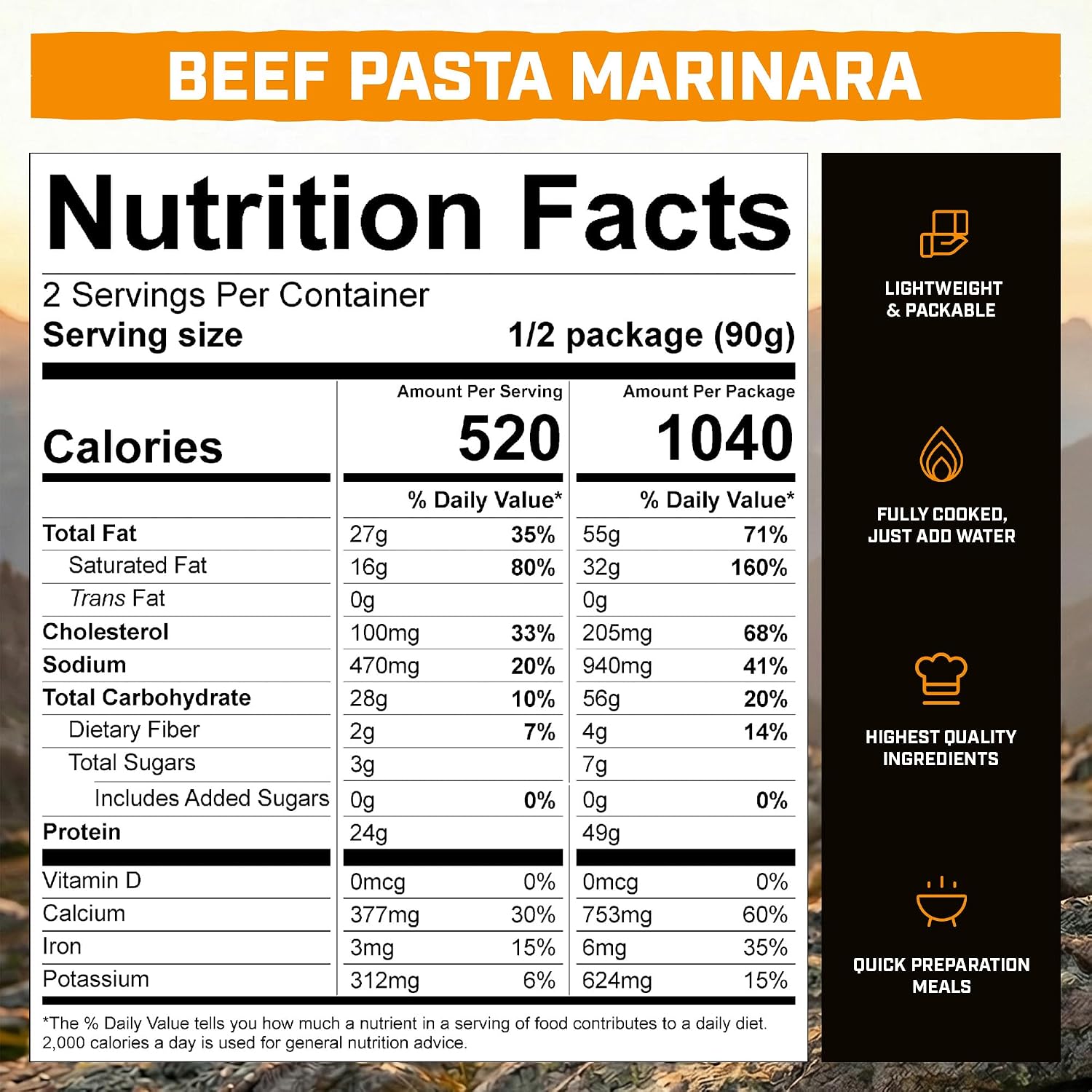
Check price on AmazonAugason Farms positions as the value tier, with shelf-life claims comparable to premium brands but a per-calorie cost often 30–40% lower on staples like rice, beans, and potato products. For buyers whose primary goal is caloric volume on a limited budget, Augason is the most common entry point.
The tradeoffs are real, however. As noted in buyer analyses published through thepreparednessreview.com, Augason’s product mix leans heavily on carbohydrate staples; complete protein options are fewer, and some products — including flavored drink mixes — carry shorter stated shelf lives than their grain-based counterparts. Augason is best treated as a caloric foundation, not a complete nutritional solution on its own.
Best for: Buyers building a bulk caloric base on a tight budget who plan to supplement with separate protein sources.
Peak
$14.95
In stock on Amazon
Check price on AmazonMountain House — Mid-Tier Benchmark
Augason
$28.60
In stock on Amazon
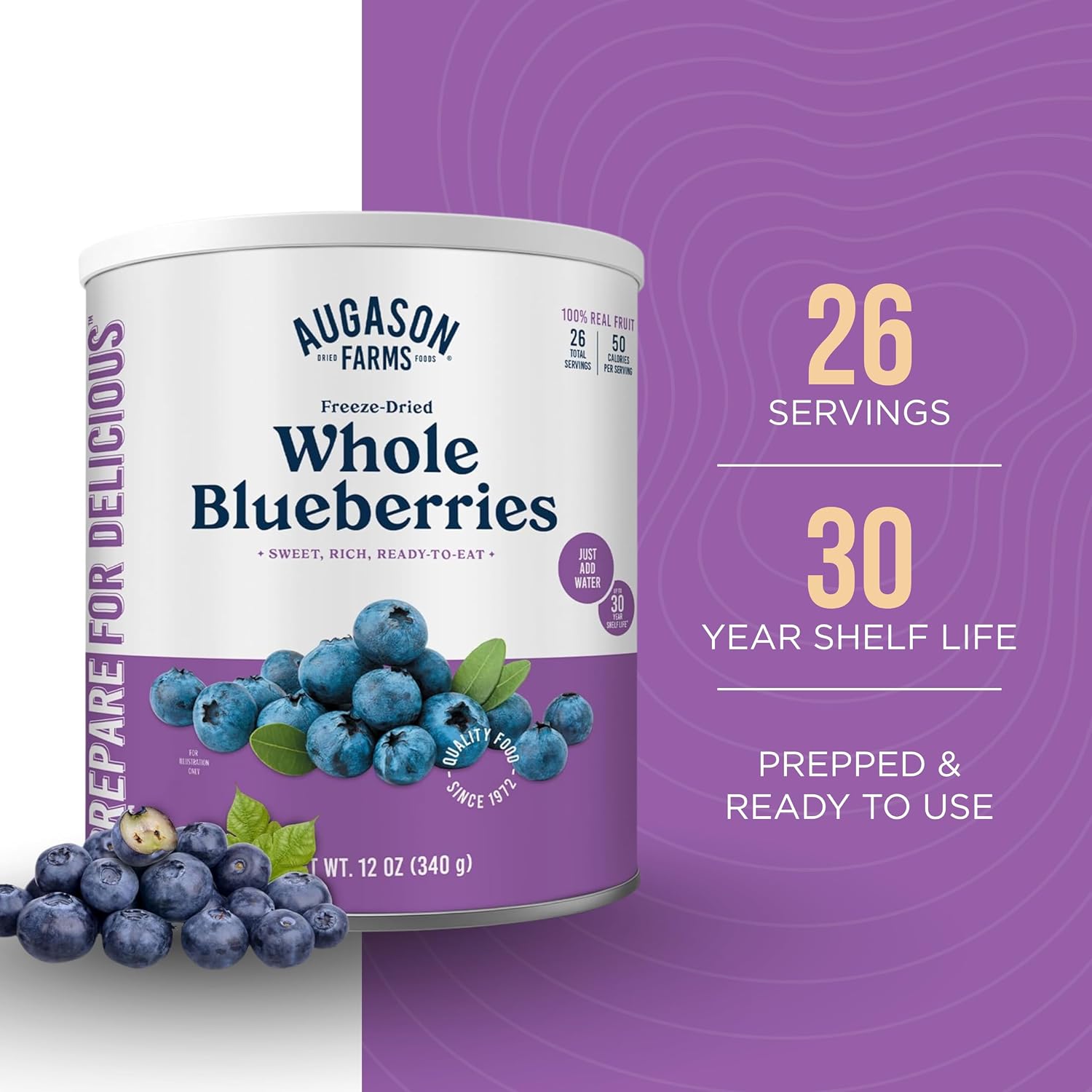
Check price on AmazonMountain House is the most cited brand in independent long-duration storage evaluations. The company has published results from actual 30-year-old sealed pouches they opened and assessed — a form of real-world validation most competitors have not offered publicly. Their entrees average roughly 250–400 calories per serving, and owner experience documented across preparedness publications consistently highlights strong taste retention even in products approaching decade-plus age.
The tradeoff is price. Mountain House typically runs $10–$14 per serving in #10 can format, putting a 30-day supply well above $600. For buyers prioritizing proven long-term quality and palatable entrees, that premium is defensible. For buyers primarily stocking carbohydrate staples, the premium is harder to justify relative to value-tier alternatives.
Best for: Buyers who want proven, independently validated shelf life and are willing to pay for entree-quality protein-forward meals.
Augason
$28.60
In stock on Amazon
Check price on AmazonThrive Life — Premium Catalog and Produce Depth
Mountain
$94.99
In stock on Amazon
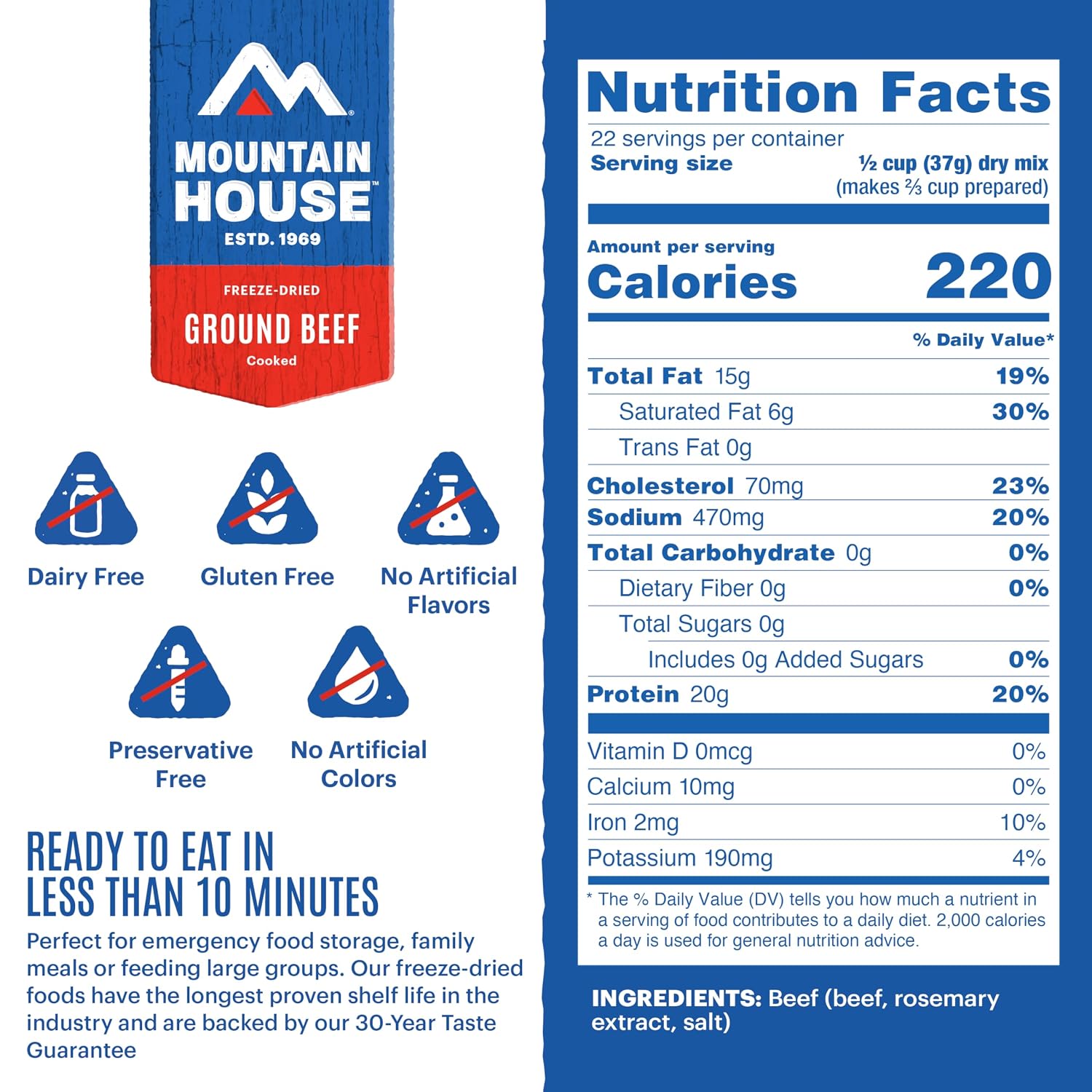
Check price on AmazonThrive Life (which absorbed the Emergency Essentials brand) occupies the premium segment with a direct-sales model and a broader catalog of freeze-dried produce and proteins than most competitors offer. Their published shelf-life documentation is detailed, and their produce selection — freeze-dried corn, peppers, tomatoes, and similar items — is genuinely broader than Mountain House’s entree-focused lineup.
The pricing reflects this premium. Cost per calorie is comparable to or above Mountain House, and the direct-sales distribution model means pricing is less transparent than retail-channel brands. Category-by-category comparison is necessary before committing, because the value proposition varies significantly between Thrive Life’s produce items (where selection justifies the price) and their basic staples (where Augason competes effectively at lower cost).
A separate caution on store-brand buckets: Wise Company and similar retail-channel bucket products have faced pointed criticism from independent preparedness researchers. An analysis published through thepreparednessreview.com found that several bucket products delivered significantly fewer calories per day than “1-month supply” labeling implied when meals were portioned at the stated serving size. If you’re evaluating any product on the basis of its packaged day-count claim, verify total calorie content directly — a genuine 2,000-calorie day requires more volume than the marketing often suggests.
Best for: Buyers who want produce diversity and protein variety beyond what entree-focused brands offer, and whose budget accommodates premium pricing.
Mountain
$94.99
In stock on Amazon
Check price on AmazonThe Nutritional Decay Problem Nobody Talks About Enough
Shelf life for “quality” typically means the food remains palatable and free from spoilage. It does not mean full nutritional retention across the entire rated duration. Vitamin C and the B-vitamins are particularly vulnerable to degradation over time, even in properly sealed containers. The Institute of Food Technologists’ scientific review of freeze-drying principles notes that vitamin C losses in freeze-dried products stored at 70°F for five years are measurable, and that losses accelerate significantly at higher temperatures.
For short-duration emergency use — a 72-hour kit or a two-week supply — this is a non-issue. For genuinely long-term caloric independence, it matters. If your emergency food plan is a decade-old case of entrees, you’re likely getting adequate macronutrients (calories, protein, carbohydrates) but potentially degraded micronutrient levels. FEMA’s preparedness guidance, published at ready.gov under “Food and Water in an Emergency,” recommends supplementing any long-term stored food plan with multivitamins, specifically because that guidance accounts for nutritional degradation over time.
Practical implication: rotate your supply. A 6-to-12-month rotation cycle eliminates the degradation question entirely and ensures you’re always consuming product at peak quality.
What to Actually Look for When Buying
If you have a purchase decision pending right now, here’s the evaluation framework that cuts through the marketing:
Check the temperature assumption in the fine print. If a brand lists “up to 30 years” without specifying a storage temperature, look for supplemental documentation. Reputable brands will publish the assumption. If it’s absent, default to the 70°F degradation curve — and assess honestly whether your storage location holds that temperature year-round.
Calculate actual calories, not servings. Divide total can calories by 2,000 (a reasonable active-adult daily baseline) to get true person-days of supply. A 30-serving can at 100 calories per serving is 1.5 person-days, not 30.
Prioritize protein and fat diversity. Pure carbohydrate storage (rice, pasta, oats) is cheaper but nutritionally incomplete. Freeze-dried meats and legumes are more expensive but necessary for anything beyond a week of genuine dependence on stored food.
Buy one case before you buy a pallet. Taste matters for long-term compliance. Owners consistently report significant variance in palatability across brands, even on comparable products like “beef stew” or “scrambled eggs.” A sampler case ($60–$120 across most brands) is worth the investment before committing to a full-year system.
The Decision Rule
If you’re storing in a temperature-controlled interior space that stays below 70°F year-round — a climate-controlled basement, an interior closet in a temperate climate — then the 25-to-30-year claims are plausible for quality brands, and the cost-per-calorie math justifies building a larger supply. Use Mountain House or Thrive Life for protein-forward entrees, and supplement with Augason Farms staples for caloric volume.
If your storage environment regularly hits 80°F or above — a garage, shed, attic, or home without central air in the storage area — then cut the advertised shelf life roughly in half for planning purposes. In that environment, a 1-to-3-year rotation model with annual replenishment is more realistic than stacking 30-year product and trusting the label. The food is still worth buying; just plan to use and replace it rather than storing it indefinitely.
The 30-year claim is not a lie. It’s a ceiling with conditions attached. Know the conditions, audit your storage environment honestly, and buy accordingly.