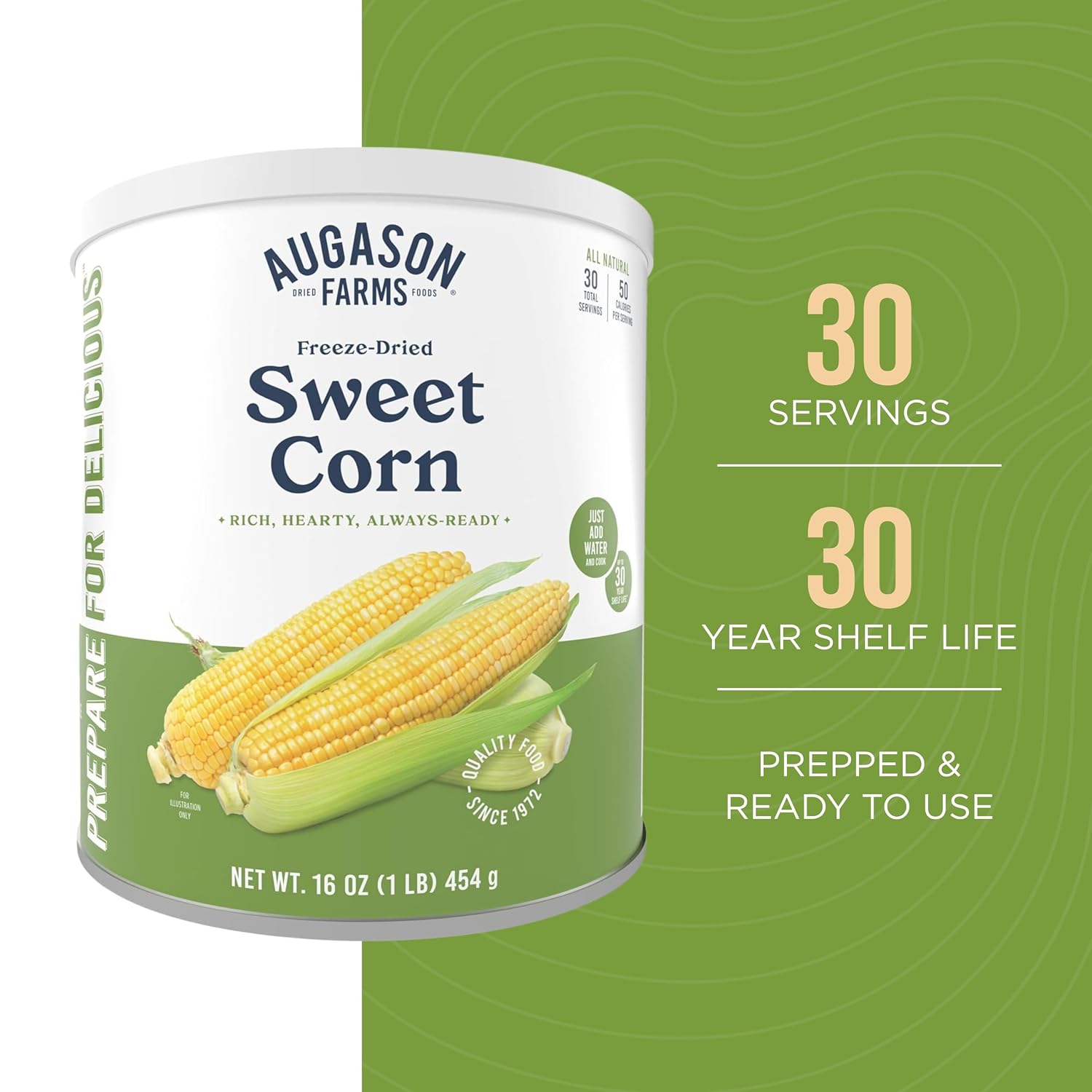
Freeze-drying is a preservation process where food is frozen solid and then placed in a vacuum chamber that pulls out nearly all the moisture — leaving the food’s structure, color, and flavor largely intact while extending shelf life to 25 years or more in a sealed can. What most people don’t realize until they actually crack open a #10 can (that’s the large restaurant-supply-size tin most survival food brands use, holding roughly 6 cups of dry product) is that freeze-dried ingredients work remarkably well as everyday pantry staples — not just as emergency insurance. This guide focuses on what experienced users are actually doing with Augason Farms corn, blueberries, and other freeze-dried ingredients in real kitchens, how to think about rotation and shelf life after opening, and where the cost math tips in your favor versus buying fresh or from competing brands.
If you’ve already got a few #10 cans on the shelf and you’re still treating them as sacred emergency objects, this article is specifically for you. Using them regularly is actually the right move — both for taste and for practical rotation discipline.
| EDITOR'S PICKMountain House Ground Beef #10… | Mid-tierAugason Farms Freeze-Dried Whol… | Budget pickAugason Farms Freeze-Dried Swee… | |
|---|---|---|---|
| Servings | 22 | 26 | 30 |
| Shelf life | — | 30 years | 30 years |
| Container | #10 can | — | — |
| Gluten-free | ✓ | — | — |
| Food type | Ground beef | Blueberries | Sweet corn |
| Brand | Mountain House | Augason Farms | Augason Farms |
| Price | $94.99 | $28.60 | $21.99 |
| See on Amazon → | See on Amazon → | See on Amazon → |
What Regular Users Are Actually Doing With These Cans
The most interesting pattern in long-form reviews of Augason Farms corn and blueberry products is how thoroughly everyday the use cases are. These aren’t people building elaborate survival scenarios — they’re making muffins on a Tuesday.
Freeze-dried corn: sweeter than you expect, snackable straight from the can. Owners consistently report that the corn has a concentrated, almost candy-like sweetness when eaten dry — which makes sense, since freeze-drying removes water without destroying the natural sugars. Multiple reviewers describe eating it straight as trail mix or a snack, noting it has a satisfying crunch. The more surprising use case: baking it into cookies. The sweetness contribution is apparently meaningful enough that some bakers reduce other sweeteners slightly when using freeze-dried corn in baked goods. This isn’t a gimmick — the Institute of Food Technologists’ technical review on freeze-drying notes that sugar concentration increases as a direct function of moisture removal, which explains the intensified flavor profile owners describe.
Freeze-dried blueberries: baking without rehydrating is the default move. Owners universally report that freeze-dried blueberries go directly into muffin batter, pancake mix, and oatmeal without rehydrating — and hold their shape better than fresh berries during baking because they don’t release as much juice. One family of reviewers describes their kids eating blueberries straight from the can as a snack and a spouse using the same can for baking. That dual use pattern — snack and baking ingredient from one container — is exactly the kind of rotation-friendly behavior that keeps your supply cycling instead of aging on a shelf.
Mountain House ground beef: recognizable texture for real dishes. Where Mountain House’s ground beef products stand out in aggregated reviews is rehydration quality for composite dishes. Owners report using it as the base for stroganoff, chili, and pasta sauces with results they describe as “recognizable” — meaning the texture, while not identical to fresh-cooked beef, holds up well enough in a sauce or gravy context that the dish reads as the intended meal. That’s a meaningful distinction from other brands where reviewers describe a mushy or grainy texture post-rehydration.
Chicken dices and the powder residue trick. This is the most actionable technique you’ll find buried in owner reviews, and it’s worth highlighting explicitly: the fine powder that accumulates at the bottom of Augason Farms chicken dice cans is fully food-safe and highly flavorful. Owners describe whisking it into warm water or broth to create an instant sauce thickener or flavor base — effectively a chicken bouillon concentrate that costs you nothing because you’d otherwise ignore it. Per USDA Food Safety and Inspection Service guidance on shelf-stable foods, residue from commercially sealed freeze-dried products carries no additional food safety concern beyond the product itself; it’s simply fine particulate of the same ingredient.
The Shelf-Life-After-Opening Reality Check
This is where the gap between manufacturer claims and real-world experience is most actionable for rotation planning.
Manufacturers typically recommend consuming opened #10 cans within 6–12 months when stored with the plastic lid in a cool, dry location. That’s the standard guidance across Augason Farms’ product specification sheets. But one particularly rigorous blueberry reviewer documented a 3.5-month shelf-life experiment after opening, checking quality at intervals — and the findings matter: meaningful quality decline was apparent by month three, not month six. The berries became noticeably less crisp, lost some color vibrancy, and developed what the reviewer described as a slightly stale background note.
The practical implication: For delicate freeze-dried fruits, plan your rotation around a 90-day consumption window after opening, not the 12-month maximum on the label. This is especially true in humid climates or kitchen environments where the plastic resealable lid gets opened frequently. Ready.gov’s emergency food guidance recommends dating opened containers and cycling oldest-open first — the same discipline applies here.
By the Numbers: Opening a #10 Can
| Product | Approximate servings per #10 can | Target rotation window (opened) |
|---|---|---|
| Augason Farms Freeze-Dried Blueberries | ~43 servings | 60–90 days |
| Augason Farms Freeze-Dried Sweet Corn | ~39 servings | 90–120 days |
| Augason Farms Chicken Dices | ~24 servings | 90 days |
At 43 blueberry servings, hitting a 90-day window means roughly one serving every two days — very achievable if the can sits on the counter instead of in a closet.
Cost-Per-Ounce Math: Augason Farms vs. Mountain House vs. Fresh
Reviewers are notably price-conscious when comparing freeze-dried ingredient cans, and the math is worth laying out explicitly because it changes the “is this worth it” calculation considerably.
Augason Farms typically positions as the value tier in the #10 can freeze-dried market. Across aggregated review discussions, the price-per-ounce comparison against Mountain House ingredient cans consistently favors Augason by a meaningful margin — reviewers frequently cite Augason running 20–40% cheaper per ounce depending on the product and purchase channel. Mountain House’s premium is partly brand recognition and partly a longer documented track record in the taste-quality category, particularly for protein items like ground beef.
For fruit and vegetable ingredients specifically — corn, blueberries, peas, bell peppers — the quality gap between brands narrows considerably, and Augason Farms’ cost advantage becomes the dominant factor for most buyers. This is why cost-sensitive reviewers default to Augason for produce items and sometimes pay up for Mountain House on protein items where texture-after-rehydration matters more.
Against fresh produce, the comparison depends heavily on seasonality and geography. Fresh blueberries in peak season in the Pacific Northwest are priced very differently than fresh blueberries in February in the Midwest. Freeze-dried blueberries purchased by the #10 can often beat out-of-season fresh prices on a per-serving basis, and they eliminate spoilage loss entirely — a factor several reviewers cite explicitly. The Institute of Food Technologists notes that freeze-dried produce retains a higher percentage of its original nutrient profile than many preservation methods, which adds a non-cost reason to consider them beyond pure price comparison.
Practical Rehydration Guide for Protein Items
For vegetable and fruit items eaten dry or baked into goods, rehydration is optional. For protein items — chicken dices, Mountain House ground beef — getting the water ratio right is the difference between a usable texture and a wet sponge.
Chicken dices: Owners report the best results using a 1:1 ratio by volume of freeze-dried chicken to warm water, letting it sit covered for 10–15 minutes before draining excess liquid. The texture at this ratio holds up well in stir-fries and casseroles — it won’t replicate a freshly grilled breast, but it reads as chicken in context. Using boiling water speeds the process to 5–7 minutes.
Mountain House ground beef: Published product guidance from Mountain House recommends roughly ½ cup of boiling water per ¼ cup of freeze-dried beef. Owners in longer reviews note that slight under-hydration — pulling it a minute early while it still looks slightly dry — results in better texture for applications like stroganoff where the meat sits in a sauce and continues absorbing liquid during cooking. Over-hydrating produces the mushy result reviewers complain about most.
The powder residue: As noted above, don’t discard the powder from protein cans. A tablespoon whisked into a cup of warm water makes a light chicken broth substitute; two tablespoons in a reduced butter-and-flour base makes a credible pan sauce. This is a technique that experienced camp cooks have used for years, and it’s well-documented in overlander cooking discussions.
Frequently Asked Questions
How long does a #10 can of freeze-dried ingredients stay good after opening? Manufacturer guidance on Augason Farms packaging states up to 12 months in a cool, dry location with the resealable plastic lid in place. Real-world owner experience, including one documented 3.5-month experiment with blueberries, suggests meaningful quality decline begins around month three for delicate fruits. A practical target is 90 days for fruits, 90–120 days for vegetables and protein items.
Can I eat freeze-dried corn or blueberries straight from the can without rehydrating? Yes — and this is actually one of the most common uses reviewers report. Both have a satisfying crunch when dry. Freeze-dried corn develops a sweet, concentrated flavor that makes it genuinely snackable. Blueberries eaten dry have a crisp texture and intensified tartness. Neither requires any preparation.
How much water do I need to rehydrate a serving of freeze-dried chicken or beef to a usable texture? For Augason Farms chicken dices, a 1:1 volume ratio of chicken to warm water, resting 10–15 minutes covered, is the owner-reported standard. For Mountain House ground beef, published specs recommend approximately ½ cup boiling water per ¼ cup product, with owners noting that slightly under-hydrating produces better texture when the meat will sit in a sauce.
Is the powder residue at the bottom of the chicken can safe to eat or use in cooking? Yes. Per USDA Food Safety and Inspection Service guidance on shelf-stable foods, the fine powder in sealed freeze-dried protein cans is the same product in particulate form and carries no additional food safety concern. Experienced users whisk it into warm water or broth as a flavor base and sauce thickener.
How do Augason Farms ingredient cans compare in cost to buying the same items freeze-dried from Mountain House? Across aggregated buyer reviews and price comparisons, Augason Farms typically runs 20–40% cheaper per ounce on comparable freeze-dried produce items. Mountain House commands a premium that is more defensible on protein products where texture-after-rehydration is consistently rated higher. For fruits and vegetables, most cost-sensitive buyers choose Augason; for protein-forward meals, many buyers consider Mountain House worth the premium.
Can I use freeze-dried blueberries in baking without rehydrating first? Yes — this is the dominant baking use case described by owners. Freeze-dried blueberries added directly to muffin or pancake batter hold their structure better than fresh berries during baking because they don’t release moisture prematurely. They rehydrate from the batter itself during baking. Reviewers describe the results as superior to fresh in terms of even distribution and appearance.
The Decision Framework: If X, Then Y
If your goal is everyday snacking and zero-prep convenience, Augason Farms corn and blueberries are strong picks — eaten dry, no preparation, cost-competitive at the #10 can level.
If your goal is baking integration, freeze-dried blueberries go in dry and outperform fresh for structure — buy by the #10 can if you bake weekly, by the smaller pouch if you’re testing the format first.
If your goal is protein-forward emergency meals where taste and texture matter, Mountain House ground beef earns its price premium over Augason for recognizable dishes like stroganoff — budget for the extra cost-per-ounce on protein specifically.
If you’re managing rotation on opened cans, treat 90 days as your working window for fruits regardless of what the label says, and keep opened cans in the kitchen, not the storage closet — visibility drives consumption.
If you’re buying for cost efficiency across a full pantry system, use Augason for produce and consider Mountain House for proteins where the texture premium justifies the spend. That hybrid approach is exactly what experienced multi-can buyers describe in aggregated reviews.