Picture this: it’s day two of a winter storm outage. Your kids are restless, your partner is quietly anxious, and you’ve just opened your emergency food supply for the first time under real pressure. What you pull out of that bin — whether it smells like actual biscuits and gravy, tastes like a cardboard nutrition fact, or lands somewhere in between — is going to matter more than you expect. Emergency food isn’t just about calories; it’s about keeping morale from cratering when everything else already has. This article compares three main categories of emergency food: freeze-dried meals (pouches of real ingredients that rehydrate with hot or warm water into something resembling a normal dinner), MREs (Meals Ready-to-Eat — self-contained military-style rations with built-in heating pouches), and calorie bars (dense, compressed blocks of shortbread-style food engineered to deliver a day’s worth of calories in a pocket-sized package). By the end, you’ll have a clear decision framework for your household — not a generic “store all three” hedge.
What Each Format Is Actually Selling You
Before you compare price-per-calorie in a spreadsheet, understand what each format’s core value proposition actually is — because they’re not competing for the same job.
Freeze-Dried Meals: Selling You Normalcy
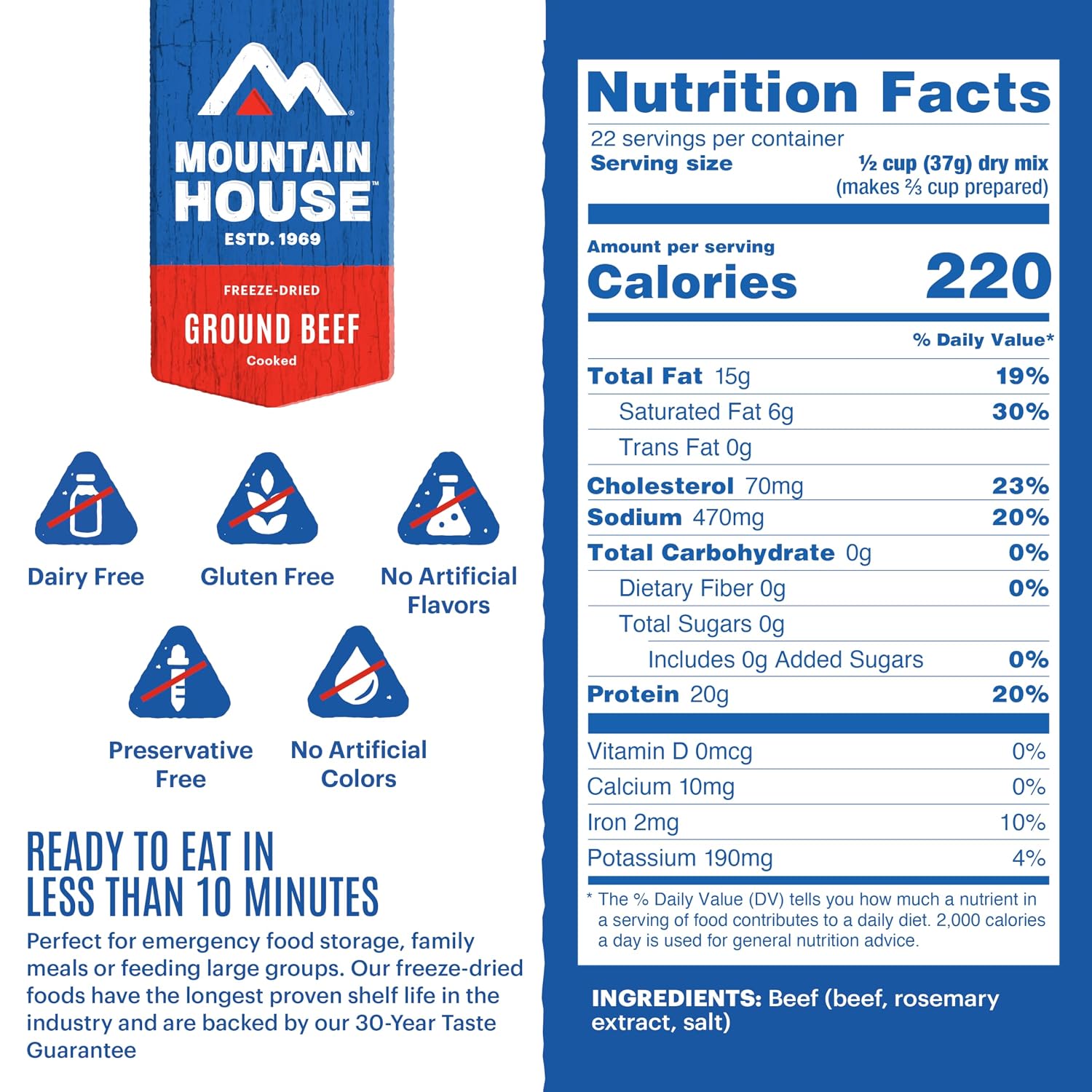
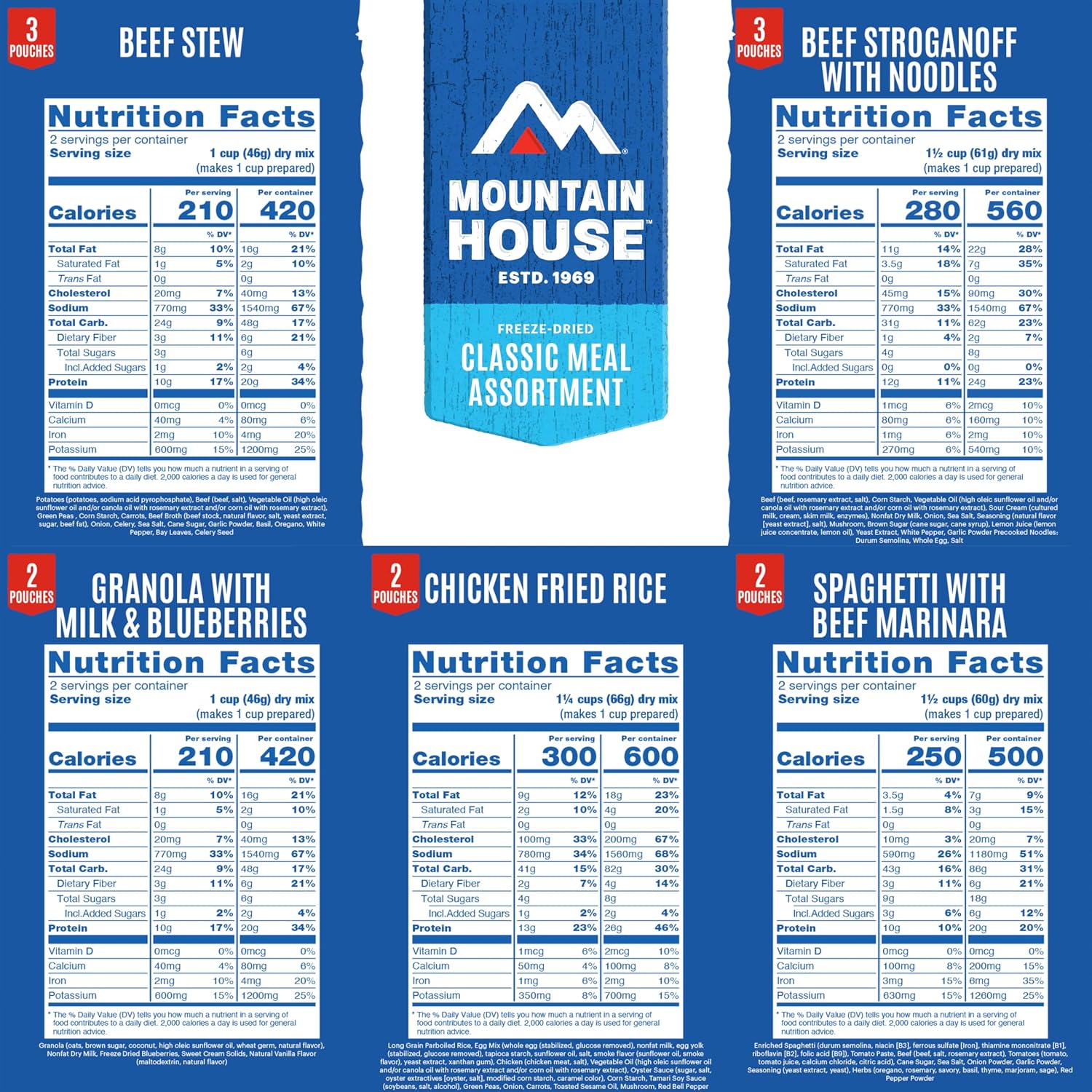
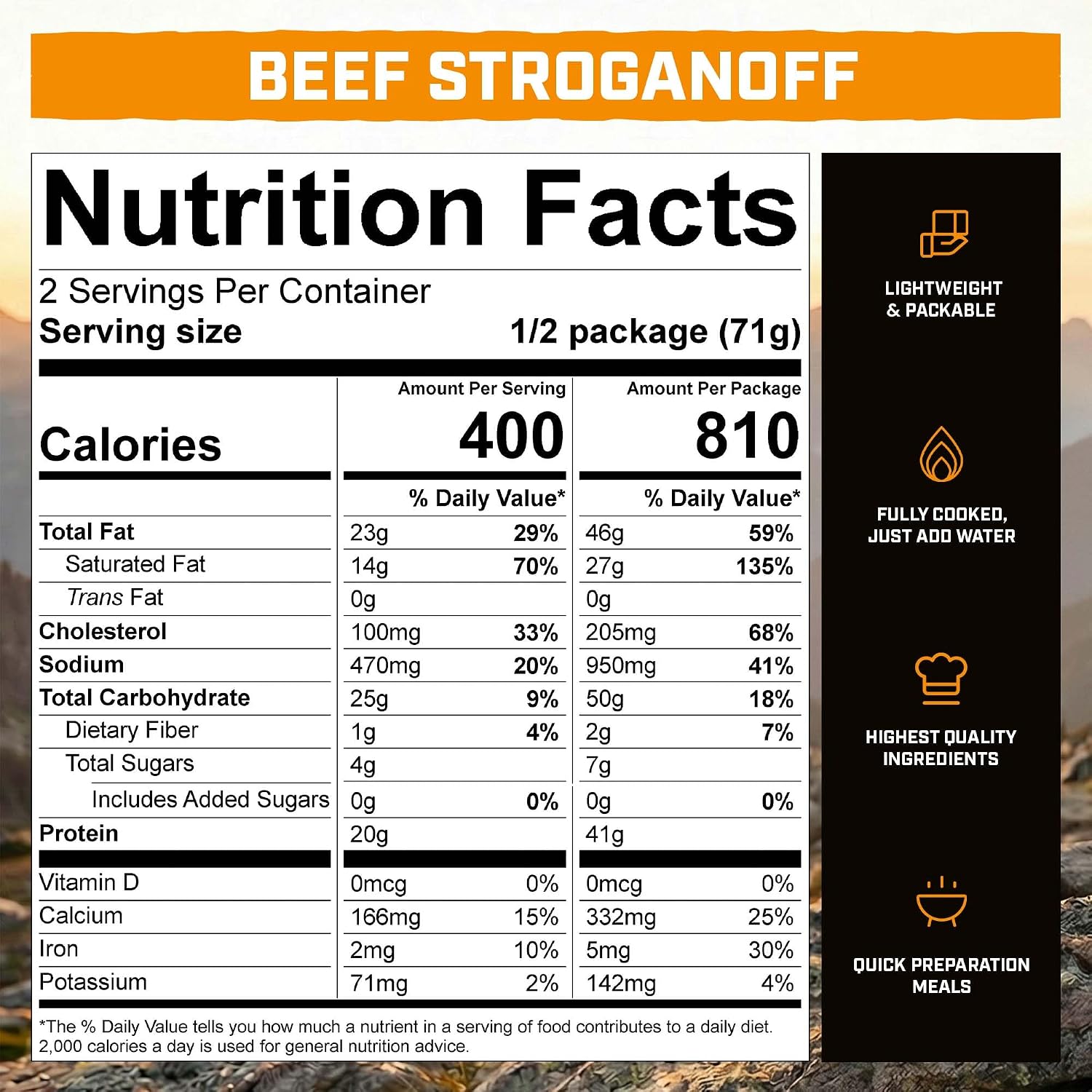
Brands like Mountain House and Peak Refuel lead this category. The freeze-drying process removes nearly all moisture from real cooked food, which locks in flavor and extends shelf life to 25–30 years for Mountain House’s nitrogen-sealed cans, or 5–7 years for Peak Refuel’s ingredient-focused pouches. Owners consistently describe freeze-dried meals with language you don’t normally hear about emergency food: multiple Mountain House owners report cooking those meals on weeknights at home — not because they’re prepping, but because they enjoy them. Outside Online’s 2025 backpacking meal roundup (Outside Online, “The Best Backpacking Meals of 2025”) flagged the emotional dimension of trail food explicitly, noting that palatability under stress is a performance variable, not a luxury.
Mountain
$94.99
In stock on Amazon
Check price on AmazonMREs: Selling You Operational Independence
Civilian MRE brands like XMRE and Eversafe offer the same self-contained logic as military-issue rations without the procurement paperwork. Every component — entrée, side, dessert, condiments, utensil — is hermetically sealed in a single meal packet that needs no cookware and no external water source to heat. The flameless ration heater (FRH), a chemical pouch activated by a small amount of water, warms the entrée inside the pouch in about 12 minutes. Reviewers consistently cite this heater as the decisive feature for scenarios where no stove is available. The tradeoff is bulk: a civilian MRE case of 12 meals weighs roughly 15–18 pounds, and a family of four eating three meals a day over 72 hours needs approximately 36 packets — close to 55–65 pounds of food. That’s a significant vehicle weight and storage commitment.
Mountain
$127.77
In stock on Amazon
Check price on AmazonCalorie Bars: Selling You Pure Logistics
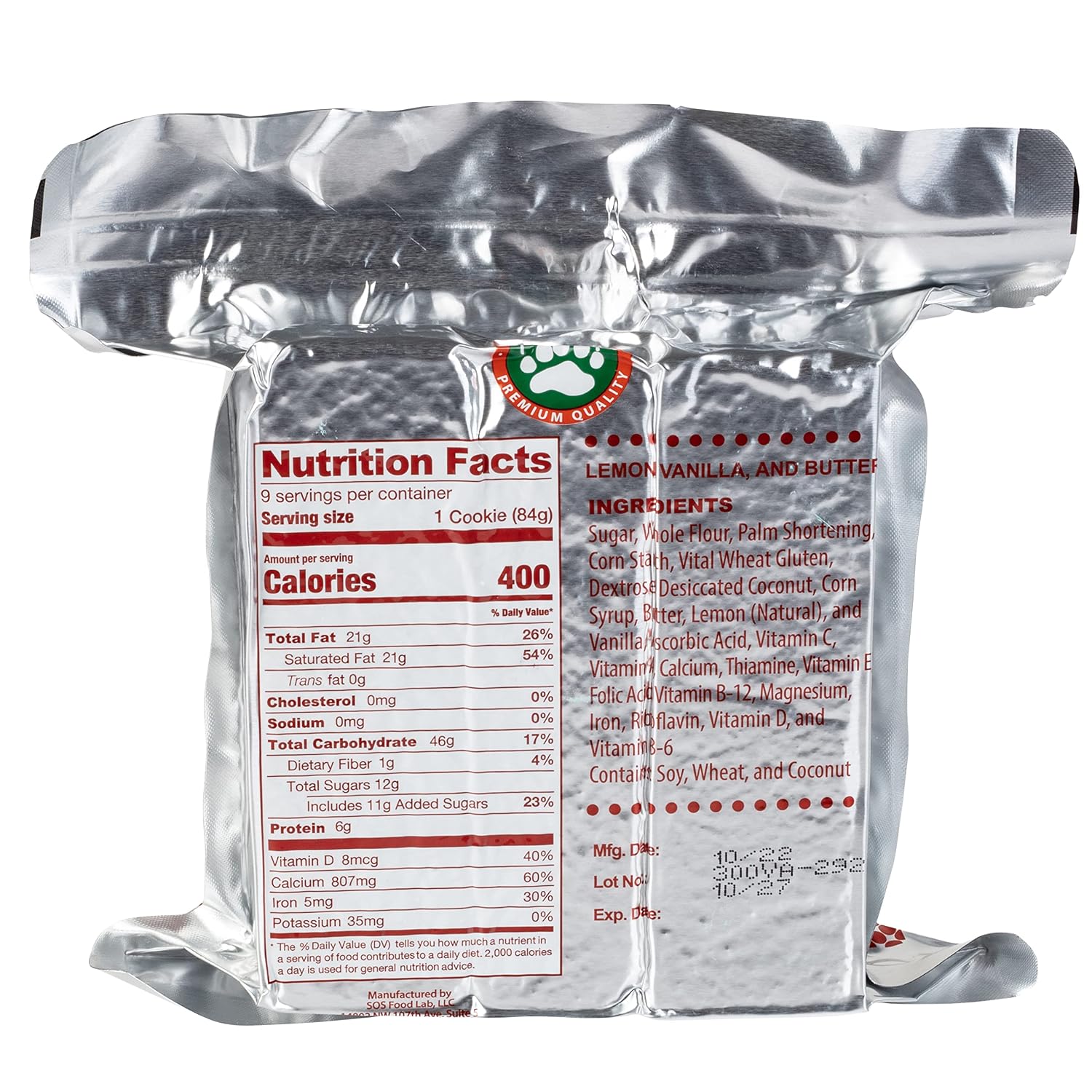
Grizzly Gear, Mayday, and Datrex are the most-reviewed civilian calorie bar brands. A 3,600-calorie bar (a common single-package size) weighs roughly 500–600 grams and provides approximately one day’s worth of calories for one adult. They require no water, no heat, no prep, and no cleanup. Reviewers are candid about the category ceiling: these bars are functional and tolerable, designed for one job. The chocolate flavor variants score best among users, but even positive reviewers consistently note they’re “not good enough to snack on by choice” — an important honesty signal about what you’re actually buying. Popular Mechanics’ 2025 emergency food kit review (Popular Mechanics, “Best Emergency Food Kits,” 2025) noted that calorie bars serve a specific mobility role that freeze-dried meals and MREs cannot fill, but that family acceptance rates — especially for children — are substantially lower than for the other two formats.
Peak
$14.95
In stock on Amazon
Check price on AmazonThe Comfort-vs-Logistics Matrix
Here’s where the practitioner’s decision lives. The question isn’t which format is “best” — it’s which combination maps to your specific scenario.
By the numbers — a 72-hour baseline for one adult:
| Format | Calories/unit | Weight | Water needed | Heat needed | Realistic morale score |
|---|---|---|---|---|---|
| Mountain House pouch (2-serving) | ~500–700 kcal | ~130g | 2 cups hot/warm | Yes (or warm) | High |
| MRE full meal packet | ~1,200 kcal | ~500–700g | None for heating | No (FRH included) | Medium-High |
| Grizzly Gear 3,600-cal bar | ~3,600 kcal | ~540g | None | None | Low-Medium |
Morale score synthesized from aggregated owner review language across verified purchase sources.
FEMA’s “Food and Water in an Emergency” publication (ready.gov) recommends storing at least one gallon of water per person per day — a figure that does not account for the additional water freeze-dried meals consume in rehydration. That’s a real budget pressure if you’re managing both water and food simultaneously during a prolonged outage.
The family stress multiplier: Children and adults under acute stress typically experience appetite suppression followed by comfort-seeking. REI Co-op’s Learning Center article “Backpacking Food: How to Choose” (rei.com/learn) notes that familiar flavors dramatically improve food acceptance under physical and psychological stress — a pattern outdoor educators have documented across guided wilderness programs. A child who rejects a calorie bar at hour 36 isn’t being difficult; they’re responding predictably to stress chemistry. A recognizable dinner — even one from a pouch — resets that cycle in ways that compressed shortbread cannot.
Tradeoffs You Need to Name Before You Buy
Freeze-dried: the water dependency problem. Every freeze-dried meal is a hostage to your water supply and heat source. If you’re rationing water below one gallon per person per day, you’re making a hard choice between drinking and cooking. At high altitude — above 8,000 feet — water boils at lower temperatures (around 194°F at 10,000 feet versus 212°F at sea level), which means rehydration takes longer and results can be inconsistent. Backpacker Magazine’s high-altitude cooking guidance (Backpacker Magazine, “High-Altitude Cooking and Rehydration Guide”) recommends adding 5–10 extra minutes of soak time above 8,000 feet and keeping the pouch sealed and insulated while it absorbs. This matters for overlanders staging in the Rockies or Cascades, and for any family whose shelter-in-place scenario involves significant elevation.
MREs: the bulk and sodium reality. As noted above, a family of four needs roughly 55–65 pounds of MRE packets for a 72-hour supply eating three meals daily. Beyond weight, sodium content in full civilian MRE meal packets averages 1,800–2,500mg per meal per published XMRE nutrition specifications — not inherently dangerous for healthy adults, but a legitimate concern for family members managing hypertension or cardiovascular conditions. On the morale side, multiple MRE reviewers describe eating through entire cases as a genuinely enjoyable experience rather than a grudging one, so the format’s reputation as purely utilitarian isn’t entirely accurate. Variety across multi-day use is a genuine MRE strength.
Calorie bars: the thirst and satiety gap. This tradeoff doesn’t get enough direct discussion. Grizzly Gear bars and similar products are designed to be calorie-dense without requiring water to eat — but their macronutrient profile (high in carbohydrates and fat, lower in protein relative to volume) means satiety drops faster than the calorie count suggests. The recommended serving across most brands is roughly 400 calories every few hours, not one large bar per sitting. Owners consistently report feeling adequately fueled but not full — a distinction that matters at hour 20 of a stressful situation with children asking when dinner is. On thirst: calorie bars are specifically formulated to keep sodium low, so they don’t add materially to your thirst burden. In a water-rationing scenario, they’re neutral on this metric — which is actually their best argument over saltier alternatives like jerky or crackers.
Building the Decision Framework
If you’re reading this with an active purchase decision in mind — configuring a 72-hour kit, a two-week household supply, or a vehicle load-out — here are the scenario-matched rules that hold up across the published guidance and owner evidence:
If your emergency scenario involves reliable water access and a heat source, freeze-dried meals from Mountain House or Peak Refuel should anchor your food supply. The morale return is disproportionately high relative to cost and weight, and the shelf life of 25+ years on Mountain House cans means the investment doesn’t expire before you need it.
If your scenario is vehicle-based, shelter-in-place with no cookware, or likely to involve coordinating a group under operational pressure where eating needs to happen fast, MREs earn their bulk. The FRH independence is genuinely valuable. Stock one MRE per person per day as a no-stove baseline, then layer freeze-dried meals around it when conditions allow cooking.
If your scenario involves true bug-out mobility — a 72-hour carry bag where every ounce matters and water is uncertain — calorie bars are the correct choice for an emergency caloric floor, not a comfort food substitute. Be honest with your family about what they are. Frame them as the “keep moving” option. Supplement with a handful of single-serving freeze-dried pouches for morale if weight budget allows.
For families with children under 12: Popular Mechanics’ 2025 emergency food kit review explicitly noted that child acceptance of food under stress is consistently underweighted in family prep planning. Their finding aligns with the pattern above — prioritize at least one recognizable, liked meal format per day, even if it costs more weight or water. The cognitive and behavioral stability payoff in children is real and affects the whole household’s ability to function.
Frequently Asked Questions
Can you rehydrate freeze-dried meals like Peak Refuel without boiling water? Yes, with caveats. Peak Refuel’s own product guidance acknowledges warm-water rehydration; owners report acceptable results at around 150°F — hot tap water territory. Cold water technically works for some ingredients but dramatically extends soak time to 20–30 minutes minimum, and texture suffers noticeably. A 12V immersion heater or an insulated thermos pre-filled before an outage can bridge this gap in no-stove scenarios.
How long do Grizzly Gear calorie bars actually keep you full? Based on aggregated owner reports, the satiety window on a standard 400-calorie portion is roughly 2–3 hours for a moderately active adult — shorter than most people expect, because bar fiber content is low and protein is limited relative to volume. Planning a portion every 2.5 hours is more realistic than a “three meals a day” framing.
Are MRE flameless heaters safe to use indoors? The FRH generates heat through a magnesium-iron reaction activated by a small amount of water. The byproduct is a small amount of hydrogen gas. In any normally ventilated indoor space — a room with a door or window cracked — this is not a practical hazard. In a fully sealed room with no airflow, cracking a window is a sensible precaution. U.S. Army Natick Laboratories documentation on FRH chemistry confirms hydrogen release is minimal and dissipates rapidly under normal conditions.
How does Mountain House rehydrate at high altitude? As noted above, water boils at lower temperatures above 8,000 feet, slowing rehydration. Backpacker Magazine’s high-altitude cooking guidance recommends extending soak times by 5–10 minutes and keeping the pouch insulated — under a jacket or inside a cozy — while it absorbs. Mountain House products rehydrate acceptably at altitude with this adjustment; the bigger variable is fuel consumption if you’re heating water on a canister stove in cold temperatures.
What is the realistic serving count in a Peak Refuel two-serving pouch for a hungry adult? Honest answer: one serving for a hungry adult under stress, not two. The “two-serving” designation reflects caloric math — typically 500–720 calories total — not appetite satiation math. Multiple owners note finishing a pouch as a single meal. If you’re building a four-person, three-day supply assuming two adults each eat half a pouch, you will run short. Plan one pouch per adult per meal occasion.