If you’ve ever opened a large metal can of freeze-dried food and wondered whether it could do anything more than sit on a shelf for thirty years, you’re in the right place. Freeze-drying is a preservation process that removes nearly all moisture from food — proteins, vegetables, fruits — while leaving the cellular structure mostly intact, so when you add water back, the food returns to something close to its original texture and flavor. The result is an ingredient that weighs almost nothing, stores for years without refrigeration, and can slot into a skillet, a soup pot, or a baking recipe with almost zero prep. This guide is built around real-world use: what freeze-dried protein and fruit ingredients actually perform like when you cook with them every day, not just when the power is out. We’ll cover the honest tradeoffs, the math on how far a single can goes, and the techniques — including one genuinely clever trick with the powder at the bottom of a chicken can — that make these ingredients worth having in rotation regardless of your preparedness level.
| EDITOR'S PICKMountain House Emergency Meal A… | Mid-tierMountain House Ground Beef #10… | Budget pickAugason Farms Freeze-Dried Whol… | |
|---|---|---|---|
| Shelf life | 30 years | — | 30 years |
| Servings | — | 22 | 26 |
| Container | — | #10 can | — |
| Gluten-free | — | ✓ | — |
| Cooking use | — | — | ✓ |
| Price | $127.77 | $94.99 | $28.60 |
| See on Amazon → | See on Amazon → | See on Amazon → |
What “Cooking With” Actually Means for Freeze-Dried Ingredients
There’s a meaningful difference between eating freeze-dried food as a survival ration and using freeze-dried ingredients as a pantry staple. The first framing treats them as emergency calories. The second treats them as convenience ingredients that happen to have a 25-year unopened shelf life — and that framing opens up a lot more utility.
The proteins we’re focused on here are primarily Augason Farms freeze-dried chicken (diced and sliced varieties in #10 cans) and Mountain House freeze-dried ground beef. On the fruit side, Augason Farms freeze-dried blueberries and Augason Farms freeze-dried sweet corn are the standout ingredient-style options because they rehydrate cleanly and translate directly into recipes rather than just snacking.
The key variable that most buyers underestimate is rehydration ratio and time. Freeze-dried chicken needs roughly equal parts water by volume and about 5–10 minutes of soak time in warm water to reach a usable texture. Mountain House ground beef is faster — closer to 3–5 minutes — because the fat content and smaller particle size mean water absorbs quickly. Neither requires boiling water to rehydrate, but hot water noticeably speeds the process and improves final texture. More on cold-water rehydration in the FAQ below.
By the numbers — what a #10 can actually contains:
| Product | Approximate servings | Rehydrated yield (approx.) | Typical opened shelf life (manufacturer-stated) |
|---|---|---|---|
| Augason Farms Freeze-Dried Chicken | 21–23 servings | ~46 oz rehydrated | 1 year after opening |
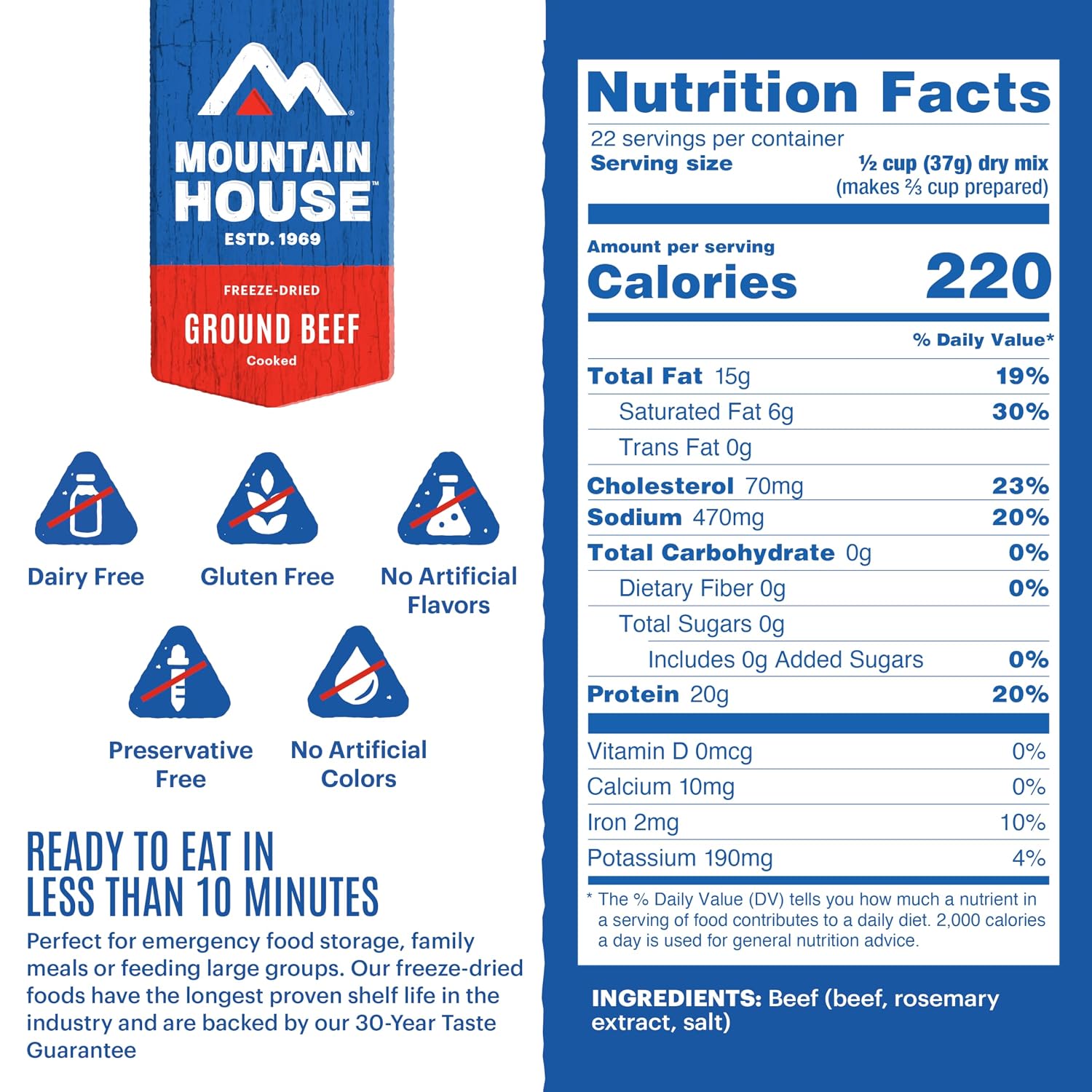
| Mountain House Freeze-Dried Ground Beef | 10–13 servings | ~26 oz rehydrated | 12 months after opening |
| Augason Farms Freeze-Dried Blueberries | 35–39 servings | Variable by use | 1 year after opening |
| Augason Farms Freeze-Dried Sweet Corn | 27–30 servings | ~2:1 water-to-corn ratio | 1 year after opening |
Sources: Augason Farms product specification labels; Mountain House published product specs.
Those serving counts assume standard ¼-cup dry portions. If you’re building full protein-centered meals rather than side servings, divide the realistic meal count roughly in half — which still makes a single #10 can of chicken a meaningful contribution to a week of cooking.
Everyday Integration: Where These Ingredients Actually Show Up
The most consistent pattern across owner reviews of Augason Farms ingredient cans is that buyers stop treating them as emergency stores and start treating them as pantry items within the first few months of purchase. Reviewers of the corn variety describe eating it dry straight from the can in trail mix applications, adding it to cornbread batter without rehydrating, and mixing it into baked goods where the slight crunch is a feature rather than a flaw. The blueberry variety gets similarly versatile treatment — reviewers report adding the freeze-dried berries directly to oatmeal or dry cereal in the morning, where the cereal’s own milk handles rehydration passively over a few minutes.
This matters for one practical reason: rotation. The biggest mistake preparedness-minded buyers make with #10 cans is opening them and then not using them, which means the clock on that 1-year opened shelf life ticks down while the can sits half-full in a cabinet. Building these ingredients into weekly cooking solves the rotation problem automatically.
For the chicken specifically, the cooking applications reviewers return to most often are soups, chicken salad (where the rehydrated texture closely resembles canned chicken), pasta dishes, and casseroles. The Mountain House ground beef earns particularly strong praise: across aggregated reviews, the pattern is that owners describe it as genuinely resembling real ground beef after rehydration — crumbled texture, neutral-to-meaty flavor, no off-notes — which is higher praise than freeze-dried meat typically earns. Owners use it in tacos, pasta sauces, stuffed peppers, and rice dishes without noting any meaningful quality gap versus fresh-cooked and drained ground beef.
The powder-residue technique: Here’s the single most useful pro tip that surfaces across Augason Farms chicken can reviews, and it deserves more attention than it typically gets. As you work through a #10 can of freeze-dried chicken, fine protein powder accumulates at the bottom — broken pieces and dust from the diced chicken pieces. Reviewers have found that this residue, stirred into soups, stews, or pan sauces during the last few minutes of cooking, acts as a natural protein-based thickener. The effect is similar to adding a small amount of flour or cornstarch, but with added flavor and nutrition rather than neutral starch. The USDA Food Safety and Inspection Service’s shelf-stable food safety guidance confirms that freeze-dried protein powders and residues are fully safe to consume as long as the can has been stored correctly and is within its use window — there’s nothing structurally different about the powder versus the intact pieces.
The Shelf-Life Reality Check: What Manufacturers Don’t Emphasize
Both Augason Farms and Mountain House state approximately one year as the post-opening shelf life on their #10 cans. That number is worth interrogating against real-world owner experience before you build your rotation plan around it.
Ready.gov’s food and water emergency guidance notes that moisture is the primary degradation mechanism for opened freeze-dried products — which tracks with owner reports. One reviewer tracking their Augason Farms blueberries after opening reported noticeable quality degradation — texture softening, increased clumping, and flavor flattening — at roughly the 3-month mark, not the 12-month mark the label implies. The National Center for Home Food Preservation at the University of Georgia notes in their canning principles guidance that even low-moisture foods experience accelerated quality loss once the original sealed atmosphere is compromised, particularly in humid climates or kitchens with steam exposure.
The practical implication: if you live in a humid environment (coastal, humid southern states, apartments without climate control), treat 6 months as your realistic post-opening quality window rather than 12. Desiccant packets — the same silica gel packets you find in supplement bottles — can extend this. Some owners report sealing partially used #10 cans with a plastic lid plus a fresh desiccant packet and storing them in a dark, cool cabinet, with better results than simply leaving them open on a pantry shelf.
This gap between manufacturer claims and field experience is exactly the kind of thing worth knowing before you open a $40+ can and expect it to stay peak-quality for a year.
Building Actual Meals: A Practical Framework
The “real cooking” framing only works if you’re thinking in complete meals rather than isolated ingredients. Here’s a decision framework based on what ingredient-can owners actually report cooking:
If you have freeze-dried chicken + corn: Rehydrate the chicken in warm water (5–10 min), drain, and add directly to a skillet with oil and your choice of seasoning. Add the corn dry into the skillet — it will rehydrate in the residual moisture and steam from the pan over 3–4 minutes. This produces a complete chicken-and-corn skillet in under 15 minutes with zero fresh ingredients required.
If you have Mountain House ground beef: Rehydrate with hot water (3–5 min), drain excess water, and proceed exactly as you would with fresh ground beef cooked and drained. Reviewers consistently note that the crumble size and texture make it indistinguishable from fresh in sauced applications like tacos or Bolognese. One #10 can of Mountain House ground beef produces approximately 10–13 half-cup servings of rehydrated beef — enough for roughly 5–6 full taco nights for a family of four using two servings per person.
If you have freeze-dried blueberries for baking: Freeze-dried fruit rehydrates completely when baked into muffins or cookies because the moisture from the batter and steam from the oven handles rehydration during cooking. You can substitute freeze-dried blueberries for fresh at a ratio of roughly 1:3 by volume (1 cup freeze-dried for every 3 cups fresh called for) because freeze-dried fruit is lighter and more concentrated. Reviewers confirm this works in standard blueberry muffin recipes with no modification to wet ingredients required — the berries absorb batter moisture and emerge with a texture nearly identical to baked-in fresh berries.
Frequently Asked Questions
How long does a #10 can of Augason Farms freeze-dried corn or blueberries last after it has been opened? Augason Farms states approximately one year on their labeling. However, at least one reviewer tracking the blueberry variety reported noticeable quality decline starting around 3 months after opening, particularly in humid storage conditions. A practical guideline: plan to use an opened can within 6 months in average home environments, or 3–4 months if you’re in a humid climate. Store with a desiccant packet and a tight plastic lid to push toward the longer end.
Can you rehydrate freeze-dried chicken and ground beef with cold water, or does it need to be hot? Cold water works — it’s not unsafe — but expect roughly double the rehydration time (15–20 minutes for chicken, 8–12 minutes for ground beef) and slightly softer, less cohesive texture versus hot water. Mountain House’s published rehydration guidelines recommend hot or boiling water for best results. For everyday cooking, using hot water from the tap or a quick microwave warm is worth the extra 30 seconds.
Is the powder residue at the bottom of a freeze-dried chicken can safe to eat or use in cooking? Yes. Per USDA Food Safety and Inspection Service guidance on shelf-stable foods, the powder is structurally identical to the intact pieces — it’s just mechanically broken. It’s fully safe to eat or cook with. Owners recommend stirring it into soups, sauces, or stews as a thickener and flavor booster rather than discarding it.
How do you store a partially used #10 can to extend freshness after opening? Replace the manufacturer’s lid with a fitted plastic #10 can lid (sold separately by most preparedness retailers), drop in a fresh food-grade silica desiccant packet, and store in a cool, dark location away from heat and steam. Avoid the cabinet above the stove. Some owners transfer the remaining contents to a vacuum-seal bag or glass jar with an oxygen absorber if the can is more than half depleted.
Can freeze-dried ingredients replace fresh produce in normal baking recipes like muffins and cookies? Yes, with minor adjustments. For fruit like blueberries, substitute at roughly 1:3 volume (freeze-dried to fresh) because freeze-dried fruit is lighter and more concentrated. No changes to wet ingredients are needed for muffins — the batter provides enough moisture. For cookies, which have less batter moisture, a brief 2-minute pre-soak in warm water before adding to the dough produces better texture.
How many actual meals can you build from one #10 can of Mountain House freeze-dried ground beef? Based on Mountain House’s published specs of 10–13 half-cup servings per can, and assuming a standard meal uses about one cup of rehydrated ground beef per person, a single can yields roughly 5–6 one-person meal portions of protein-centered dishes. For a family of four eating tacos, plan on approximately 1.5 cans per taco night. Budget your stock accordingly.