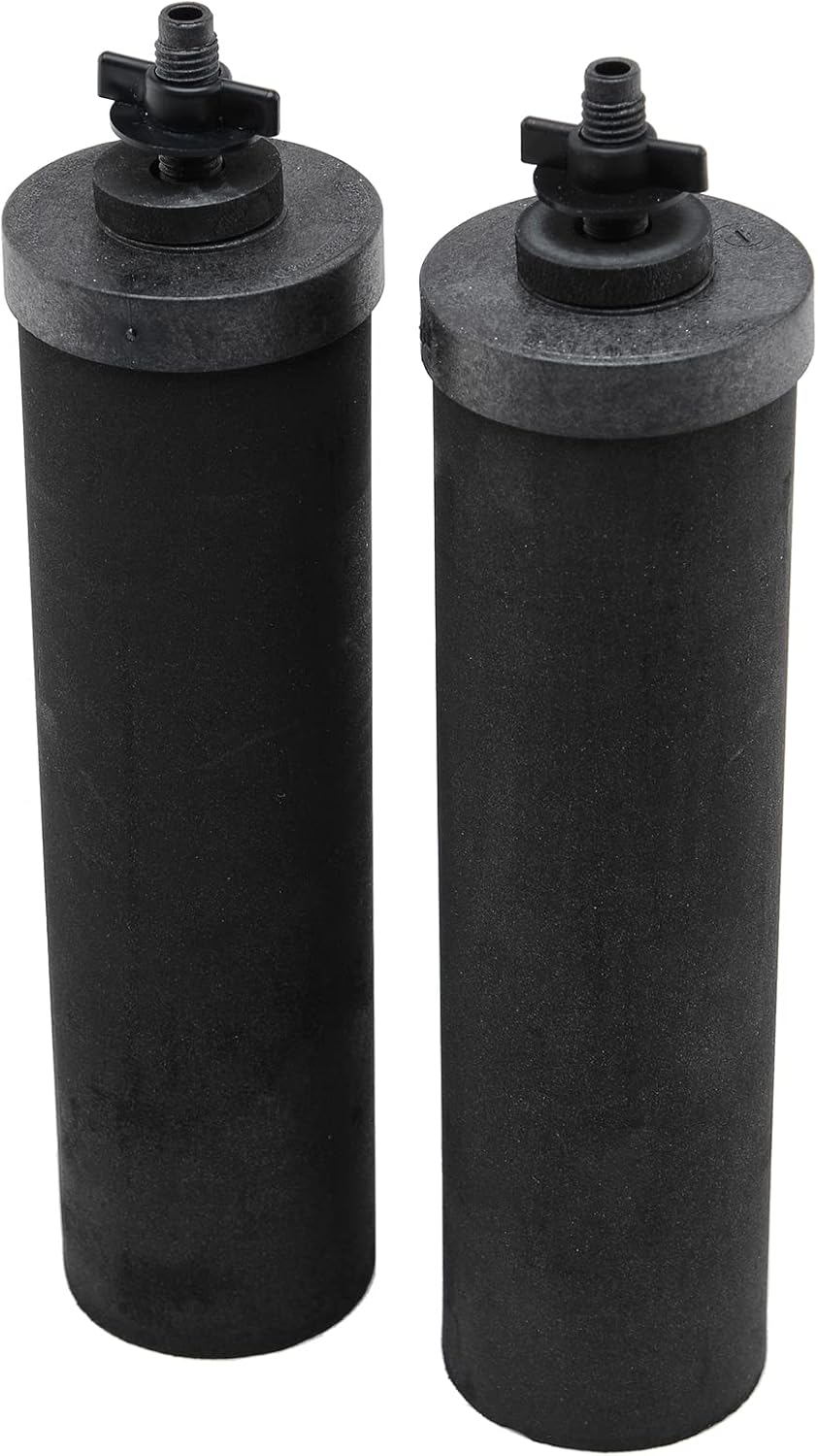
A countertop gravity filter is exactly what it sounds like: water poured into an upper chamber slowly drips through one or more filter elements into a lower holding tank — no electricity, no plumbing, no pump required. That simplicity is the whole point. After the East Palestine, Ohio train derailment in early 2023, one Big Berkey owner described on a major retail review platform upgrading from a standard Brita pitcher specifically because they wanted something capable of handling a wider range of contaminants than a basic carbon pitcher addresses. That kind of purchase trigger — a real-world event amplifying distrust of tap water — is common. What’s less common is the follow-up conversation about what happens after the filter is set up and the novelty wears off. Month one tends to go fine. Month three is where owners start learning things the manual didn’t cover.
This guide is for people who already own a gravity filter, are seriously considering one, or are evaluating whether to upgrade a household system. The focus is on the failure modes that generate one-star reviews — mold, inadequate flow, mysterious certification claims — and what to actually do about them.
The Mold Problem Is Real, and It’s Almost Always a Drying Failure
Across aggregated reviews for brands including Waterdrop, Big Berkey, and ProOne, one complaint surfaces with enough consistency to treat as a design reality rather than a user error edge case: mold growth after cleaning. A Waterdrop reviewer explicitly documented filters going moldy after washing, which frames the issue clearly. This isn’t a manufacturing defect. It’s a moisture management problem.
Gravity filter housings are made of food-grade plastic or stainless steel with numerous crevices — gaskets, spigot fittings, filter stem channels — that trap water. When owners wash the components with dish soap, rinse them, and reassemble while still damp, they’ve created a sealed, dark, nutrient-light environment at room temperature. That’s a textbook mold incubation setup.
What the maintenance protocol actually needs to look like:
- Disassemble completely — upper chamber, lower chamber, spigot, all gaskets.
- Wash with mild, fragrance-free dish soap. Avoid bleach on filter elements unless the manufacturer explicitly permits it; most don’t.
- Rinse thoroughly.
- Air dry all components — inverted on a clean drying rack — for a full 24 hours before reassembly. Not an hour. Not until it “looks dry.” Twenty-four hours.
- If mold is already present on plastic housing components (not filter elements), a 1-tablespoon-per-gallon bleach solution applied with a soft brush, followed by thorough rinsing and the full drying cycle, is the standard remediation approach per CDC guidance on household mold on food-contact surfaces.
If mold appears on the filter elements themselves, the elements need to be replaced. There is no safe way to remediate a moldy ceramic or black carbon filter element; the porous structure that makes it effective at filtering is the same structure that makes it impossible to fully decontaminate once colonized.
The practical takeaway: schedule cleaning on a day when you can leave components out overnight. Reassembling the next morning is not inconvenient — reassembling at 10 PM because you started at 9 PM is how mold problems start.
Flow Rate Math: Why a Single-Filter System May Not Serve Your Household
One of the most instructive one-star reviews in the gravity filter category comes from a Culligan unit owner who documented an 18-hour wait for 2 gallons using a single-filter configuration. That number is worth sitting with: 2 gallons in 18 hours is approximately 0.11 gallons per hour, or roughly 1 cup every 90 minutes.
For context, the average American household consumes 1–2 gallons of drinking and cooking water per day per person (per FEMA’s emergency water planning guidance, which recommends 1 gallon per person per day as a minimum). A family of four needs 4–8 gallons daily. At that Culligan rate, you’d be waiting multiple days to fill a single day’s need.
By the numbers — dual-filter vs. single-filter throughput:
| Configuration | Typical Flow Rate | Hours to Produce 8 Gallons |
|---|---|---|
| Single filter (base install) | 0.5–1.5 gal/hr | 5–16 hours |
| Dual filter (standard upgrade) | 1.0–3.0 gal/hr | 2.5–8 hours |
| Dual filter + primed elements | 2.5–4.0 gal/hr | 2–3 hours |
Manufacturer-rated flow figures assume properly primed filters and clean source water. Real-world rates from owner reports consistently run 20–40% below spec, especially with harder water or higher sediment loads. If your system came with a single filter and your household is more than two people, adding a second filter element is the single most impactful upgrade available — more so than any housing upgrade.
Priming matters too. Most ceramic and black carbon elements ship with air pockets in the filter media. Running water through them under gentle pressure before first use (holding the element under a faucet and allowing water to saturate through from the outside in) displaces that trapped air and dramatically improves initial flow. Owners who skip this step and then complain about slow flow in week one are often fixing a priming problem, not a filter defect.
The Visibility Gap: Why No Level Window Is a Real Operational Problem
Multiple reviewers across Big Berkey, ProOne, and Purewell units cite the same frustration: there’s no way to see how much filtered water is available in the lower chamber without lifting the upper chamber or reaching around the housing. For a countertop unit that may sit in a corner or under cabinets, this creates a daily annoyance that compounds over time.
This matters beyond convenience. Owners who can’t easily check the lower chamber tend to either over-fill the upper chamber (causing overflow) or run the lower chamber dry and then forget to refill the upper, creating dry-run conditions that can stress filter elements — particularly ceramic types, which can crack if they repeatedly cycle between wet and dry states.
If you’re evaluating a unit that lacks a level window, the workarounds are:
- A simple rubber band on the outside of a stainless steel unit positioned at the “half full” line — a tactile reference when you reach behind it.
- A small kitchen timer set as a refill reminder every 6–8 hours during heavy-use periods.
- For units with removable spigots, a clear replacement spigot sometimes sold by third-party accessory suppliers allows some visual reference.
If you’re still in the buying phase and this bothers you: treat “visible water level indicator” as a hard checklist item, not a nice-to-have. The units that include it — typically via a plastic window strip or a clear lower chamber — generate measurably fewer operational complaints in long-run owner reviews.
Third-Party Replacement Filters: What NSF Certification Actually Covers
Filterlogic replacement filters represent a category of owner behavior worth examining carefully: buyers who purchased a Big Berkey or similar premium housing and are now actively seeking lower-cost replacement elements. The NSF certification logos on third-party filter packaging are the primary trust signal these buyers use. That’s a reasonable heuristic — but only if you understand what those certifications actually test.
NSF/ANSI 42 (the most commonly displayed certification on gravity filter replacement elements) covers aesthetic contaminant reduction: chlorine taste and odor, particulates, and zinc. It does not certify removal of pathogens, heavy metals, PFAS compounds, nitrates, or most of the contaminants that drive emergency preparedness purchases. Per NSF International’s published standard documentation, NSF 42 is specifically scoped to taste and odor improvement — a useful certification, but not a safety certification in the way most buyers assume.
NSF/ANSI 372 certifies that a product’s wetted components (the parts that contact water) meet lead-content requirements. It says nothing about what the filter removes. Seeing NSF 372 on a filter box means the materials are safe — not that the filter performs any particular removal function.
The certification that actually matters for health-effects claims — pathogen reduction, heavy metals, VOCs — is NSF/ANSI 53. PFAS reduction claims require testing against NSF/ANSI 58 protocols or the newer NSF/ANSI 473 standard specifically developed for PFAS. If a replacement filter element doesn’t list 53 or 58/473 certification, it hasn’t been independently verified to remove the contaminants most emergency preparedness buyers have in mind.
This doesn’t mean all third-party replacement elements are unsafe or ineffective — some are legitimately tested and perform well. It means the NSF 42 logo on the box is not the verification signal buyers are treating it as. Before purchasing any replacement element (OEM or third-party), check the NSF Certified Products database (searchable at nsf.org) to confirm the specific model, not just the brand, holds the certifications listed.
PFAS and Gravity Filters: An Honest Assessment
PFAS (per- and polyfluoroalkyl substances — the class of synthetic chemicals increasingly detected in municipal water supplies and private wells) is the contaminant category driving a significant portion of premium gravity filter purchases in 2025–2026. The EPA’s published PFAS drinking water regulations, finalized in 2024, set Maximum Contaminant Levels for six PFAS compounds — a regulatory shift that legitimately elevated buyer awareness.
The honest answer: standard black carbon filter elements — the type that ships with most Big Berkey, ProOne, and similar systems — are not independently certified for PFAS removal under NSF/ANSI 58 or 473. Some manufacturers make PFAS reduction claims in marketing materials; those claims require scrutiny. Per EPA guidance on drinking water contaminants, granular activated carbon (GAC) can reduce some PFAS compounds at certain concentrations, but performance varies significantly by contact time, PFAS chain length, and source water chemistry.
If PFAS removal is a primary purchase driver, the verification path is:
- Confirm the specific filter element (not just the housing brand) has NSF/ANSI 58 or 473 certification in the NSF product database.
- Request the manufacturer’s third-party test data showing the specific PFAS compounds tested and the percent reduction achieved.
- Recognize that gravity filters with adequate contact time (slower flow, longer residence time in the filter media) generally outperform the same media used at faster flow rates — which reframes “slow drip” from annoyance to mechanical advantage in some scenarios.
Frequently Asked Questions
Why did my gravity filter go moldy after I cleaned it, and how do I prevent it? Mold after cleaning is almost always a drying failure. Filter housings have gaskets and crevices that hold moisture. The fix is a full 24-hour air-dry of all disassembled components before reassembly. If mold appears on filter elements themselves, replace them — porous filter media cannot be safely decontaminated.
Are third-party replacement filters like Filterlogic safe to use in a Big Berkey housing? Housing compatibility (thread size, stem diameter) is the first check — most standard Big Berkey-style housings accept compatible third-party elements. Performance verification is the second check: confirm the specific element holds NSF/ANSI 53 certification (health effects) in the NSF product database, not just NSF 42 (aesthetic effects) or NSF 372 (lead-free materials).
How often should I clean my countertop gravity filter and what should I use? Every 4–6 weeks for regular household use, or immediately if you notice slowing flow, visible residue, or any off-taste. Mild fragrance-free dish soap for plastic and stainless components. For ceramic filter elements, a soft brush under running water (no soap) to scrub off the outer layer of accumulated sediment. Full 24-hour dry before reassembly.
Why is my gravity filter dripping so slowly — is something wrong? Usually one of three things: filter elements weren’t primed (air-locked), sediment has clogged the outer filter surface (scrub ceramic elements gently under running water), or you’re running a single-filter configuration that’s undersized for your household’s throughput needs. Add a second filter element if your housing supports it.
What does NSF/ANSI 42 certification actually mean for a water filter? It means the filter has been independently tested to reduce chlorine taste and odor, and to meet particulate reduction standards. It does not mean the filter removes pathogens, heavy metals, PFAS, or most contaminants associated with emergency preparedness scenarios. For health-effects claims, look for NSF/ANSI 53.
Does a gravity filter remove PFAS, and how do I verify a specific filter’s claims? Some activated carbon filter elements reduce certain PFAS compounds, but performance is highly variable. To verify: search the NSF Certified Products database (nsf.org) for the specific filter element model and confirm NSF/ANSI 58 or NSF/ANSI 473 certification. Marketing claims on packaging are not a substitute for database verification.