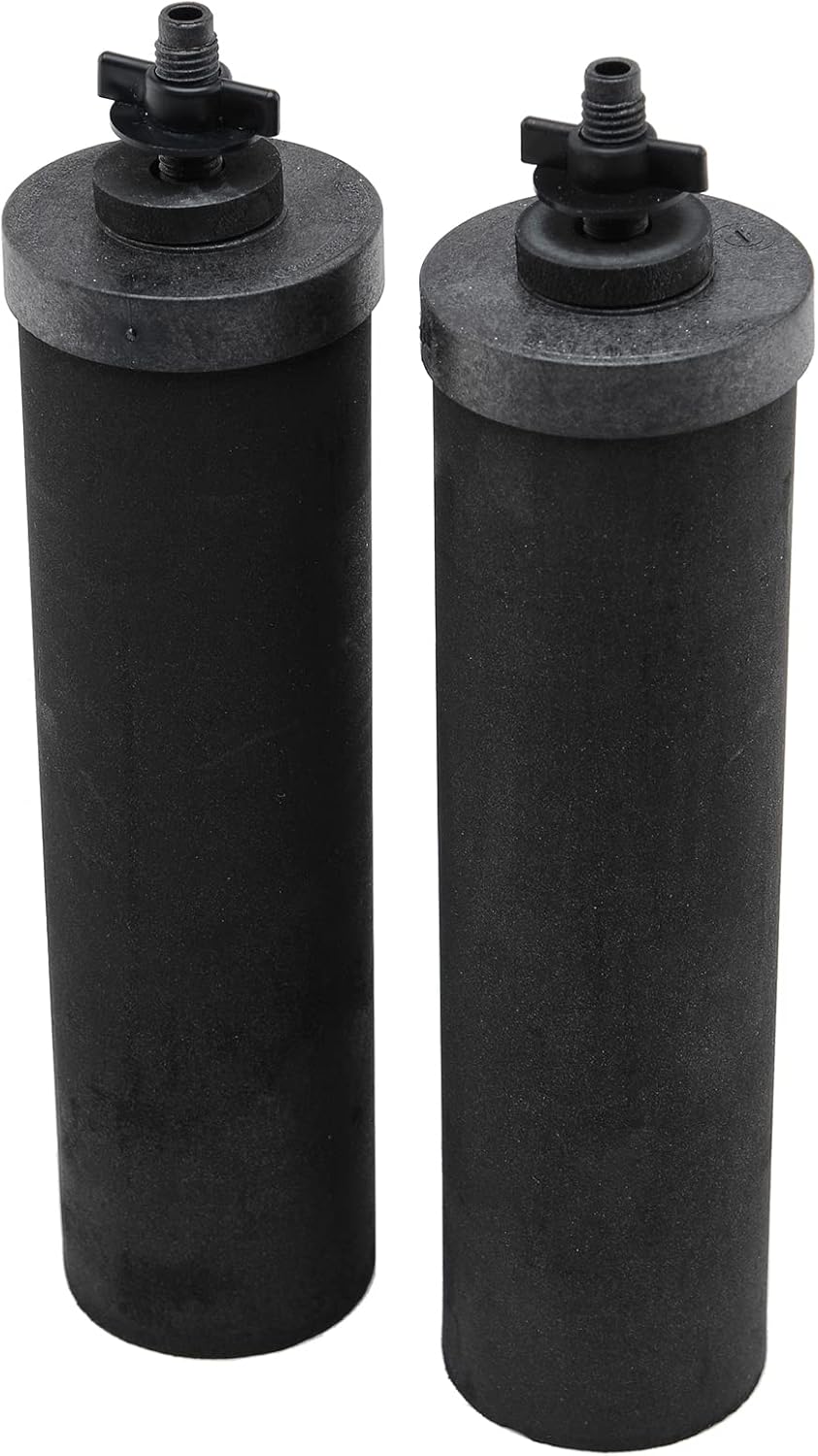
A gravity filter is exactly what it sounds like: water poured into a top chamber slowly drips through one or more filter elements into a lower storage tank, using nothing but gravity — no electricity, no pressure, no plumbing required. That simplicity is why systems like the Big Berkey have become a fixture in prepared households, RVs, and off-grid setups alike. The filter elements (the replaceable cylinders inside the housing that actually do the cleaning) are where most of the long-term cost lives — and where the generic-vs.-brand-name debate gets real. If you own a Big Berkey or are sizing up your first gravity system, this article will help you decide whether a third-party element like Filterlogic is a smart cost move or a risk you can’t afford to take.
| EDITOR'S PICKBig Berkey Gravity-Fed Stainles… | Mid-tierProOne Big+ Gravity Water Filte… | Budget pickFilterlogic Gravity Water Filter | |
|---|---|---|---|
| System type | Gravity-fed | Gravity-fed | — |
| Capacity | 2.25 gal | — | — |
| Certified to | — | IAPMO-certified | NSF/ANSI 42 & 372 |
| Reduces PFAS | — | ✓ | — |
| Reduces lead | — | ✓ | — |
| Pack count | — | — | 2 pack |
| Price | $367.00 | $181.98 | $29.99 |
| See on Amazon → | See on Amazon → | See on Amazon → |
What You’re Actually Comparing: OEM Elements vs. Third-Party Alternatives
Berkey’s proprietary Black Berkey purification elements are the benchmark the whole conversation circles around. Berkey claims each element filters up to 3,000 gallons before replacement and that a set of two covers the average household’s drinking water needs for several years. At roughly $130–$150 per pair (OEM pricing as of mid-2026), that math works out to about $0.025 per gallon — reasonable, but not cheap when you factor in periodic replacement across a decade of ownership.
Filterlogic replacement elements are positioned as a direct drop-in for Big Berkey housings at roughly 40–50% of OEM cost. The value proposition is simple: same threaded stem, same basic activated-carbon-plus-ceramic construction, lower sticker price. Owners across aggregated reviews consistently describe a leak-free fit in standard Big Berkey housings, with no modification required — the threading seats properly and the wing nut tightens the same way.
That compatibility finding matters, because the first failure mode with any third-party element isn’t filtration performance — it’s physical fit. A poorly seated element creates a bypass channel where unfiltered water skips the media entirely. Owners reporting on Filterlogic elements have not flagged seating or bypass issues at notable rates, which is a meaningful baseline.
What they have flagged, and what you should weigh honestly: Filterlogic elements carry NSF/ANSI 42 certification, not NSF/ANSI 53. That distinction is explained in the FAQ below, but the short version is that 42 covers aesthetic improvements (taste, odor, chlorine) while 53 covers health-effect contaminants (lead, VOCs, certain pesticides). Berkey’s own elements operate in a more complicated certification space — they are not NSF-certified in the traditional sense but carry independent lab results the company publishes directly. Wirecutter’s water filter overview notes that independent lab testing and NSF certification address different questions, and that neither is a perfect proxy for real-world performance.
The honest tradeoff: If your primary use case is improving municipal tap water quality day-to-day, Filterlogic’s certification profile is probably sufficient. If you’re relying on the filter as your sole treatment stage for uncertain source water — well water, stored rainwater, surface water in an extended outage — the gap in contaminant-coverage documentation matters more.
By the Numbers
| Element | Rated Gallons/Element | Certifications | Approx. Cost/Pair | Est. Cost/Gallon |
|---|---|---|---|---|
| Black Berkey (OEM) | 3,000 gal | Independent lab (Berkey-published) | ~$135–$150 | ~$0.025 |
| Filterlogic Replacement | 1,500–2,000 gal (mfr. rated) | NSF/ANSI 42 | ~$65–$80 | ~$0.025–$0.033 |
| ProOne G2.0 (Big+ system) | 2,000 gal | NSF/ANSI 53 + NSF/ANSI 42 | ~$85–$100/element | ~$0.04–$0.05 |
Rated gallons vary by source water turbidity and maintenance frequency. Cost-per-gallon estimates assume rated lifespan is achieved under normal household use.
The Mold Warning Nobody Talks About Enough
One owner’s experience with a Waterdrop TK-FS system surfaced a maintenance failure mode that applies universally to gravity filter elements regardless of brand: mold growth after washing the filters improperly between uses. The scenario goes like this — the owner cleaned the elements, reassembled the system without fully air-drying the media, and discovered visible mold growth inside the housing weeks later.
This is not a Waterdrop defect. It’s a ceramic and carbon media reality. Both materials are excellent at harboring biological growth when kept damp in a sealed, low-airflow environment. The fix is straightforward but non-negotiable: after any wet maintenance (scrubbing the ceramic shell, rinsing the housing), allow elements to air-dry completely before reassembly, or store them submerged in clean filtered water in the refrigerator if the system will sit unused for more than a few days.
Consumer Reports’ water filter buying guide reinforces that biological contamination of filter media is one of the most underreported failure modes in point-of-use filtration, precisely because it’s invisible until it’s significant. Build a maintenance calendar — not just a replacement schedule.
Practical maintenance pattern for gravity elements:
- Scrub ceramic shells with a soft brush under running water every 30–60 days, or whenever flow rate slows noticeably
- Never use soap or detergent on filter media
- Air-dry fully if storing; keep submerged if storing short-term in a clean, cold environment
- Inspect the lower tank and spigot for biofilm monthly
Gravity Filters Compared: Berkey, ProOne, Purewell, and Waterdrop
Understanding whether the Filterlogic element swap is worth it is easier when you see how gravity systems differ across the board.
Big Berkey (with OEM Black elements): Owners describe this as a lifestyle purchase — it sits on the counter, filters water for drinking, cooking, and anecdotally for pets and plants, and becomes part of the household rhythm. The loyalty is real and well-documented across long-form reviews. The main owner complaint is cost of OEM elements over time, which is precisely what drives the Filterlogic search.
ProOne Big+: The reviewer profile here is useful context. One prominent owner came to the ProOne Big+ after their Aquatru reverse-osmosis unit failed, and framed gravity filtration as simpler and more reliable — fewer moving parts, no membrane to pressure-fail, no drain water waste. ProOne’s G2.0 elements carry both NSF/ANSI 42 and NSF/ANSI 53 certifications, which addresses the certification gap that Filterlogic has. The cost-of-ownership comparison against a reverse-osmosis system favors gravity filtration significantly: no installation, no electricity, no filter variety to manage. ProOne published third-party lab results showing reduction of 200+ contaminants, a data point Berkey’s own documentation similarly leads with.
Purewell system: A real-world usability finding from Purewell owners is worth noting for anyone who runs their top chamber perpetually full: the system has an overflow risk if the top chamber is loaded before the lower tank has adequate space. This isn’t a safety issue, but it’s a countertop mess. The operational fix is simple — check lower tank capacity before refilling the top — but it points to a design consideration Berkey’s wider-base models handle better.
Waterdrop gravity system: The mold incident noted above aside, Waterdrop’s gravity lineup addresses a different buyer: those who want a more compact form factor and don’t need the 2–4 element capacity of a Big Berkey. The tradeoff is throughput — flow rate is slower and daily output is lower, which matters in a household with multiple people drawing water through an extended disruption.
The Decision Rule: When Generic Makes Sense and When It Doesn’t
Here’s the framework that actually resolves this for most buyers:
If your source water is treated municipal supply and your filter is a daily-use convenience item: Filterlogic elements represent a legitimate cost-reduction strategy with acceptable tradeoffs. NSF/ANSI 42 coverage handles the contaminants you’re realistically dealing with. The cost savings across a 5-year ownership window are meaningful — potentially $150–$250 per replacement cycle depending on how you run the system.
If you’re building a preparedness system where the filter may be processing uncertain source water during an extended outage: The certification gap matters. NSF/ANSI 53 coverage for lead, VOCs, and biological-adjacent contaminants is the spec you need verified. In that scenario, pay for OEM Black elements or consider a ProOne-equipped system that carries the 53 certification natively. This is not about brand loyalty — it’s about knowing what the filter is rated to do when you need it most.
If you’re outfitting an RV or overlanding vehicle: See the FAQ below for the vibration question, but the short answer is that gravity filters are viable in RVs at camp — not while moving. For vehicle-mobile water treatment, a pump filter or squeeze filter handles in-transit needs; the gravity system supplements at destination.
The Filterlogic replacement is not a risk in the sense that it will harm you under normal use. It’s a risk in the sense that it narrows your documented contaminant coverage at the moment when contaminant coverage matters most. Know your use case, know the certification profile, and make the call that matches the scenario you’re actually preparing for.
Frequently Asked Questions
Do Filterlogic elements fit Big Berkey housings without leaking? Based on aggregated owner reports, yes — Filterlogic elements use the same threaded stem diameter as OEM Black Berkey elements and seat correctly in standard Big Berkey upper chambers. Owners have not reported bypass leaks or fitment issues at notable rates. The standard priming and seating process (filling the top chamber and checking for drip-through at the wing nut) is the same as with OEM elements.
How do you prevent mold from growing on gravity filter elements between uses? The key variable is moisture. After any maintenance cleaning, allow elements to air-dry completely before reassembly. If the system will sit unused for more than 72 hours, either leave elements fully submerged in filtered water in the refrigerator (a cold, stable environment that inhibits biological growth) or remove and air-dry them in a clean location. Never reassemble a damp element into a sealed housing and walk away for days at a time.
How often do Big Berkey black elements actually need replacing under daily household use? Berkey rates each Black element at 3,000 gallons. For a household of four using roughly 1 gallon of filtered water per person per day, a pair of elements processes about 1,460 gallons per year — suggesting a replacement interval of roughly 4 years per element under that usage pattern. Slower flow rate despite regular scrubbing is the practical signal that capacity is being reached, not a calendar date.
What is the difference between NSF/ANSI 42 and NSF/ANSI 53 certification for gravity filters? Per NSF International’s drinking water treatment standards documentation, NSF/ANSI 42 certifies that a filter reduces contaminants affecting aesthetic qualities — chlorine taste and odor, particulates, and sediment. NSF/ANSI 53 certifies reduction of contaminants with documented health effects — lead, certain volatile organic compounds (VOCs), cysts like cryptosporidium and giardia, and others. A filter can hold both certifications. For preparedness applications involving uncertain source water, NSF/ANSI 53 coverage is the meaningful threshold.
Can you use a gravity filter system in an RV or does vibration damage the filters? Gravity filter systems are viable in RVs, but only when the vehicle is stationary. Driving with water in the chambers risks cracking the ceramic shell on the filter elements — ceramic media does not flex, and road vibration with liquid weight creates enough stress to fracture it. The standard practice is to empty both chambers before travel, transport elements dry (or wrapped), and set up the system at camp. For in-transit hydration, a separate pump filter handles the mobile need.
Does the Waterdrop gravity system remove fluoride or only chlorine and lead? Waterdrop’s gravity filter elements, based on published product documentation, are rated for chlorine, lead, and sediment reduction. Standard activated-carbon and ceramic composite elements — the type used in Waterdrop’s gravity lineup — do not remove fluoride. Fluoride reduction requires either a reverse-osmosis membrane stage or a dedicated fluoride-reduction media such as activated alumina. If fluoride removal is a priority, verify that any gravity system you’re evaluating explicitly lists fluoride in its contaminant reduction claims and check the supporting test data.