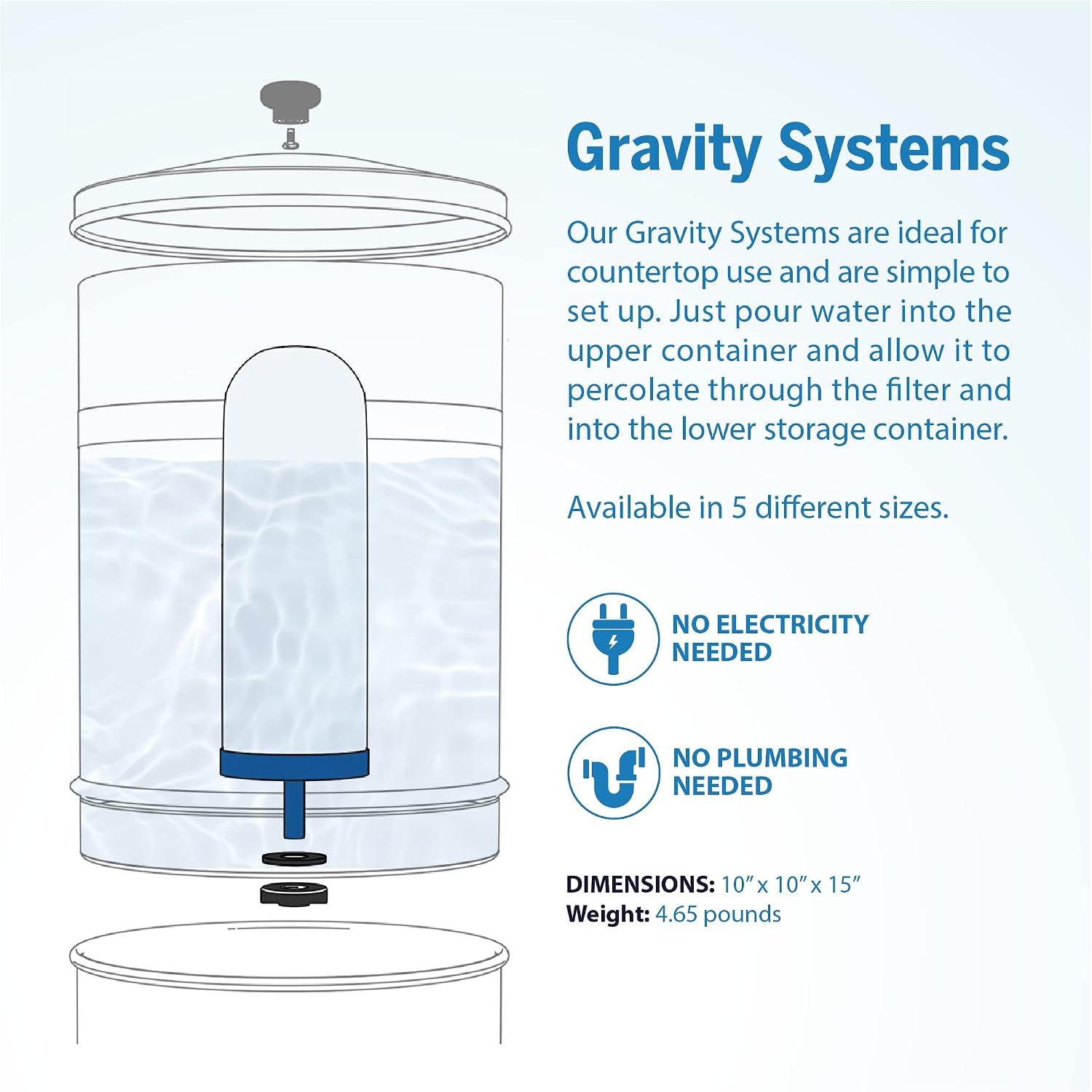
A gravity water filter is exactly what it sounds like: you pour untreated water into a top chamber, gravity pulls it down through one or more filter elements, and clean water collects in a lower chamber you can pour from — no electricity, no pump, no plumbing required. That simplicity is the entire point. Whether you’re building a 72-hour emergency kit for your apartment, stocking a suburban home for a multi-week disruption, or running a basecamp setup for backcountry trips, a countertop gravity filter gives you drinking water independence the moment tap water becomes unreliable or suspect. FEMA’s ready.gov emergency water supplies guidance recommends storing one gallon of water per person per day as a minimum, and notes that purification capability is even more valuable than stored supply for anything beyond a short outage, because storage eventually runs out. This guide walks through three systems that dominate the mid-market: the Big Berkey, the Waterdrop Gravity Filter, and the Purewell Gravity Filter. We’ll go spec by spec, flag the real ownership patterns buyers consistently report, and give you a clean decision rule at the end.
| EDITOR'S PICKBig Berkey Gravity-Fed Stainles… | Mid-tierProOne Big+ Gravity Water Filte… | Budget pickFilterlogic Gravity Water Filter | |
|---|---|---|---|
| Capacity | 2.25 gal | — | — |
| Material | Stainless steel | Stainless steel | — |
| Filters incl. | 2 | — | 2 |
| Filter type | Black Berkey BB9-2 | — | Black carbon |
| Certified | — | IAPMO | NSF/ANSI 42 & 372 |
| Compatibility | Berkey BB9-2 | — | Berkey, Purewell, ProOne, Waterdrop |
| Price | $367.00 | $181.98 | $29.99 |
| See on Amazon → | See on Amazon → | See on Amazon → |
What the Specs Actually Mean Before You Buy
Before diving into the three-way comparison, two terms are worth pinning down, because manufacturers use them inconsistently and the difference has real consequences.
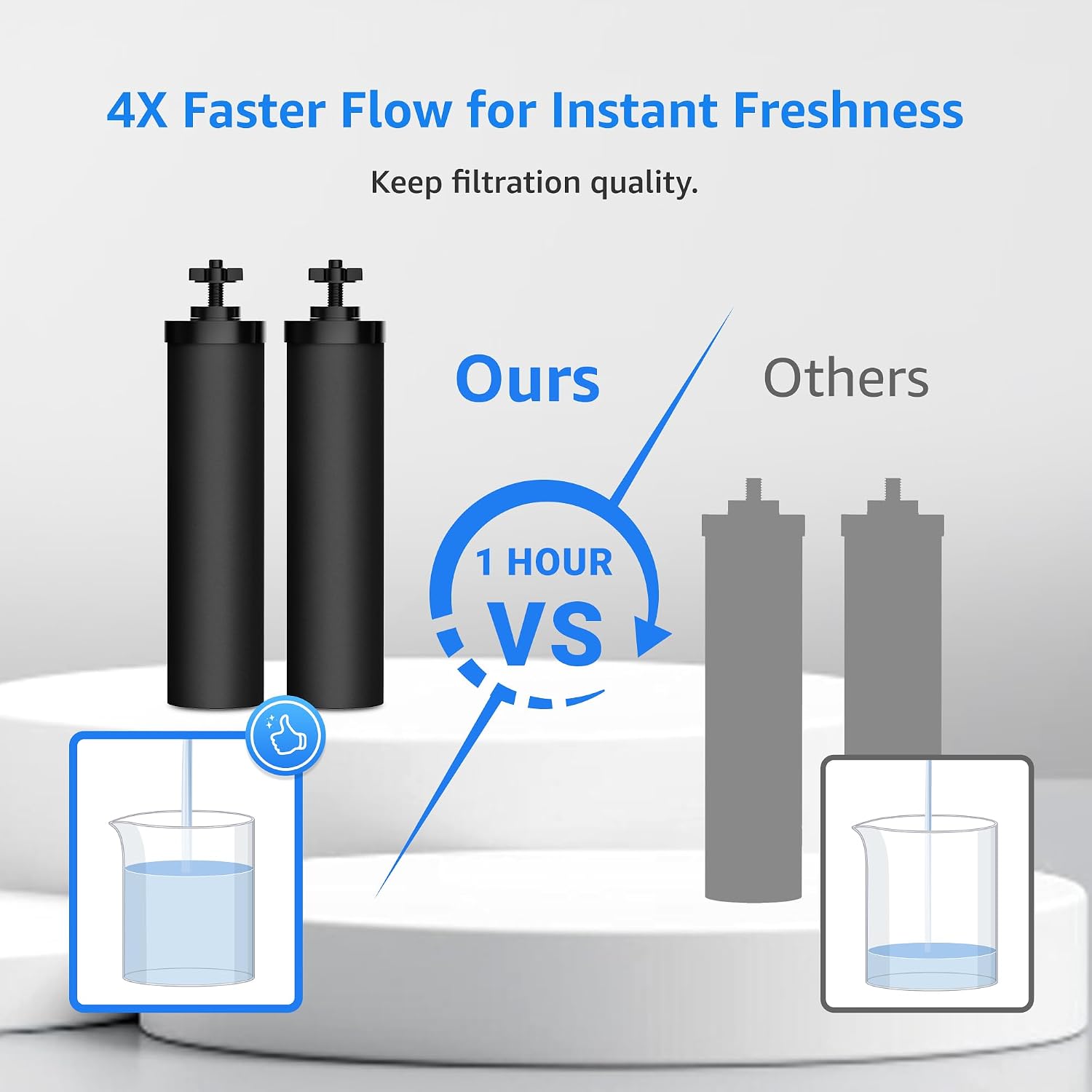
Flow rate is how many gallons per hour the system produces under normal gravity conditions — full upper chamber, clean filters. Manufacturers rate this at peak, meaning a new filter and full tank, often under ideal source water conditions. Owners consistently report that real-world flow is 30–50% slower, especially as filters load up with sediment or as you draw from harder water. Popular Mechanics’ 2024 article “How Gravity Water Filters Actually Work” confirms that flow rate degrades predictably with filter age and source water quality, and that the spec-sheet number is a ceiling, not a steady-state figure.
Filter certification matters more than the marketing copy on the box. NSF International runs the most recognized independent certification program for water filters in North America. NSF/ANSI Standard 42 covers aesthetic contaminants — chlorine taste and odor, particulates. Standard 53 covers health-related contaminants: lead, cysts like Giardia and Cryptosporidium, and certain volatile organic compounds. A filter claiming to remove lead or cysts without NSF 53 certification is making an unverified claim. Wirecutter’s “The Best Water Filters” buying guide consistently flags NSF certification status as a first-pass screening criterion before evaluating anything else in the category.
Holding capacity — the total volume the lower chamber stores — determines how often you’re refilling the upper tank. For a family of four consuming the FEMA-recommended gallon per person per day for drinking and cooking, a 2.25-gallon system means roughly two refill cycles daily. A 3-gallon system can get you through a full day on a single fill under moderate demand.
Head-to-Head: Three Systems, Three Tiers
The comparison below breaks each system into its own section with the tradeoffs that matter most to emergency preparedness buyers and everyday users alike. After the three sections, a summary table pulls the key numbers together.
Big Berkey: The Long-Track Record System
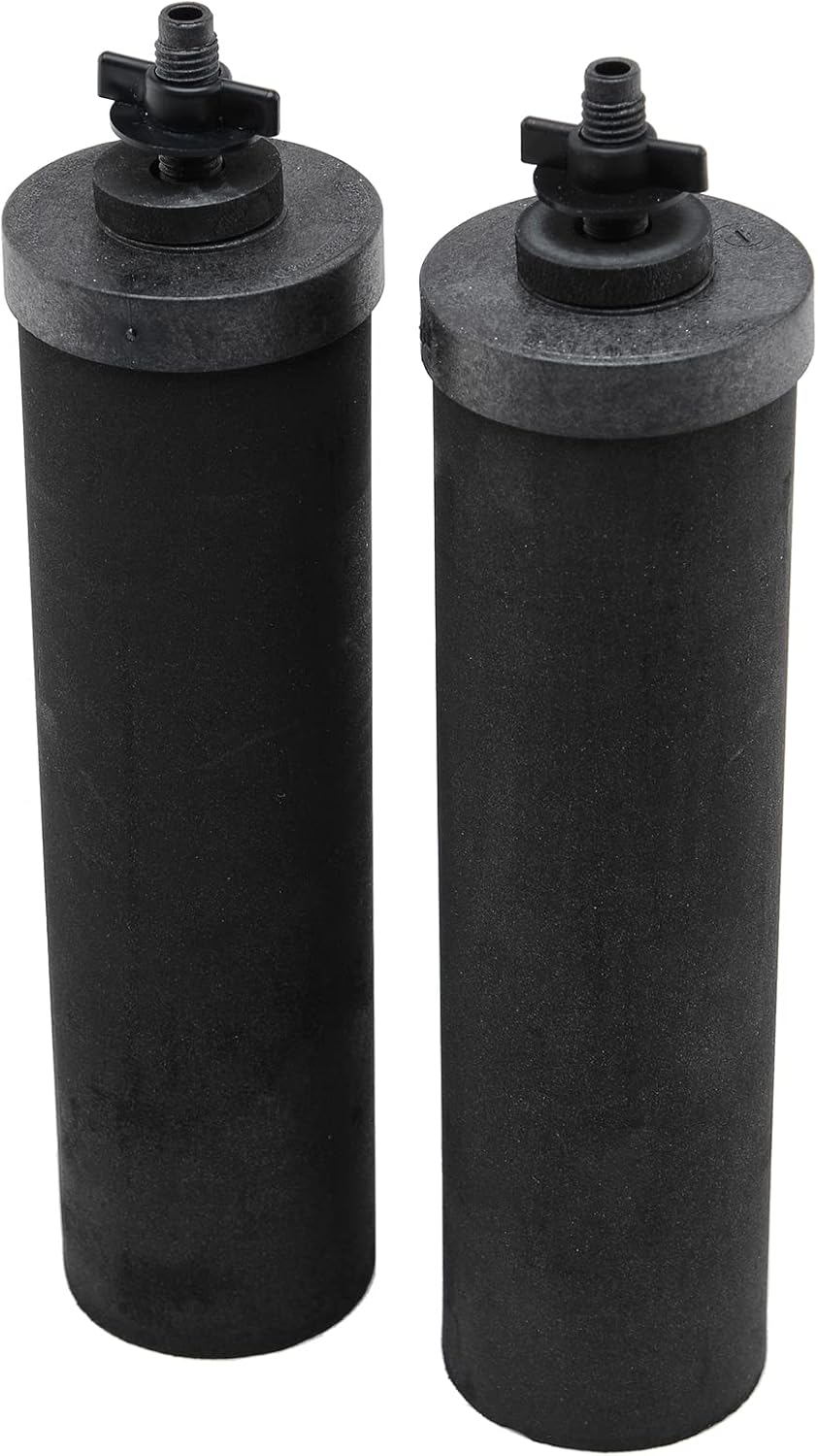
The Big Berkey has been on the market long enough to accumulate a substantial ownership record, and that record is genuinely useful for cutting through the marketing. The system holds 2.25 gallons, ships with two Black Berkey filter elements (upgradeable to four), and is rated by the manufacturer for up to 6,000 gallons per element pair before replacement.
By the numbers — Big Berkey:
- Capacity: 2.25 gallons (upper + lower combined)
- Filter life: Up to 6,000 gallons per pair of Black Berkey elements
- Manufacturer-claimed flow rate: approximately 1 gallon per hour with 2 elements; approximately 3.5 gallons per hour with 4 elements
- Filter replacement cost: approximately $130–$150 per pair (mid-2026 pricing)
- Cost per gallon (filter media only): approximately $0.022–$0.025 per gallon at rated life
The Black Berkey elements are where the reputation lives — and also where the scrutiny lives. The manufacturer claims removal of bacteria, viruses, heavy metals including lead and arsenic, pesticides, and pharmaceuticals. However, NSF International certification for the Black Berkey elements has been a persistent question in the owner community. As of this writing, Black Berkey elements are not NSF 53 certified for the full contaminant list the marketing implies. The manufacturer has conducted and published their own testing, but Consumer Reports’ Water Filter Buying Guide (2025 edition) consistently distinguishes between manufacturer self-testing and independent third-party certification, noting that buyers should weight those two categories differently when making health-related purchasing decisions.
What owners consistently praise: the stainless steel construction is genuinely durable and carries a long ownership ceiling, the modular design lets you upgrade from two to four filters without buying a new housing, and the ecosystem of add-on filters — fluoride reduction elements, post-filter stages — gives it configurability the other two systems lack. Wirecutter’s “The Best Water Filters” guide acknowledges that the Big Berkey’s accessory ecosystem is among the most developed in the countertop gravity segment.
What owners flag as friction: priming the filters before first use takes 20–30 minutes and is fiddly if you follow the instructions closely. The system also sits tall — owners in apartments with low cabinet clearance consistently note it doesn’t fit under standard upper cabinets once the spigot clearance is factored in.
[PRODUCT_BIG_BERKEY_GRAVITY_FILTER — affiliate]
Big
$367.00
In stock on Amazon
Check price on AmazonWaterdrop Gravity Filter: NSF-Certified at a Mid-Tier Price
Waterdrop entered the countertop gravity segment more recently, and their strategy is straightforward: lead with NSF certification, price below Big Berkey, and target buyers who do the research. The Waterdrop Gravity Filter system carries NSF/ANSI 42 and 53 certification — independently verified contaminant reduction claims, not self-reported testing. That is a meaningful differentiator for buyers who prioritize verifiable performance over marketing breadth.
The system holds approximately 2 gallons, with a manufacturer-rated flow of around 1–2 gallons per hour depending on filter age and source water. Filter life is rated at 2,000 gallons per element, which is lower than the Big Berkey’s claimed ceiling. That shorter filter life is the primary tradeoff against the lower upfront cost — the cost-per-gallon math narrows considerably when you factor replacement filters over a multi-year horizon.
Filter replacement economics (Waterdrop vs. Big Berkey, simplified):
- Waterdrop filter replacement: approximately $35–$45 per element, rated 2,000 gallons → approximately $0.018–$0.022 per gallon
- Big Berkey pair replacement: approximately $130–$150, rated 6,000 gallons → approximately $0.022–$0.025 per gallon
- At face value these figures are close — but the Big Berkey’s unverified certification changes the value calculation depending on how much weight you place on NSF third-party verification
Owners who come from a preparedness background and have worked through the NSF certification debate consistently report landing on Waterdrop when they want certified performance without debating the fine print. The stainless steel housing is present on higher-tier Waterdrop configurations; some entry models use BPA-free plastic, which owners in long-run reviews occasionally flag as a concern in hot storage environments like vehicles or garages.
The Waterdrop system’s most commonly cited limitation in owner feedback: the filter ecosystem is less mature. There are fewer add-on options, and the brand’s track record for long-term parts availability is shorter than Berkey’s. For a 72-hour kit or a one-year supply buffer, that is a low-stakes concern. For a 10-year preparedness investment, it is worth weighting.
[PRODUCT_WATERDROP_GRAVITY_WATER_FILTER — affiliate]
ProOne
$181.98
In stock on Amazon
Check price on AmazonPurewell Gravity Filter: The Budget Entry Point and Its Ceiling
Purewell occupies the entry tier in this comparison — system prices sit roughly $30–$60 below Waterdrop, and well below Big Berkey’s upfront cost. For apartment dwellers or first-time kit builders who want countertop gravity filtration without committing to a premium price, Purewell is the most common starting point reviewers encounter in the category.
The Purewell system typically ships with hollow-fiber filter membranes rated to 0.1-micron filtration, which is sufficient to remove bacteria and cysts — Giardia and Cryptosporidium — but does not address viruses, an important distinction in certain emergency scenarios. Popular Mechanics’ 2024 article “How Gravity Water Filters Actually Work” notes that hollow-fiber membranes at 0.1 micron are the most common filter type in entry-tier systems, and that their limitation with viruses is well-documented and should factor into any scenario planning that involves compromised municipal water or surface water sources.
NSF certification status on Purewell varies by SKU and is worth confirming at the time of purchase. Some configurations carry NSF 42 certification covering aesthetic contaminants; NSF 53 health claims require checking the specific model’s documentation before assuming coverage.
Where Purewell earns consistent positive reviews: simplicity, portability, and low barrier to entry. The system is lighter than stainless alternatives, sets up in under five minutes with no priming ritual, and fits under standard kitchen cabinets without clearance issues. For an overlander who wants a compact system that deploys fast at basecamp, or an apartment dweller assembling a first kit on a constrained budget, the ownership reports lean positive.
Where the ceiling shows: filter life is typically rated at 1,000–1,500 gallons per element, the lowest of the three systems reviewed here. Long-run owners who push past the first filter replacement cycle sometimes find that cost savings erode faster than expected, and a portion of reviewers note that flow rate degradation is more noticeable as filters approach end-of-life compared to higher-end elements.
[PRODUCT_PUREWELL_GRAVITY_WATER_FILTER — affiliate]
Filterlogic
$29.99
In stock on Amazon
Check price on AmazonSummary Comparison and the Decision Rule
| Spec | Big Berkey | Waterdrop | Purewell |
|---|---|---|---|
| Capacity | 2.25 gal | ~2 gal | ~1.5–2 gal |
| NSF 53 certified | No (manufacturer-tested) | Yes | Varies by SKU |
| Filter life (rated) | 6,000 gal/pair | 2,000 gal | 1,000–1,500 gal |
| Build material | Stainless steel | Stainless or plastic | Plastic |
| Priming required | Yes (20–30 min) | Minimal | Minimal |
| Virus reduction | Claimed, not NSF-verified | NSF-verified | Not addressed |
| Ecosystem depth | High | Moderate | Low |
| Entry price range | $$$ | $$ | $ |
The decision logic here is cleaner than most gear categories.
If NSF-verified contaminant reduction is your non-negotiable — you’re filtering for a household with immunocompromised members, you want documentation that holds up in an emergency briefing, or you simply don’t want to read competing testing documents — the Waterdrop is the defensible call. NSF-certified performance at a mid-tier price is the strongest verifiable position in this category right now. Consumer Reports’ Water Filter Buying Guide (2025 edition) reinforces that independent certification status should be the primary screening criterion before weighing price, flow rate, or ecosystem depth.
If you’re building a long-horizon preparedness system and want maximum configurability — you plan to add fluoride filters, scale to four filter elements for higher throughput, or want a stainless housing you expect to still be running in a decade — the Big Berkey is worth the premium, with the explicit understanding that you’re trusting manufacturer testing on the full contaminant claims rather than NSF verification. The ownership record is long, the ecosystem is real, and Wirecutter’s “The Best Water Filters” guide acknowledges the Big Berkey’s dominant position in the long-run preparedness segment despite the certification gap.
If you’re a first-kit builder on a tight budget, an overlander who needs compact and lightweight, or someone assembling a 72-hour emergency kit before deciding to scale — Purewell gets you into the category without overcommitting. Understand the virus limitation of hollow-fiber membranes, verify the NSF documentation on the specific SKU you’re buying, and treat it as a starting point rather than a terminal system.
One number worth keeping in mind regardless of which system you choose: FEMA’s ready.gov emergency water supplies guidance sets one gallon per person per day as the minimum for drinking and basic sanitation needs. A family of four needs 4 gallons daily. Map your chosen system’s real-world output — not the manufacturer-rated peak — against that number before you buy, and size up if the math is close. The filter that looks adequate on paper can fall short fast when a weather event stretches from 48 hours into a week.