A portable water filter is exactly what it sounds like: a device small enough to carry in a pack that removes harmful microorganisms — bacteria, protozoa, and in some cases viruses — from untreated water sources like rivers, lakes, or even questionable tap water abroad, making it safe to drink without boiling. For anyone building a 72-hour emergency kit, preparing for backcountry travel, or assembling a go-bag for international trips, it’s one of the most consequential pieces of gear you’ll choose. Get it wrong and you’re either sick, thirsty, or both. This article breaks down three filters that consistently appear at the top of buyer shortlists — the GRAYL GeoPress, the Katadyn Hiker Pro, and the Sawyer Mini — with enough detail to make a confident, scenario-specific decision. If you already know what a micron rating is and you’ve heard the squeeze-filter pitch before, you’re in the right place.
The Core Tradeoff: Speed, Weight, and Threat Coverage
Before comparing these three head-to-head, it’s worth naming the axis that actually decides the winner for most buyers: what biological threats does the water source carry, and how fast do you need clean water in hand?
Bacteria and protozoa (like Giardia and Cryptosporidium) are the threats present in virtually every backcountry water source in North America. Viruses — norovirus, hepatitis A, rotavirus — are less common in remote wilderness but become a real concern in international travel destinations, disaster-affected municipal supplies, and densely populated backcountry areas with high human traffic. This distinction matters enormously because most filters on the market, including the Sawyer Mini, are not rated for virus removal. The GRAYL GeoPress is.
That single fact often ends the debate for a specific buyer. Here’s the rest of the picture.
Side-by-Side Specifications
| GRAYL GeoPress | Katadyn Hiker Pro | Sawyer Mini | |
|---|---|---|---|
| Weight | 10.9 oz | 11 oz | 2 oz |
| Rated throughput | 65 gallons per cartridge | 750 liters (~200 gallons) per filter | 100,000 gallons lifetime |
| Virus removal | Yes (purifier-rated) | No | No |
| Flow method | Press (like a French press) | Pump | Squeeze or inline |
| Output per cycle | 24 oz | Continuous | Continuous (variable) |
| Best scenario | Travel, disaster, viral risk | Group camp, high volume | Solo hike, ultralight build |
The Three Filters, Head to Head
GRAYL GeoPress: The Traveler’s Purifier in a Bottle
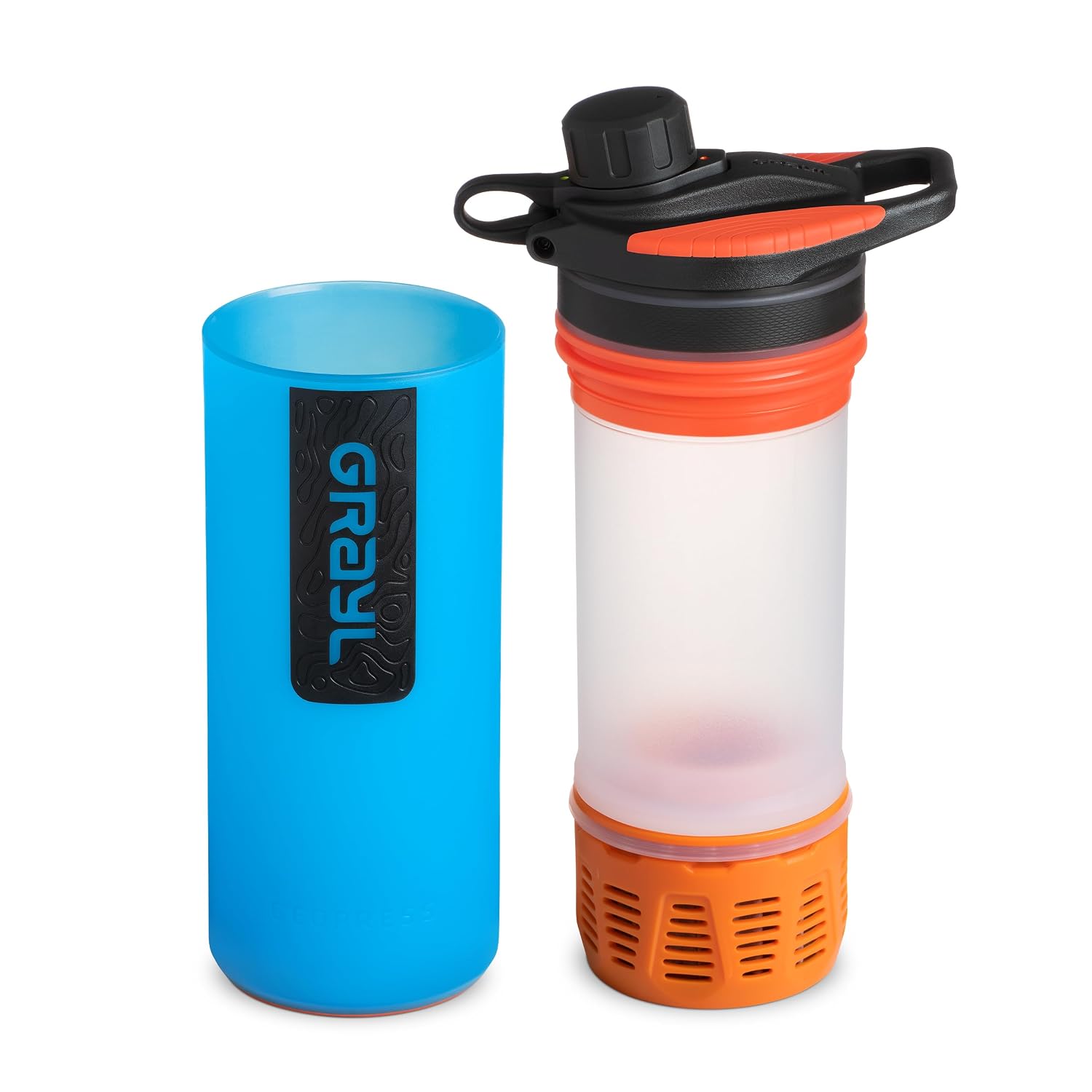
The GRAYL GeoPress works on a principle most people grasp instantly: you fill the outer vessel with raw water, insert the inner press, and push down. Twenty-five seconds later, you have 24 ounces of purified water. No hoses, no pumping motion, no chemical wait time.
According to GRAYL’s own product documentation and cartridge replacement guidance, the GeoPress meets NSF Protocol P231 standards for virus removal — the threshold that elevates it from a filter to a true purifier, and the single most important technical distinction separating it from the other two options in this comparison. Wirecutter’s water filter buying guide specifically identifies virus-removal certification as the key differentiator for international travelers and disaster-preparedness scenarios, noting that most mainstream backcountry filters do not meet this standard.
Owners consistently report successful use with visibly murky and sediment-heavy backcountry water. International travelers frequently cite the GeoPress as daily-carry insurance when using hotel or resort tap water in regions where they wouldn’t trust the municipal supply — a legitimate use case given the purifier rating.
The tradeoffs are real. Press resistance is the most documented complaint: the cartridge requires meaningful downward force through both palms, and that resistance increases as the cartridge ages and clogs. Users with hand or wrist fatigue, limited grip strength, or arthritis flag this as a genuine barrier. REI Expert Advice, in its guide “How to Choose a Water Filter or Purifier” (available at rei.com/learn), notes that press-style purifiers demand more physical effort than gravity or squeeze systems, particularly as filter media approaches end of life. Cartridge capacity is the second consideration: at 65 gallons before replacement, the cost-per-gallon math is higher than either competitor. For travel use where you’re filtering one or two bottles per day, that math rarely matters. For sustained backcountry use measured in hundreds of gallons, it adds up.
GRAYL’s documentation recommends pre-filtering heavily sediment-laden water through a bandana or cloth before pressing, which meaningfully extends cartridge life and reduces resistance over the 65-gallon rated span.
Best for: International travel, post-disaster urban environments where viral contamination is plausible, solo travelers who want one device to cover all threat categories.
GRAYL
$99.95
In stock on Amazon
Check price on AmazonKatadyn Hiker Pro: The Reliable Pump for Group Water or Murky Sources
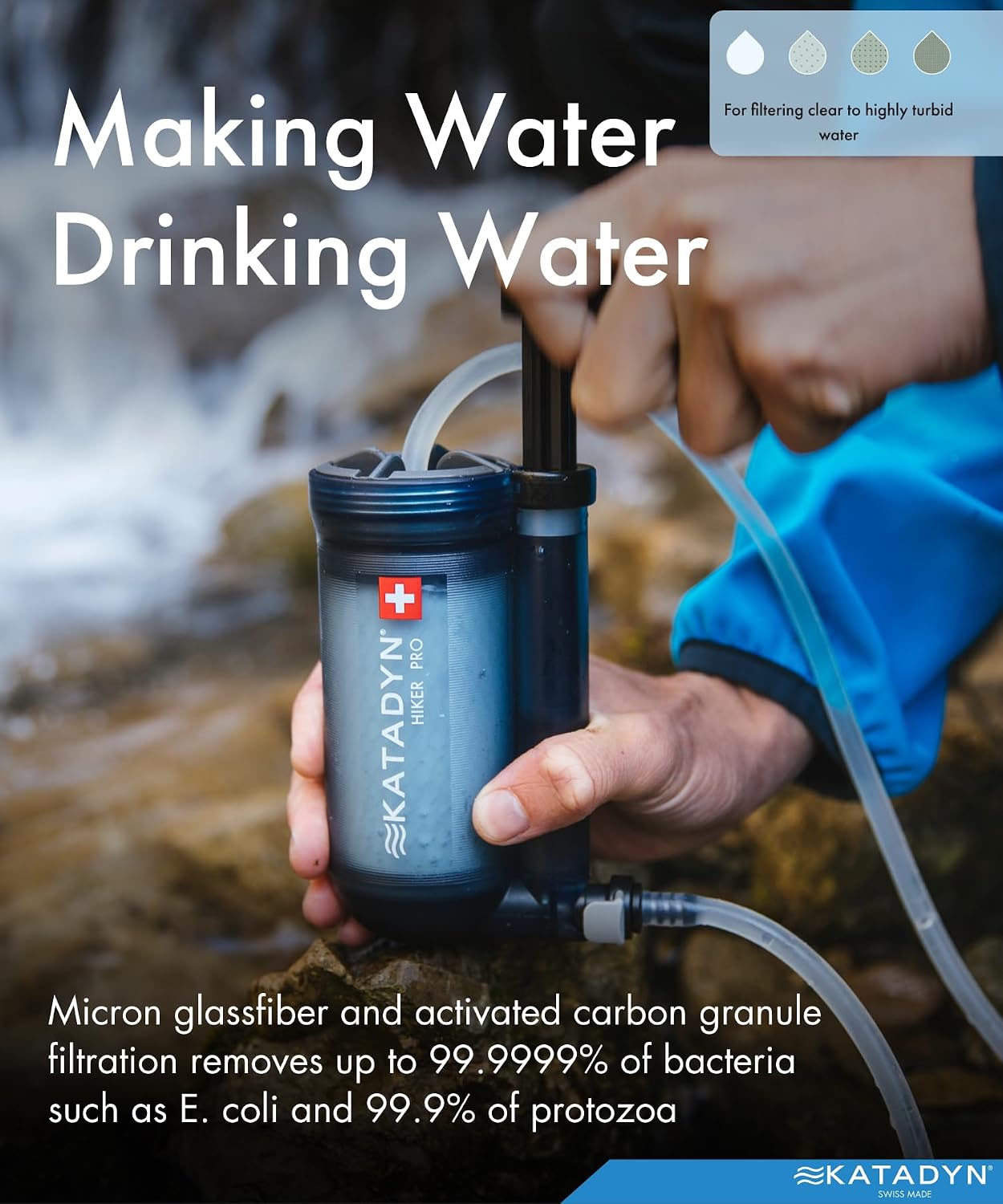
The Katadyn Hiker Pro is a pump filter — one hose in the source water, the other in your bottle or reservoir, and a lever you pump to push water through the cartridge. Katadyn’s product specification sheet rates flow at approximately one liter per minute, a figure that holds up across owner accounts even with brown, sediment-heavy river water. Backpacker Magazine’s annual “Best Water Filters” roundup (backpacker.com) consistently places the Hiker Pro in the group and base-camp tier precisely because the pump mechanism can sustain volume output that squeeze-style filters cannot match over extended sessions.
At 11 ounces, the Hiker Pro is nearly identical in weight to the GeoPress — a fact that surprises some buyers who expect a pump unit to be heavier. The difference is form factor: the Hiker Pro is a standalone pump, not an all-in-one bottle. That means you need separate water containers, which adds system complexity but also flexibility — you can pump directly into any vessel, including wide-mouth bottles and hydration reservoirs.
Filter lifetime runs to 750 liters (roughly 200 gallons) per cartridge — approximately three times the GeoPress cartridge lifespan by volume, and at a lower cost-per-liter. For a family using this regularly across a camping season, or a household keeping it in a vehicle emergency kit, that longevity is a meaningful budget advantage. Outside Online’s portable water filter coverage (outsideonline.com) has highlighted the Hiker Pro’s cartridge economy as a primary reason it remains competitive despite being an older pump-style design in a market increasingly dominated by squeeze and gravity systems.
The honest downsides: pumping is physical work, and the mechanism introduces failure points — O-rings, hose connections, the lever itself — that simpler filters avoid. For solo bug-out use, 11 ounces of dedicated pump hardware is harder to justify against ultralight alternatives. Like the Sawyer Mini, it is not rated for virus removal.
Best for: Group camping, family preparedness kits, filtering high daily volumes from murky backcountry sources, vehicle emergency bags.
Katadyn
$74.89
In stock on Amazon
Check price on AmazonSawyer Mini: The Ultralight Workhorse (With a Pairing Caveat)
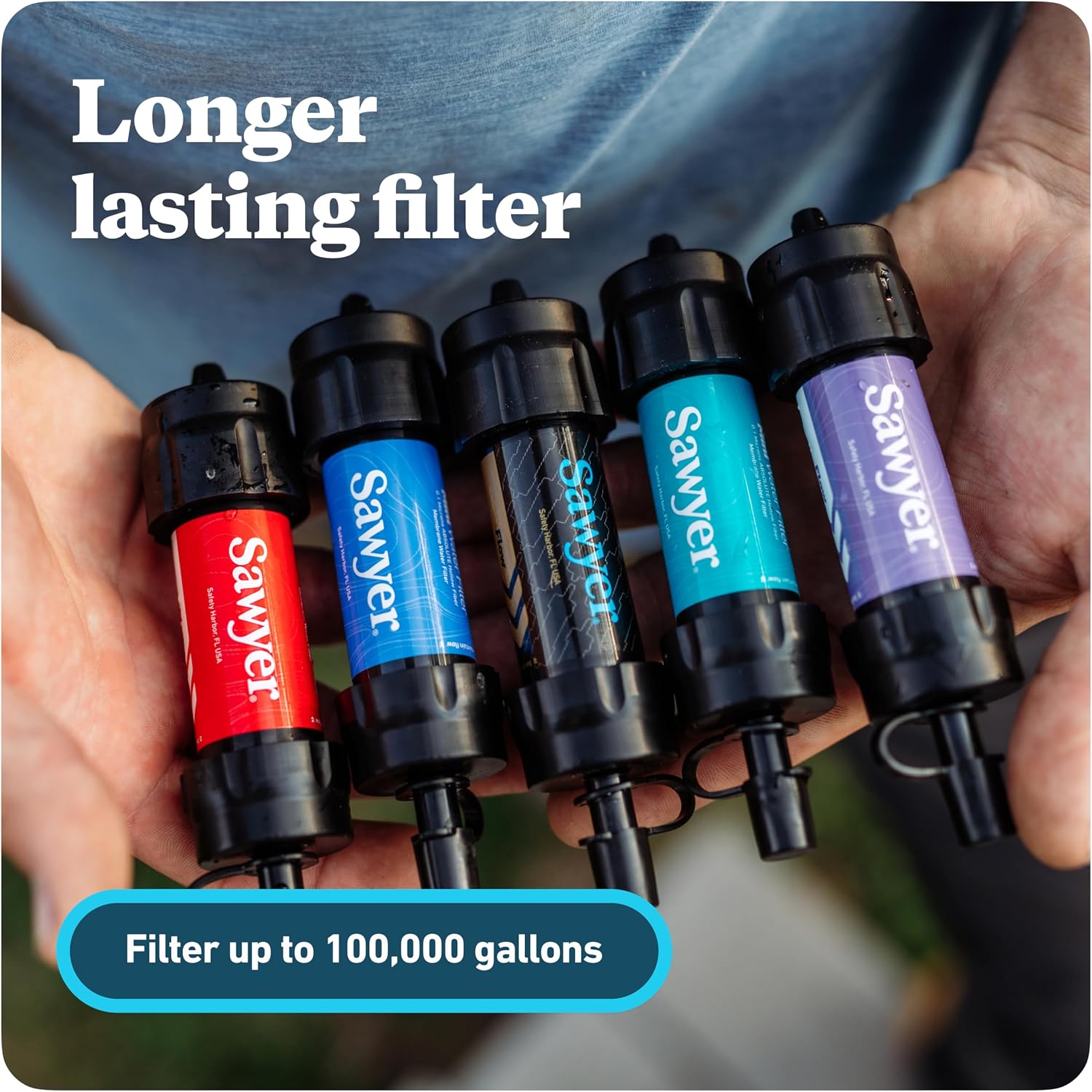
The Sawyer Mini weighs 2 ounces. That number is genuinely difficult to argue against for solo hikers and anyone building a lightweight bug-out bag. It uses a hollow-fiber membrane rated to 0.1 micron — finer than the 0.3-micron rating on the Hiker Pro — and Sawyer’s owner documentation rates its lifetime at 100,000 gallons, a figure so large it effectively means the filter outlasts the user’s interest in keeping track.
Here’s where practitioner-level knowledge changes the picture: the Sawyer Mini’s real-world flow rate is slow when used with the included squeeze pouch, and that pouch is the weak link in the system. REI Expert Advice’s guide “How to Choose a Water Filter or Purifier” (rei.com/learn) flags squeeze pouch durability as a known limitation of this filter category, noting that pouch failure rather than filter failure is the typical failure mode for squeeze-style systems. The standardized fix among experienced Sawyer owners is pairing the Mini inline with a CNOC Vecto 2L collapsible bladder — a separate purchase. That combination transforms the Mini’s flow experience: the Vecto’s wide-mouth opening enables fast filling from streams and lakes, its durable construction sustains squeeze pressure over thousands of uses, and the overall system becomes genuinely capable rather than merely adequate.
The Mini also works inline with most hydration bladder systems, threading between the reservoir and the drinking tube. For hands-free filtration while moving, this is a useful configuration that the GeoPress and Hiker Pro cannot replicate. Wirecutter’s water filter buying guide (wirecutter.com) identifies inline compatibility as one of the Sawyer Mini’s primary advantages for through-hikers and long-distance trail runners who don’t want to stop and manually filter.
The hard ceiling: the Sawyer Mini removes bacteria and protozoa. It does not remove viruses. For North American backcountry use, this is generally an acceptable risk — Outside Online’s filter coverage notes that viral contamination in remote U.S. wilderness is rare enough that most backcountry travelers accept this gap. For international travel or post-disaster scenarios, it is not acceptable.
Best for: Solo backcountry travel, ultralight builds, backup filter roles, through-hiking — paired with the CNOC Vecto 2L bladder, which should be considered part of the system rather than an optional upgrade.
Sawyer
$28.99
In stock on Amazon
Check price on AmazonFrequently Asked Questions
Which of these filters removes viruses?
Only the GRAYL GeoPress. It meets NSF Protocol P231 standards for virus removal, making it a true purifier. Both the Katadyn Hiker Pro and the Sawyer Mini remove bacteria and protozoa but are not effective against viruses. If your use case involves international travel, developing-world water sources, or post-disaster municipal water of unknown quality, the GeoPress is the only option in this comparison that addresses all three threat categories. FEMA’s emergency preparedness guidance (fema.gov) notes that waterborne viral pathogens become a meaningful risk following infrastructure disruptions — a scenario where purifier-rated devices matter.
Does the Sawyer Mini work inline with a hydration bladder?
Yes. The Mini threads directly into standard hydration bladder drinking tubes and works in that configuration. Owners report that the included squeeze pouch — not the filter itself — is the weak point of the standard setup. The near-universal upgrade among experienced Sawyer users is the CNOC Vecto 2L bladder, which pairs with the Mini as a gravity or squeeze system and dramatically improves both flow rate and long-term durability. Buy them together; treating the Vecto as optional means accepting the included pouch’s limitations.
Is the Katadyn Hiker Pro too heavy for a solo bug-out bag?
For most solo builds, yes. At 11 ounces with a dedicated pump mechanism, it fits better in group kits, vehicle emergency bags, or base-camp setups where volume output and filter longevity matter more than pack weight. For a solo 72-hour bag, the Sawyer Mini wins on weight by a factor of five; the GeoPress wins on threat coverage. The Hiker Pro’s value proposition is group throughput and cartridge economy, neither of which applies to a solo minimalist build.
Can someone with limited grip strength operate the GRAYL GeoPress?
This is a documented concern. The GeoPress requires sustained downward force through both palms — resistance increases as the cartridge ages. REI Expert Advice’s filter guide (rei.com/learn) notes that press-style devices demand more physical exertion than gravity-fed alternatives, and that this effort compounds as filter media clogs. For users with wrist, hand, or arthritis limitations, the Sawyer Mini’s squeeze method or the Katadyn’s pump lever — which engages a different muscle group — may be more accessible, though neither offers virus removal.
How long does the GRAYL cartridge last under daily travel use?
GRAYL’s product documentation rates the cartridge at 65 gallons (approximately 250 liters). For a single traveler filtering one to two 24-ounce bottles per day — a realistic hotel and transit scenario — that works out to roughly 100–130 days of daily use before replacement. Heavy backcountry users pushing multiple fills per day will reach replacement significantly sooner. GRAYL sells replacement cartridges separately, and the replacement cost should be factored into total ownership math for frequent travelers.
The Decision Rule
The decision usually resolves cleanly once you map filter to scenario:
- Virus risk is present — international travel, disaster scenario, or uncertain municipal supply → GRAYL GeoPress. No substitute in this group for full-spectrum coverage.
- Group use, high daily volume, murky backcountry sources → Katadyn Hiker Pro. The pump throughput and long cartridge life justify the form factor for anything beyond solo use.
- Solo hiking, ultralight bag, North American backcountry → Sawyer Mini, paired with the CNOC Vecto 2L bladder. Purchase them as a system.
- Solo travel where one filter must cover all scenarios → GeoPress is the premium call, with the understanding that you’re paying for virus coverage and accepting higher cartridge replacement costs over time.
None of these is a wrong answer in its correct context. The mistake is applying the wrong filter to the wrong scenario — buying ultralight because it’s cheap and ending up somewhere with viral risk, or buying a group pump for a solo bag that never gets packed because it’s too heavy. Match the tool to the threat, and this decision is straightforward.