A portable water filter is any device small enough to carry in a pack that turns questionable water from a stream, lake, or emergency barrel into something safe to drink by physically removing bacteria, protozoa (think Giardia and Cryptosporidium), and in some cases sediment. If you have ever built a 72-hour emergency kit or planned a backcountry trip, you have almost certainly hit the same wall: the gear aisle offers hand pumps, gravity bags, and squeeze filters, and the packaging on all three says “removes 99.9999% of bacteria” — so how are they actually different? The short answer is that each design solves a different problem. Hand pumps work on demand regardless of your setup. Gravity bags do the work for you while you sleep or cook, but they need somewhere to hang. Squeeze filters are the lightest option but require manual effort at volume. This article maps those tradeoffs to the situations you are most likely to face — moving fast, managing a group, or running a vehicle-based camp — so you can buy once and buy right.
| EDITOR'S PICKPlatypus GravityWorks Group Cam… | Mid-tierKatadyn Hiker Pro Hand Pump Wat… | Budget pickSawyer Products Mini Water Filt… | |
|---|---|---|---|
| Filter type | Gravity bag | Hand pump | Squeeze |
| Capacity | 6 L | — | — |
| Pouches incl. | — | — | ✓ |
| Storage bag | ✓ | — | — |
| Group size | Group | Solo | Solo |
| Price | $154.95 | $74.89 | $28.99 |
| See on Amazon → | See on Amazon → | See on Amazon → |
The Decision Frame: Movement Changes Everything
The single most important variable is whether you are stationary or mobile at the moment you need clean water. Every other spec — flow rate, filter life, packed size — falls out of that answer. The three main filter types divide cleanly along that axis, and understanding where each sits mechanically is what makes the comparison table and per-scenario guidance below actually useful.
Stationary situations favor gravity filters: you have time, you have something to hang from, and you want clean water without burning any energy. Moving situations favor pump or squeeze designs: you need water now, at a specific source, with no setup infrastructure. That single distinction explains why experienced overlanders, backpackers, and emergency-preparedness planners often end up owning more than one filter type — not because they failed to research, but because the right answer depends on context.
The Three Filter Types, Evaluated
Hand Pump Filters: On-Demand Reliability
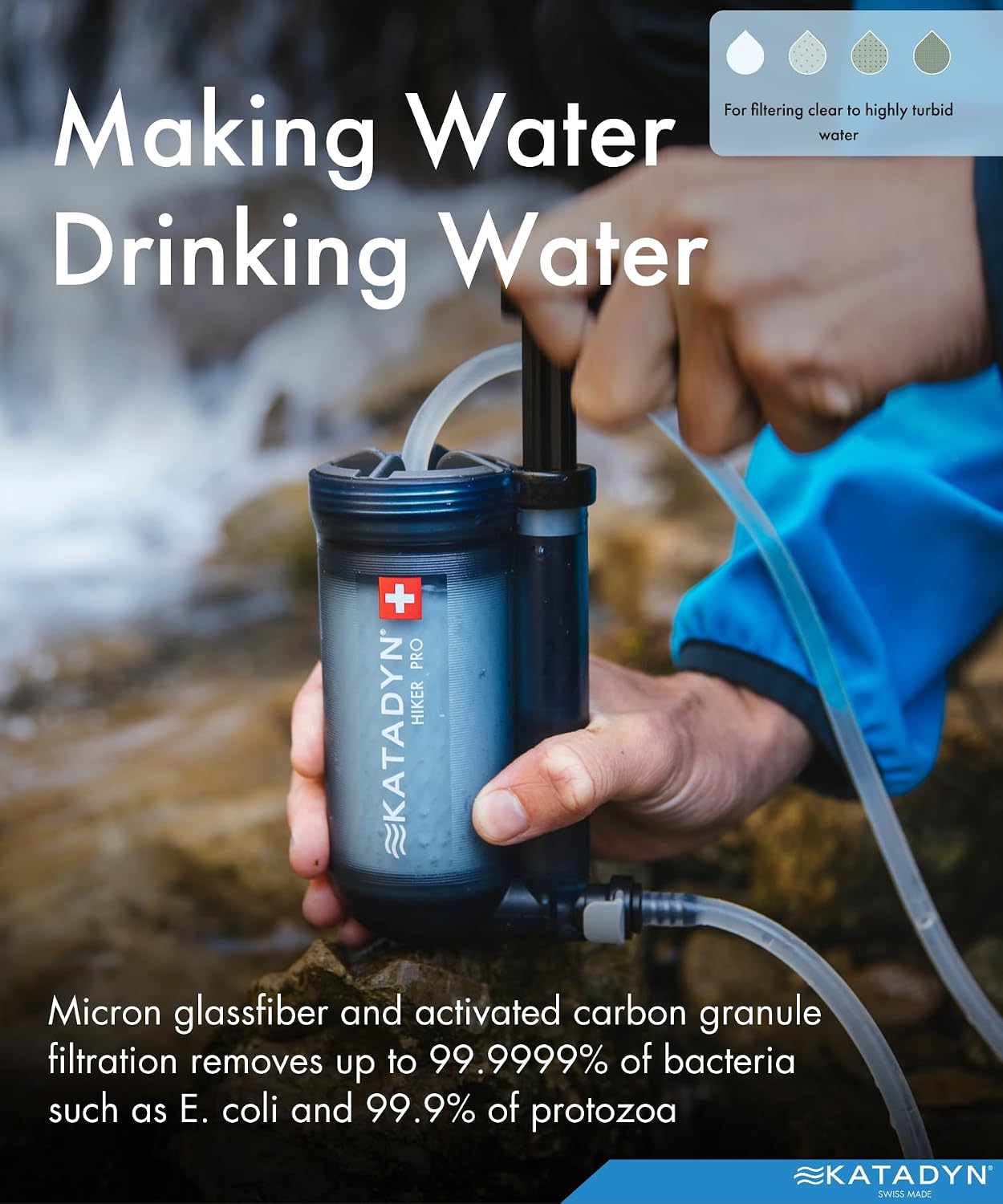
The Katadyn Hiker Pro is the category benchmark that Wirecutter (New York Times, “The Best Water Filter for Backpacking”), REI Co-op Learn (“How to Choose a Water Filter or Purifier”), and Backpacker Magazine all return to when evaluating pump-style filters for general-purpose backcountry and emergency use. The mechanics are simple: dip the intake hose into any water source, pump the handle, and clean water comes out the other end into whatever container you have on hand. You do not need a tree branch to hang anything from, a flat surface to set anything on, or two free hands for longer than the thirty seconds it takes to get started.
That operational flexibility is why the Katadyn Hiker Pro keeps appearing in emergency-preparedness coverage alongside backcountry reviews. REI Co-op Learn’s water filter buying guide (“How to Choose a Water Filter or Purifier,” rei.com/learn) notes that hand pumps are the most versatile filter form factor for unpredictable sourcing situations — a meaningful endorsement for anyone building a kit that needs to work equally well at a trailhead water source and a post-storm neighborhood puddle.
According to Katadyn’s published product documentation (Hiker Pro user manual and filter specification sheet), the Hiker Pro filters at approximately one liter per minute and its replaceable cartridge is rated for 300 liters. Katadyn’s maintenance guidance recommends backflushing the filter element after each use, allowing it to air-dry before storage, and periodically lubricating the pump O-ring with food-safe silicone grease — a packet of which ships with the filter. Neglecting the O-ring lubrication is the most consistently reported cause of a stiff, fatiguing pump action in long-run owner documentation.
The tradeoff the Hiker Pro asks you to accept is effort. Pumping roughly a liter per minute does not feel like work for the first two liters. For five people over two days, it starts to feel like a chore — which is the honest reason group travelers often look past it toward gravity options.
Katadyn
$74.89
In stock on Amazon
Check price on AmazonGravity Bag Filters: Passive Volume for Groups and Basecamps
Gravity bag filters require you to hang a dirty-water reservoir at least two to three feet above your clean-water container and wait. Flow rate is entirely passive and depends on head pressure and filter cleanliness. Two models dominate this category for different use cases.
Platypus GravityWorks 4L is the most-reviewed high-volume option and the filter that Outside Online (“Best Backpacking Water Filters,” outsideonline.com) and Backpacker Magazine most frequently cite when covering group camping filtration. According to Cascade Designs’ published product specifications (GravityWorks product page and flow-rate specification sheet), the GravityWorks is rated at approximately 1.5 liters per minute under ideal head pressure, which puts a full four-liter fill at roughly two and a half to three minutes of unattended hang time. The filter element is rated to 1,500 liters. Users managing groups of ten or more consistently report that the volume capacity handles the load without the filter slowing noticeably until sediment accumulation sets in; backflushing restores most of the original flow rate.
The near-universal minor frustration documented across GravityWorks reviews is that repacking the storage pouch is fiddly, particularly in cold weather when fingers are stiff. That is a minor tax on a filter that otherwise handles group volume better than any squeeze or pump option at a comparable price point.
One practical configuration that experienced overlanders have documented is converting the GravityWorks into a basecamp spigot by adding quick-connect adapters to the output hose and suspending the dirty bag from a vehicle rack — effectively a gravity-fed camp water station that requires no pumping and no supervision. If you run a truck or overlanding rig at a semi-permanent camp, that configuration turns the GravityWorks from a camping filter into water infrastructure.
Katadyn
$74.89
In stock on Amazon
Check price on AmazonKatadyn BeFree Gravity addresses a different mobility constraint. According to Katadyn’s published product documentation (BeFree specification sheet and system compatibility notes), the BeFree filter element is rated to 1,000 liters, and the soft flask pairs with standard 42mm-thread water bottles, keeping the system flexible. The BeFree’s distinguishing feature is its soft flask, which rolls up small enough to fit inside a riding vest pocket — a form factor that Outside Online has flagged in its portable filter coverage (“Best Backpacking Water Filters,” outsideonline.com) as the right solution for adventure motorcyclists and overlanders who want passive filtration without the bulk of a full gravity system. Published flow rate specifications place the BeFree Gravity at approximately two liters per minute under optimal conditions.
Katadyn
$74.89
In stock on Amazon
Check price on AmazonSqueeze Filters: Ultralight Solo and Two-Person Travel
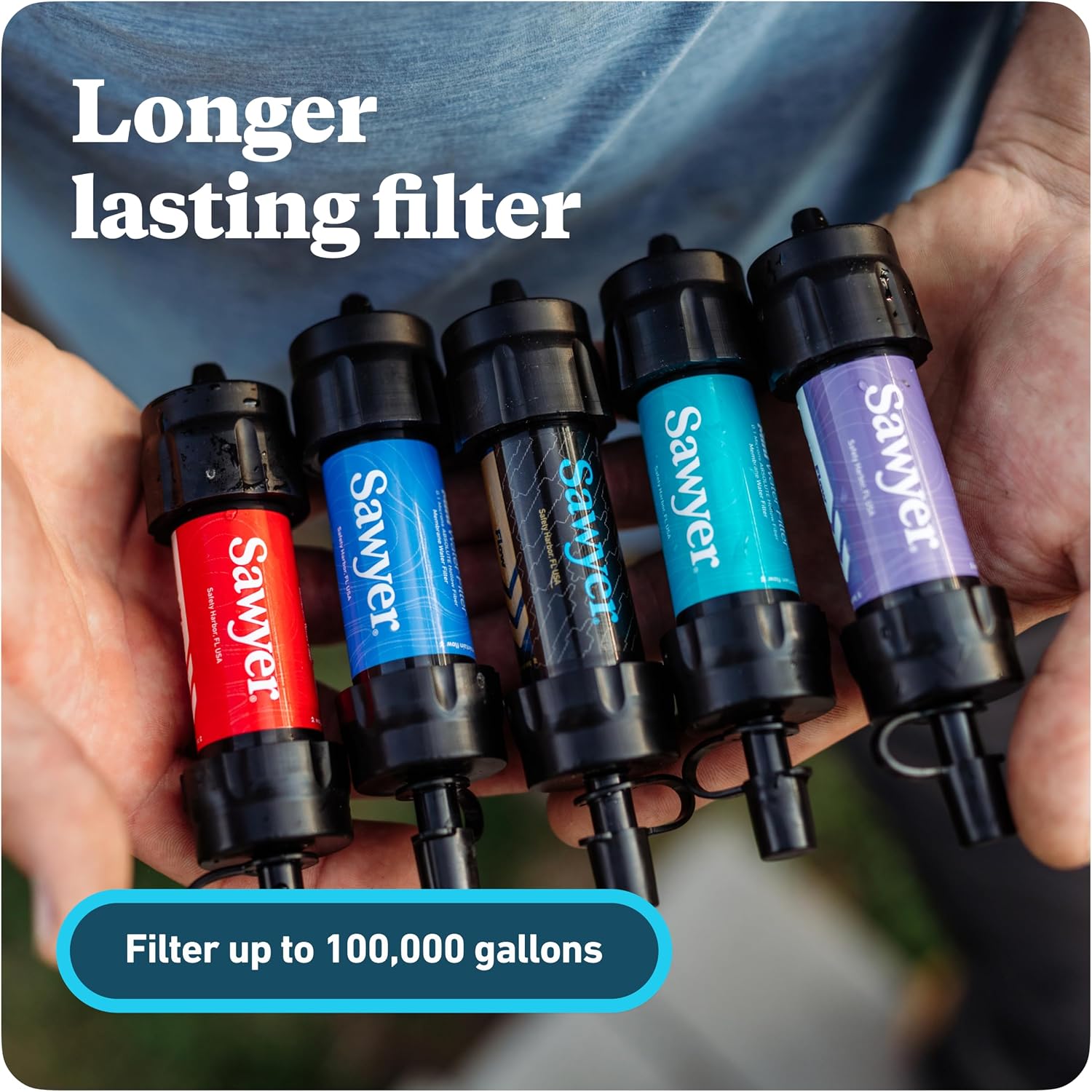
The Sawyer Mini and Sawyer Squeeze are the two variants most reviewers compare in this category. According to Sawyer Products’ published specifications (Squeeze Filter system specifications and field-use guidance), the Mini filters at roughly half a liter per minute under normal hand pressure and carries a rated filter life of 100,000 gallons — a number so far beyond realistic individual use that filter lifespan is effectively a non-issue for any single buyer. You fill a soft pouch with untreated water, attach the filter cartridge, and squeeze water through it into your mouth or a container.
The Sawyer Mini’s weight (approximately 57 grams including the pouch) and near-zero filter-life concern make it the standard recommendation in ultralight backpacking coverage. Wirecutter’s backpacking water filter review (“The Best Water Filter for Backpacking,” wirecutter.com, New York Times) and REI Co-op Learn’s buying guide (“How to Choose a Water Filter or Purifier,” rei.com/learn) both position squeeze filters as the default choice for solo or two-person travel where pack weight is the primary constraint.
The upgrade that Sawyer Mini owners document most consistently is pairing the filter with the CNOC Vecto collapsible bladder rather than the included squeeze pouch. The Vecto’s wide-mouth opening fills faster from a stream, its construction is more durable than the stock bag under repeated use, and its 2-liter and 3-liter sizes make group filtering significantly less tedious. REI Co-op Learn’s filter buying guide and Backpacker Magazine’s filter comparison coverage both flag bladder compatibility as a meaningful quality-of-life upgrade for Sawyer users — not a gimmick, but a genuine system improvement that changes how the filter performs at volume.
Sawyer
$28.99
In stock on Amazon
Check price on AmazonBy the Numbers
| Filter | Published Flow Rate | Filter Life (mfr.) | Packed Weight (approx.) | Virus Removal? |
|---|---|---|---|---|
| Katadyn Hiker Pro | ~1 L/min (pumping) | 300 L (replaceable cartridge) | 310 g / 11 oz | No |
| Platypus GravityWorks 4L | ~1.5 L/min (gravity) | 1,500 L | 193 g / 6.8 oz | No |
| Sawyer Mini | ~0.5 L/min (squeeze) | 378,541 L / 100,000 gal | 57 g / 2 oz | No |
| Katadyn BeFree Gravity | ~2 L/min (gravity, optimal) | 1,000 L | ~100 g (filter + flask) | No |
Sources: Katadyn product documentation (Hiker Pro user manual and BeFree specification sheet); Cascade Designs / Platypus GravityWorks published product specifications; Sawyer Products published filter specifications.
Matching Filter to Scenario
You are moving camp every day — backpacking, overlanding with daily relocations, or a bug-out scenario on foot. The hand pump or the Sawyer Mini with a Vecto bladder are your practical options. The gravity bag requires you to stop long enough to let physics work, and hang time is a luxury you may not have. The Katadyn Hiker Pro’s pump-on-demand design means you can filter water at a river crossing mid-hike without unpacking anything except the filter itself. The Sawyer Mini is lighter and filter life is effectively infinite, but for anything beyond solo use, the Vecto pairing is not optional — it is the difference between the filter being useful and being frustrating.
You are managing a group of four or more at a semi-permanent camp. The Platypus GravityWorks is the right answer. Hang it at setup, let it run, and it keeps pace with group demand without requiring anyone’s attention. The basecamp spigot configuration genuinely upgrades the system from camping filter to camp water infrastructure. The fiddly-pouch complaint is real, but it is a minor tax on a filter that handles group volume better than any squeeze or pump option at this price tier.
You are an overlander or motorcycle traveler who needs a compact gravity option. The Katadyn BeFree Gravity’s roll-up design and vest-pocket portability address the specific constraint that vehicle travelers face: you often have more reliable access to water sources than a backpacker does, so throughput per hour matters less than packed size and convenience. Soft-flask gravity filters survive compression and vibration better than anything with rigid components — a meaningful durability advantage on a vehicle that moves daily.
You are building a household emergency backup that also goes on weekend trips. The Katadyn Hiker Pro’s dual-use framing — hiking tool and emergency water solution during extended power outages — is the clearest pitch for the intermediate-preparer audience. It does not require hanging anything, it works with any container, and it produces clean water in under a minute per liter. The pump mechanism requires no infrastructure, no pressure, and no electricity, which is a meaningful advantage during a grid-down situation where a gravity setup’s performance depends on finding something to hang it from.
What None of These Filters Handle: The Virus Gap
This is the tradeoff that none of the four filters above escape. Mechanical filtration at the pore sizes used by the Hiker Pro, GravityWorks, BeFree Gravity, and Sawyer Mini physically cannot remove viruses — viral particles are smaller than the filter’s pores. In North American backcountry water sources, viruses are generally not considered a significant risk. REI Co-op Learn’s water filter buying guide (“How to Choose a Water Filter or Purifier,” rei.com/learn) and Backpacker Magazine’s comparative filter coverage both note that domestic wilderness water sources rarely present viral contamination at levels that pose meaningful risk to healthy adults.
The calculus changes for international travel, post-disaster urban water sources, or any situation involving sewage contamination of source water. In those scenarios, you need either a UV purifier (SteriPen models are the most commonly recommended pairing in Wirecutter’s backpacking filter coverage, “The Best Water Filter for Backpacking,” wirecutter.com), chemical treatment tablets (iodine or chlorine dioxide such as Aquatabs), or a filter with a purifier stage built in. The practical intermediate-preparer answer is to carry a mechanical filter from this list for everyday use and add chemical treatment tablets as a lightweight backup for high-risk sourcing situations. FEMA’s emergency water safety guidance (“Emergency Water Storage and Purification,” fema.gov) also recommends chemical disinfection as a complement to mechanical filtration when source water integrity is unknown.
Frequently Asked Questions
Can you use a gravity filter while actively moving, or does it only work at camp? Gravity filters work only when suspended at height — they require a fixed hang point and enough head pressure (typically two to three feet of elevation difference) to push water through the filter membrane. In practice this means they are stationary tools. You can set one up during a rest break, but a pump or squeeze filter is the functional choice when you are covering ground.
How long does the Platypus GravityWorks take to filter a full 4 liters for a group? Under ideal conditions with a clean filter element and proper hang height, Cascade Designs’ published product specifications (GravityWorks product page and flow-rate specification sheet) rate the GravityWorks at approximately 1.5 liters per minute, putting a full four-liter fill at roughly two and a half to three minutes of unattended hang time. Real-world times track closely when the filter is clean and backflushed. Sediment accumulation in turbid water sources slows this noticeably; backflushing restores most of the original flow rate.
What bladder is compatible with the Sawyer Mini for higher-volume filtering? The Sawyer Mini threads onto any standard 28mm squeeze pouch and connects to hydration bladder hoses with the included adapter. For higher-volume use, the CNOC Vecto collapsible bladder — available in 2-liter and 3-liter sizes — is the most consistently recommended upgrade across REI Co-op Learn’s filter buying guide (“How to Choose a Water Filter or Purifier,” rei.com/learn) and Backpacker Magazine’s filter comparison coverage. It fills faster than the included stock bags, is more durable under repeated use, and makes the filter practical for two-person or small-group trips.
Does the Katadyn Hiker Pro require maintenance between uses? Katadyn’s published maintenance documentation (Hiker Pro user manual and filter specification sheet) recommends backflushing the filter element after each use and allowing it to air-dry before storage to prevent bacterial growth in the cartridge. The pump mechanism uses an O-ring that benefits from periodic lubrication with food-safe silicone grease — a packet ships with the filter, and replacements are available separately. Consistent O-ring maintenance keeps the pump action smooth for years; neglecting it leads to a stiff pump that fatigues your hand faster under sustained use.
Which of these filters removes viruses? None of the four filters in this comparison — Katadyn Hiker Pro, Platypus GravityWorks, Sawyer Mini, or Katadyn BeFree Gravity — removes viruses. All four are mechanical filters rated to remove bacteria (including E. coli and Salmonella) and protozoa (including Giardia and Cryptosporidium) but lack the sub-0.1-micron pore size or UV/chemical stage required for viral removal. For virus-risk environments, pair any of these filters with a UV purifier or chemical treatment tablets such as chlorine dioxide, as recommended in both FEMA’s emergency water purification guidance (“Emergency Water Storage and Purification,” fema.gov) and REI Co-op Learn’s water filter buying guide (“How to Choose a Water Filter or Purifier,” rei.com/learn).