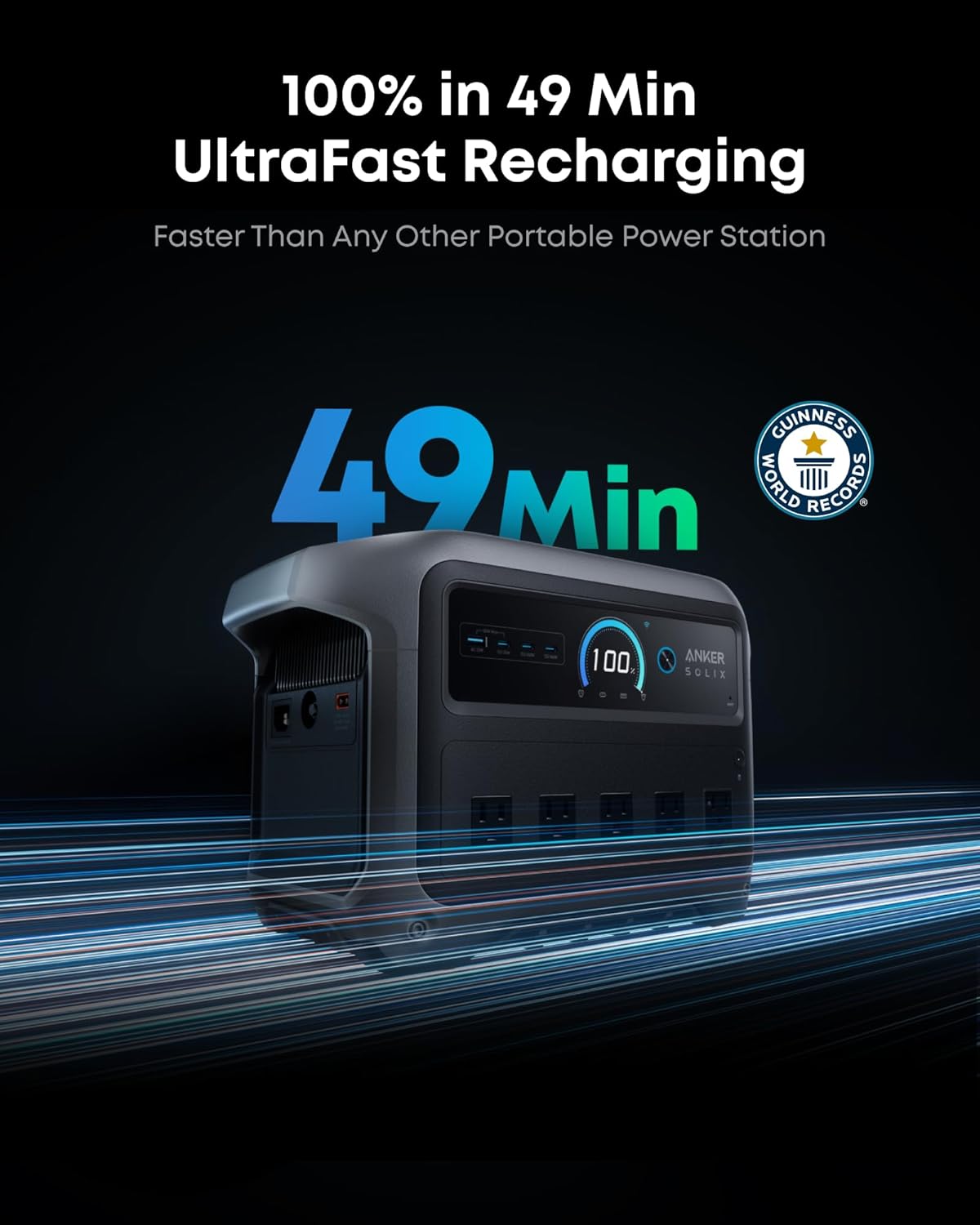
A portable power station is essentially a very large rechargeable battery in a suitcase — it stores electricity when the grid is up and releases it through standard outlets when the grid goes down. The appeal is obvious: no gasoline, no exhaust, no generator noise at 2 a.m. But the marketing for these units has drifted well ahead of reality. A label that reads “3,000Wh” sounds enormous until you calculate how many hours your refrigerator, lights, and phone chargers actually consume. This article is a spec-by-spec reality check — not a pitch for any single unit. By the end, you’ll know exactly which numbers to look at, which ones to discount, and a clear decision rule for whether a portable power station is the right tool for your home backup plan or whether you need something else entirely.
| EDITOR'S PICKJackery HomePower 3600 Plus Por… | Mid-tierBLUETTI AC200L Portable Power S… | Budget pickAnker SOLIX C1000 Portable Powe… | |
|---|---|---|---|
| Battery | 3584Wh | 2048Wh | 1056Wh |
| AC output | 3600W | 2400W | 1800W |
| Peak output | — | 3600W | 2400W |
| Expandable | Yes, to 21kWh | Yes, to 8192Wh | — |
| Battery type | LFP | LiFePO4 | LiFePO4 |
| AC outlets | — | 4 | — |
| Price | $1,799.00 | $899.00 | $399.99 |
| See on Amazon → | See on Amazon → | See on Amazon → |
The Numbers That Actually Matter (and the Ones That Don’t)
Most product listings lead with watt-hours (Wh) — the total energy a unit can store. Think of it like the size of a gas tank. A 2,000Wh unit holds roughly the same energy as 2,000 watts running for one hour, or 200 watts running for ten hours. That’s the honest version of the math manufacturers don’t spell out.
The second number is continuous output wattage — how much power the unit can deliver at any one moment. This is your “engine size.” A station with 3,000Wh of storage but only 1,500W of continuous output cannot run a standard 1,800W microwave, full stop. The storage capacity is irrelevant if the output ceiling is below what your appliance demands.
The third number, almost universally underreported in marketing copy, is peak surge wattage. Most motors — refrigerators, sump pumps, window AC units — draw 2–4× their running wattage for the first few seconds on startup. A refrigerator rated at 150W running current may spike to 600W at startup. If your power station’s surge rating is below that spike, the unit trips its own protection circuit and the appliance never starts. Consumer Reports’ portable power station evaluations consistently flag this as the most common real-world failure point buyers don’t anticipate.
By the Numbers — Typical household loads vs. what a mid-range station can handle:
| Appliance | Running Watts | Startup Surge | Hours on 2,000Wh Station |
|---|---|---|---|
| Full-size refrigerator | 150W | 600W | ~11 hrs running time |
| Window AC (5,000 BTU) | 450W | 900W | ~3.5 hrs running time |
| LED lights (10 bulbs) | 80W | ~80W | ~22 hrs |
| Phone + laptop charging | 100W | ~100W | ~18 hrs |
| Portable electric heater | 1,500W | 1,500W | ~1.2 hrs |
The refrigerator number deserves special attention: your fridge doesn’t run continuously. Its compressor cycles on and off, averaging far less than peak draw. Owners running 2,000–3,600Wh stations in extended-outage reviews frequently report real-world refrigerator runtimes of 18–30 hours, not the theoretical 11, because the compressor is only active 30–50% of the time.
Where Manufacturer Claims Break Down in Real-World Use
Capacity degradation under load is the gap that surprises most buyers. Battery chemistry — whether the unit uses lithium-iron-phosphate (LFP) or the older NMC (nickel-manganese-cobalt) cells — affects how much of the rated capacity you actually get under a heavy draw.
Wirecutter’s portable power station coverage notes that units under heavy continuous load (drawing 80% or more of rated output) can deliver 10–20% less usable capacity than the label suggests, because high discharge rates generate internal heat that the battery management system compensates for by throttling output. LFP chemistry handles this better than NMC, and it’s one reason the preparedness community has shifted strongly toward LFP-based units like the Goal Zero Yeti Pro series and EcoFlow Delta Pro despite their higher price. LFP also tolerates a wider charge/discharge temperature range and is generally rated for 3,000–6,000 charge cycles versus 500–1,000 for older NMC packs — a meaningful difference if you’re planning to use this as a long-term household asset, not a one-time emergency purchase.
Inverter type is the second real-world differentiator. A pure sine wave inverter replicates the smooth AC waveform that comes out of your wall outlet. A modified sine wave inverter produces a stepped approximation that works fine for resistive loads like lightbulbs and simple phone chargers but can cause audible hum, reduced efficiency, or outright damage with motors, medical devices (CPAP machines especially), and some variable-speed appliances. The Popular Mechanics evaluation of portable power stations specifically flags modified sine wave output as disqualifying for household use if you have any sensitive electronics or medical equipment. Every major unit in the $800+ tier now ships with pure sine wave inverters, but verify before purchasing anything in the sub-$500 bracket.
Recharge speed and solar input compatibility close out the real-world gap analysis. A 3,600Wh station takes a long time to refill from solar panels if the unit’s maximum solar input port is rated at only 400W — that’s a 9-hour full recharge under ideal conditions, which don’t exist in winter or under a cloudy post-storm sky. The U.S. Department of Energy’s home backup power guidance notes that solar recharge is most practical as a supplemental input during a multi-day outage rather than a primary same-day replenishment strategy. Owners running Goal Zero Yeti 3000X and EcoFlow Delta Pro units in long-duration reviews consistently report that pairing a single 200W panel with a 2,000+Wh station extends useful runtime significantly during daylight hours — but rarely achieves full daily recharge unless you’re running two or more panels and the station’s MPPT charge controller is properly matched to the panel array’s voltage and current profile. (MPPT mismatch — mismatching panel voltage to the charge controller’s input window — is a documented issue across brands; the unit simply won’t charge at full rate, and no error message tells you why.)
Sizing for Real Backup Scenarios, Not Spec-Sheet Scenarios
Here’s the framework that separates useful backup from expensive disappointment.
The 72-hour critical-load calculation is the right starting point. FEMA’s power outage preparedness guidance recommends a minimum 72-hour self-sufficiency window. Identify your critical loads — the appliances you cannot do without for safety and basic function — and add up only those watt-hours, not everything in your home.
A practical suburban critical load list typically looks like: refrigerator + freezer (combined 250W average cycling), LED lighting in two rooms (80W), device charging hub (100W), and a medical device like a CPAP (60–90W). Total: approximately 490W average. Over 72 hours: roughly 35,000Wh. That number immediately illustrates the real constraint — no portable power station on the market today stores 35,000Wh. A 3,600Wh unit covers approximately 7 hours of that load without solar input.
This is not a failure of the technology. It’s a planning reality. The practical strategy most preparedness reviewers, including those at Wirecutter and Popular Mechanics, arrive at is load rotation rather than whole-home coverage. Run the refrigerator for 2 hours twice daily to maintain safe temperatures (the U.S. Food and Drug Administration’s food safety guidance, cited by the Department of Energy, establishes 4°C / 40°F as the safe threshold, which a full refrigerator can hold for roughly 4 hours without power). Charge devices during a defined window. Run lights only after dark. Under a rotation strategy, a 2,000–3,600Wh station with 400W+ solar input becomes genuinely useful for a 72-hour event rather than marginally useful.
For committed preppers and extended-duration planning, the calculus shifts toward stackable systems. EcoFlow’s delta series and Goal Zero’s Yeti ecosystem both offer stackable extra battery units that add capacity without adding an entirely new station. Adding a 2,000Wh expansion battery to a 3,600Wh base unit gets you to 5,600Wh — meaningful for a 24–36 hour full critical-load run, or a 4–5 day rotation strategy. This architecture is worth understanding before purchase, because not all brands support expansion — and locking yourself into a non-expandable station at $800 may be a worse long-term investment than spending $1,200 on an expandable platform.
Transfer Switching: The Safety and Legal Layer Most Buyers Skip
One detail that rarely appears in buyer reviews but matters enormously: how you connect a power station to your home’s wiring.
If you want to power hardwired circuits — ceiling lights, outlets in the wall, a hardwired sump pump — rather than just running extension cords, you need a transfer switch installed by a licensed electrician. A transfer switch physically disconnects your home from the utility grid before allowing your backup power source to feed the panel. Without one, power fed back into your panel can travel out through the utility lines and electrocute utility workers restoring service — a hazard that is both lethal and illegal under National Electrical Code Article 702. FEMA’s power outage guidance explicitly states that backfeeding is a safety violation.
Most portable power station users avoid this entirely by using extension cords and portable appliances — which is perfectly legal and practical for most critical loads. But if your backup plan involves hardwired loads, budget $300–$800 for a licensed electrician to install a manual transfer switch before you size your station.
The Decision Rule
If you’ve read this far, here’s the clean if/then framework:
If your goal is 72-hour critical-load coverage (refrigerator, lights, device charging, one medical device) with load rotation → a 2,000–3,600Wh LFP-based unit with pure sine wave output and at least one compatible 200W solar panel is a well-matched, practical solution. Goal Zero Yeti 3000X and EcoFlow Delta Pro are the benchmarks in this tier; reviewers and owners consistently rate them as the standard against which others are measured.
If your goal is extended multi-day coverage or you have high-wattage critical loads (sump pump, oxygen concentrator, chest freezer) → size up to an expandable platform with at least 5,000Wh base capacity and budget for a second expansion battery. Plan for solar supplementation and accept that full-home coverage is not a realistic expectation from any portable station.
If you’re hoping to run a window AC unit, electric range, or electric water heater → a portable power station is the wrong tool. These loads require either a whole-home standby generator or a transfer-switch-connected inverter generator. The portable station niche tops out around 3,600W continuous output for the largest consumer units available in mid-2026, and high-resistance heating loads will drain even the largest battery in under two hours.
If you’re an overlander or remote traveler → the math is more favorable. Vehicle-based loads are smaller, solar input is more continuous, and a 1,000–2,000Wh station with 200W of roof-mounted panels (BioLite’s SolarPanel 100 and Goal Zero Nomad panels are frequently cited by overlanding reviewers for their build quality and reliable MPPT performance) covers a realistic vehicle campsite load for days at a time.
The portable power station is a genuinely capable tool for a defined, realistic job. The spec sheet will tell you its ceiling. The math in this article tells you whether your needs fit under it.