If you live somewhere with reliable tap water, it is easy to assume water is always available in a crisis — but a single burst main, a chemical spill upstream, or a four-day power outage can put safe drinking water out of reach fast. That is why a personal water filter — a compact device you use to remove bacteria, protozoa, and other contaminants from untreated water like a stream, pond, or even a rain barrel — has become a cornerstone of serious emergency kits. Unlike large gravity-fed systems designed to serve a household, personal filters are handheld and portable, meant for one or two people on the move. This article is a direct comparison of three filters that dominate the category: the LifeStraw (original and Peak Series), the Sawyer Mini, and the GRAYL GeoPress. By the end, you will know exactly which one belongs in your plan — and why the answer is not the same for everyone.
The Core Tradeoff Nobody Talks About Up Front: Threat Coverage vs. Ease of Use
Before comparing products, you need to know what any filter is actually protecting you against — because the three products in this comparison do not protect against the same threats.
All three handle bacteria (like E. coli and Salmonella) and protozoa (like Giardia and Cryptosporidium). These are the pathogens you are most likely to encounter in North American backcountry water and in domestic emergency scenarios like a flooded neighborhood or a disrupted municipal system.
Where they diverge:
- Viruses (Norovirus, Hepatitis A, Rotavirus): Only the GRAYL GeoPress removes these. Hollow-fiber straw-style filters like the LifeStraw original and the Sawyer Mini do not remove viruses. FEMA’s Ready.gov emergency water guidance — published under the document title “Food and Water in an Emergency” — explicitly notes that viral contamination is a real concern in densely populated or post-disaster environments.
- Chemicals, pesticides, heavy metals: The standard LifeStraw plastic model does not filter these. The LifeStraw Peak Series (steel body) adds activated carbon stages for chemical and heavy-metal reduction. The GRAYL GeoPress also handles these through its multi-stage cartridge. The Sawyer Mini does not address chemical contaminants.
- Microplastics: The GRAYL GeoPress filters these; the hollow-fiber competitors do not.
This is the most consequential decision point in the comparison. Your threat environment — not brand preference — should drive this choice.
Head-to-Head: Three Filters, Three Use Cases
LifeStraw: The Always-Ready Option for Vehicles and Grab Bags
LifeStraw
$13.49
In stock on Amazon
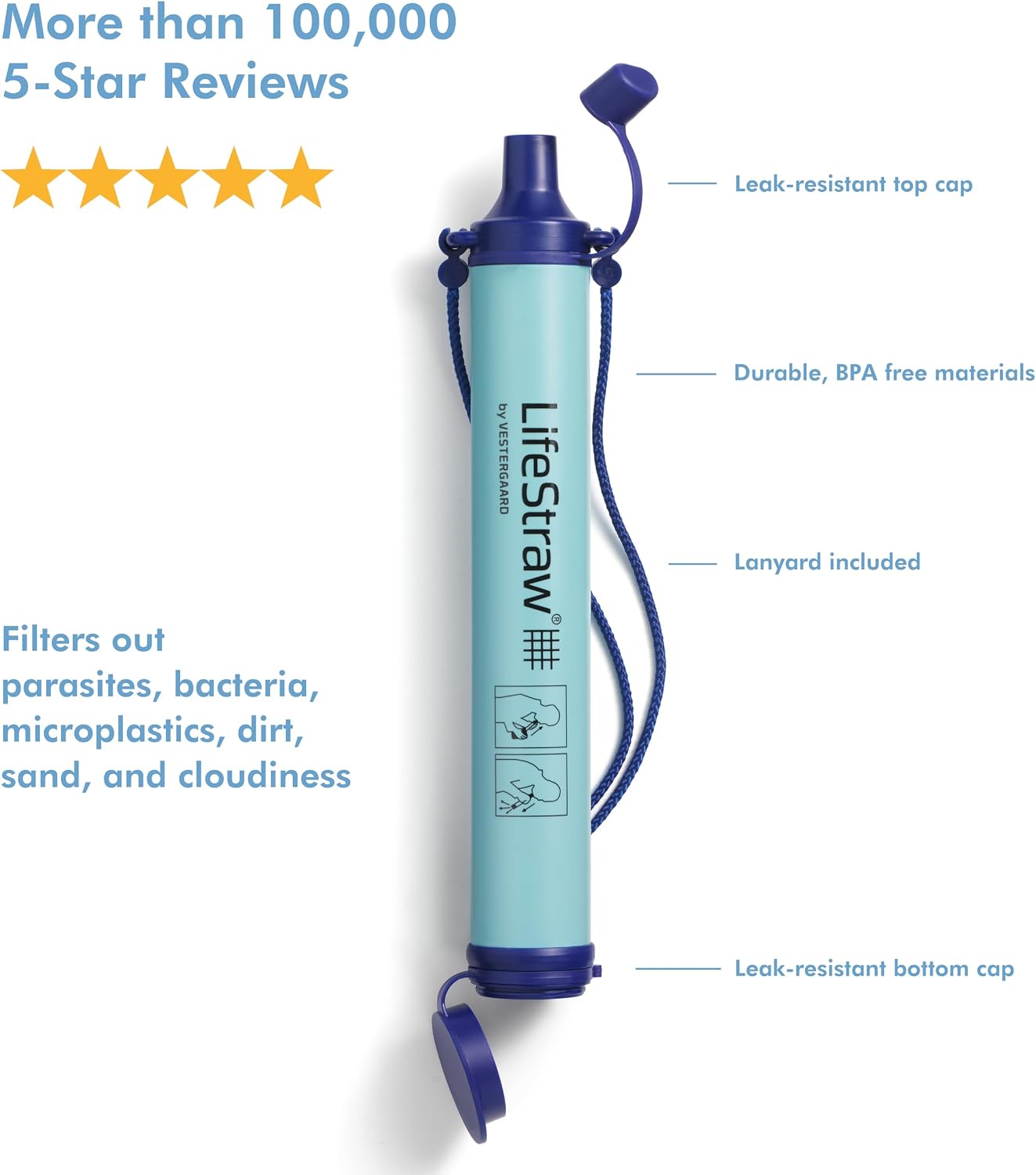
Check price on AmazonThe LifeStraw original is the filter most people have heard of, and it earns consistent praise for a specific reason: zero setup. You uncap it, put one end in water, and drink. No squeezing, no backflushing in the field to get started, no threads to cross. Owners consistently highlight this simplicity as the reason they keep one permanently in a glove box or truck center console — it is the filter you will actually have with you when something goes wrong.
The original model uses a hollow-fiber membrane rated at 0.2 microns, sufficient to block bacteria and protozoa. The manufacturer rates it for up to 4,000 liters of filtered water. Coverage by the Wirecutter (New York Times product testing team, “The Best Water Filter for Hiking and Emergencies”) and REI Co-op’s Learning Center (“How to Choose a Backpacking Water Filter or Purifier”) both cite this capacity figure and note that throughput slows noticeably as the filter loads, with backflushing by blowing back through the mouthpiece helping restore flow.
The upgrade question: The standard plastic LifeStraw does not remove chemicals, pesticides, or heavy metals. If your emergency scenario includes any doubt about chemical contamination in local water sources — check your county’s watershed hazard reports — the LifeStraw Peak Series adds activated carbon to address this gap. The Peak Series is the version worth owning in suburban or agricultural-runoff environments.
Where LifeStraw wins: Urban or suburban emergency kits where the primary threat is biological, grab-and-go convenience, and setups where the filter lives in a vehicle year-round without maintenance. Outside Online’s gear coverage (“The Best Water Filters and Purifiers”) cites its durability and reliability as primary reasons to recommend it as an entry-level emergency filter.
Where it falls short: Group filtering is awkward. It is designed for one person drinking directly. Treating water in volume, for a pot, or for family members who cannot lean over a water source requires workarounds.
LifeStraw
$13.49
In stock on Amazon
Check price on AmazonSawyer Mini: The Most Versatile Filter for Families and Overlanders
Sawyer
$28.99
In stock on Amazon
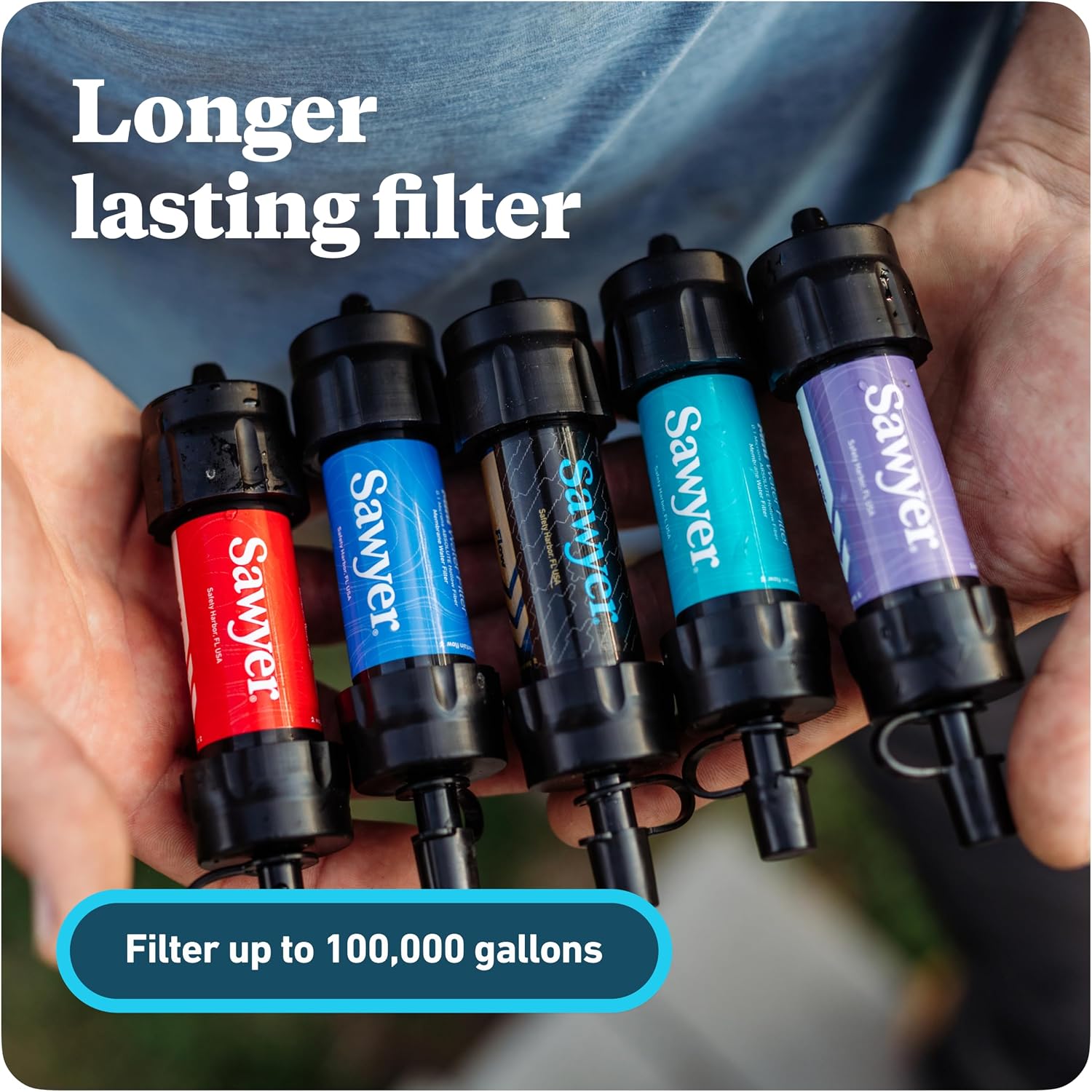
Check price on AmazonThe Sawyer Mini is also a hollow-fiber filter, rated at 0.1 microns — a finer pore size than the LifeStraw’s 0.2, though both exceed regulatory standards for bacterial and protozoal removal. The manufacturer rates it for up to 100,000 gallons, a figure that reflects clean-water throughput testing; real-world performance in sediment-heavy water is lower.
The Mini’s actual advantage over the LifeStraw is not found on the spec sheet — it is system flexibility. The Sawyer Mini ships with a squeezable pouch and threads onto standard disposable water bottles. But the configuration that experienced owners consistently cite as transformative is pairing it with a CNOC Vecto 2L collapsible bladder.
Here is why that matters: the Mini in sip-by-sip straw mode is fine for survival situations, but it is impractical for camp cooking, family use, or filling a canteen. The CNOC Vecto bladder threads directly onto the Sawyer Mini’s inlet end. You fill the 2-liter bladder from any water source, attach the Mini, and squeeze filtered water into a clean container. You have just converted a personal straw into a batch-filter system capable of treating a full day’s water supply in minutes. Backpacker Magazine’s gear testing coverage (“Best Water Filters: Tested and Reviewed”) highlights this kind of bladder-pairing approach as one of the most practical field configurations for lightweight emergency preparedness.
Backflushing matters here more than with the LifeStraw. The Mini’s flow rate degrades with use and sediment loading, and the included syringe for backflushing should be part of every use cycle. Skipping backflushing and then blaming the filter for low flow is a documented pattern across owner feedback in aggregated gear reviews by outlets including Outside Online.
Where Sawyer Mini wins: Families and small groups who need volume filtering, overlanders who want a lightweight system that can batch-treat water for cooking and drinking, and preparedness builds where budget is a constraint. The caveat is identical to the LifeStraw: no virus protection, no chemical filtration.
Sawyer
$28.99
In stock on Amazon
Check price on AmazonGRAYL GeoPress: The Filter That Does More — If You Can Press It
GRAYL
$99.95
In stock on Amazon
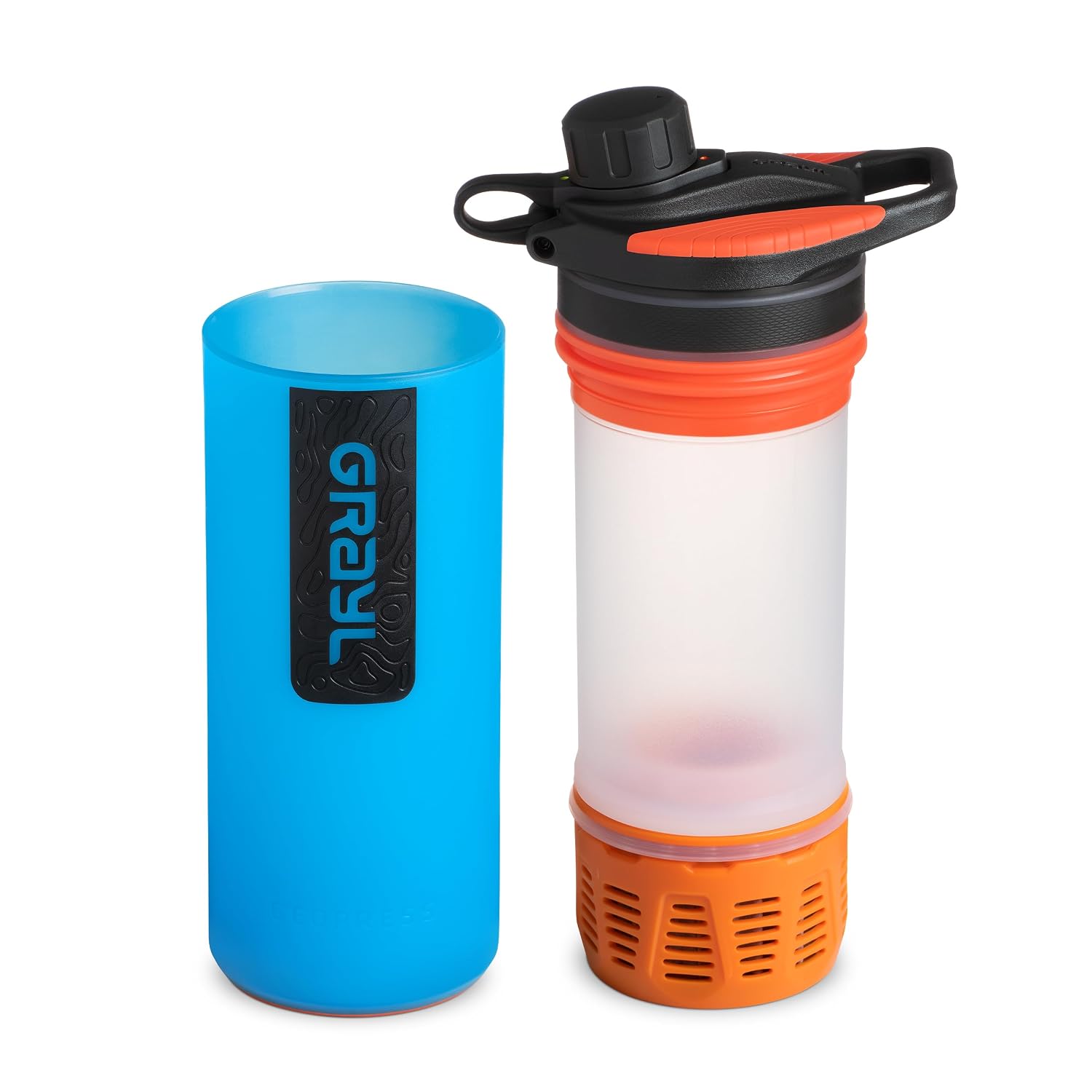
Check price on AmazonThe GRAYL GeoPress is a fundamentally different product. It is not a straw filter; it is a press-style purifier that works like this: you submerge the outer vessel to fill it with untreated water, place the inner press cylinder on top, and push down. Filtered water collects inside the inner cylinder, ready to drink from the integrated cap. One press takes approximately 8 seconds and produces roughly 710 mL (about 24 oz) of purified water.
The GeoPress’s cartridge achieves what the hollow-fiber competitors cannot: it removes viruses, microplastics, and chemicals and heavy metals in addition to bacteria and protozoa. REI Co-op’s Learning Center (“How to Choose a Backpacking Water Filter or Purifier”) describes the distinction between purification-rated systems and filtration-only systems as meaningful in high-density emergency scenarios and international travel. In a post-earthquake urban environment or any situation where viral contamination of water supplies is plausible, that distinction is the difference between safe water and unsafe water.
The hand-strength issue must be named explicitly. Multiple owners describe the press as requiring considerable force, and this is a legitimate barrier — not marketing hyperbole. The GeoPress is easier to press than the original GRAYL Ultralight model (GRAYL redesigned the mechanism), but it still requires sustained downward pressure. For children, elderly users with arthritis or reduced grip strength, or anyone with wrist or shoulder injuries, this is a real concern. Testing the press motion before putting the GeoPress into a kit for any user with physical limitations is not optional — it is essential planning.
Cartridge replacement cost is the other math you need to run. The GeoPress cartridge is rated for 350 presses, approximately 65 gallons or 250 liters. If you are treating water daily at 1.5 liters per day, one cartridge lasts roughly six months of continuous use. Over two years, you are replacing cartridges multiple times. The cost-per-liter math favors the Sawyer Mini and LifeStraw significantly in long-duration scenarios.
Where GRAYL wins: International deployments, post-disaster urban environments with unknown contamination profiles, overlanders traveling internationally, and any scenario where viral contamination is plausible. Also: any user who needs a self-contained vessel — no separate drinking setup required.
GRAYL
$99.95
In stock on Amazon
Check price on AmazonBy the Numbers
| Filter | Pathogen Coverage | Rated Capacity | Virus Protection | Chemical/Heavy Metal | Tier |
|---|---|---|---|---|---|
| LifeStraw Original | Bacteria, Protozoa | ~4,000 L | No | No | LifeStraw — $13.49 |
| LifeStraw Peak Series | Bacteria, Protozoa, Chemicals | ~4,000 L | No | Yes | Sawyer — $28.99 |
| Sawyer Mini | Bacteria, Protozoa | ~378,500 L (mfr claim) | No | No | LifeStraw — $13.49 |
| GRAYL GeoPress | Bacteria, Protozoa, Viruses, Chemicals, Microplastics | ~250 L / cartridge | Yes | Yes | GRAYL — $99.95 |
Frequently Asked Questions
Does the standard LifeStraw remove chemicals, pesticides, or heavy metals? No. The original plastic LifeStraw uses only a hollow-fiber membrane, which blocks biological threats but does not address chemical contaminants. The LifeStraw Peak Series adds activated carbon filtration for this purpose. If chemical contamination is a realistic scenario for your location, the base model is insufficient on its own.
How do you use the Sawyer Mini for more than a sip at a time? The most effective method, consistently recommended by field reviewers, is pairing it with a CNOC Vecto 2L collapsible bladder. Fill the bladder with untreated water, thread the Sawyer Mini onto the outlet, and squeeze filtered water into a pot, bottle, or cup. This converts the Mini from a personal straw into a practical batch-filter capable of treating cooking water and multiple servings at once.
Can children or elderly users operate the GRAYL GeoPress? Potentially, but not without verification. The press requires sustained downward pressure. Adults with arthritis, reduced grip strength, or limited upper-body mobility may find it difficult or impossible to operate alone. Children under approximately 10–12 are unlikely to generate enough force. Before including the GeoPress in a kit for any user with physical limitations, have that person attempt a dry press to confirm they can manage it.
Do water purification tablets kill viruses when filters don’t? Yes. Iodine-based tablets such as Potable Aqua and chlorine dioxide tablets kill viruses, bacteria, and protozoa, making them a chemical purification method rather than a filtration method. Iodine tablets leave a slight taste, which companion neutralizer tablets reduce significantly. Tablets are an effective virus-coverage backup for any hollow-fiber filter kit. FEMA’s Ready.gov document “Food and Water in an Emergency” lists chemical treatment as an approved emergency purification method.
Is it worth owning both a straw filter and tablets? Yes, and the logic is straightforward. A hollow-fiber filter handles the biological threats most likely encountered domestically. Tablets add virus coverage and serve as a complete backup if your filter is lost, damaged, or becomes too clogged to use. The combined weight and cost is minimal, and the redundancy is the point. The Wirecutter’s coverage of emergency water filters and preparedness-focused reviews from outlets including Outside Online consistently recommend the dual-carry approach for serious emergency kits.
How long does each filter actually last before replacement? The LifeStraw original is rated for 4,000 liters (about 1,000 gallons). The Sawyer Mini carries a manufacturer claim of 100,000 gallons, though real-world longevity in sediment-heavy water is lower — regular backflushing extends functional life significantly. The GRAYL GeoPress cartridge is rated for 350 presses (roughly 65 gallons / 250 liters), making it the highest ongoing cost of the three. For emergency kit planning, a stored filter should be inspected annually and replaced per manufacturer guidelines, not held indefinitely on the assumption it stays good forever.
The Decision Rule
If your emergency scenarios are domestic, your kit includes adults in reasonable health, and your primary concern is biological contamination of surface water or a disrupted municipal supply: the Sawyer Mini paired with a CNOC Vecto bladder is the practical anchor for most kits, with Potable Aqua tablets added for virus coverage. The LifeStraw original earns a permanent place in a vehicle or bag where simplicity and always-ready deployment matter more than volume capacity.
If you are overlanding internationally, building a kit for a family member who needs virus-safe water without relying on tablets, or your location’s contamination profile includes chemicals or industrial runoff: the GRAYL GeoPress is the right filter — budget for cartridge replacements, and confirm the press force works for every intended user before the filter enters service.
If your kit currently has nothing: the LifeStraw original gets you protected today, and you can build from there. Starting is more important than starting perfectly.