An MRE — Meals, Ready-to-Eat — is a self-contained, shelf-stable meal originally developed for military field use, where soldiers need to eat without a stove, fire, or refrigeration. Every pouch includes an entrée, sides, condiments, and often a flameless ration heater (FRH): a small chemical pouch that generates heat from a reaction between magnesium iron alloy and salt water. You add a few ounces of water, slide your entrée in, prop it up, and in about 12 minutes you have a hot meal with zero flame, no fuel canister, and no smoke. For anyone building out an emergency kit, planning a backcountry trip, or stocking a vehicle for remote travel, MREs solve a real problem — but what the listing says and what arrives in the box are sometimes two different things. This guide breaks down what actual buyers report, how to interpret shelf-date language that’s deliberately vague, and exactly which entrees are worth eating versus which ones you’ll skip after the first bite.
| EDITOR'S PICK2026 Inspection MRE | Mid-tierWornick Sopacko | Budget pick2026 Inspection MRE | |
|---|---|---|---|
| Pack size | 24 meals | — | 12 meals |
| Meal type | Ready meals | Ready to eat | Ready meals |
| Heater included | ✓ | — | ✓ |
| Case | A & B case | — | A or B case |
| Inspection date | 2026 | 2025 or 2026 | 2026 |
| Freeze dried | ✓ | — | ✓ |
| Price | $97.99 | $94.99 | $53.00 |
| See on Amazon → | See on Amazon → | See on Amazon → |
What “Inspection Date 2026 or Better” Actually Means — And What It Doesn’t
This is the single most common point of confusion in the MRE market right now, and it matters if you’re spending $100–$180 on a full case. Civilian MRE listings — including the most popular cases on major retail platforms — frequently describe their product as “2026 or better” or “inspection date 2026 or newer.” That language sounds like a guarantee of freshness. It isn’t.
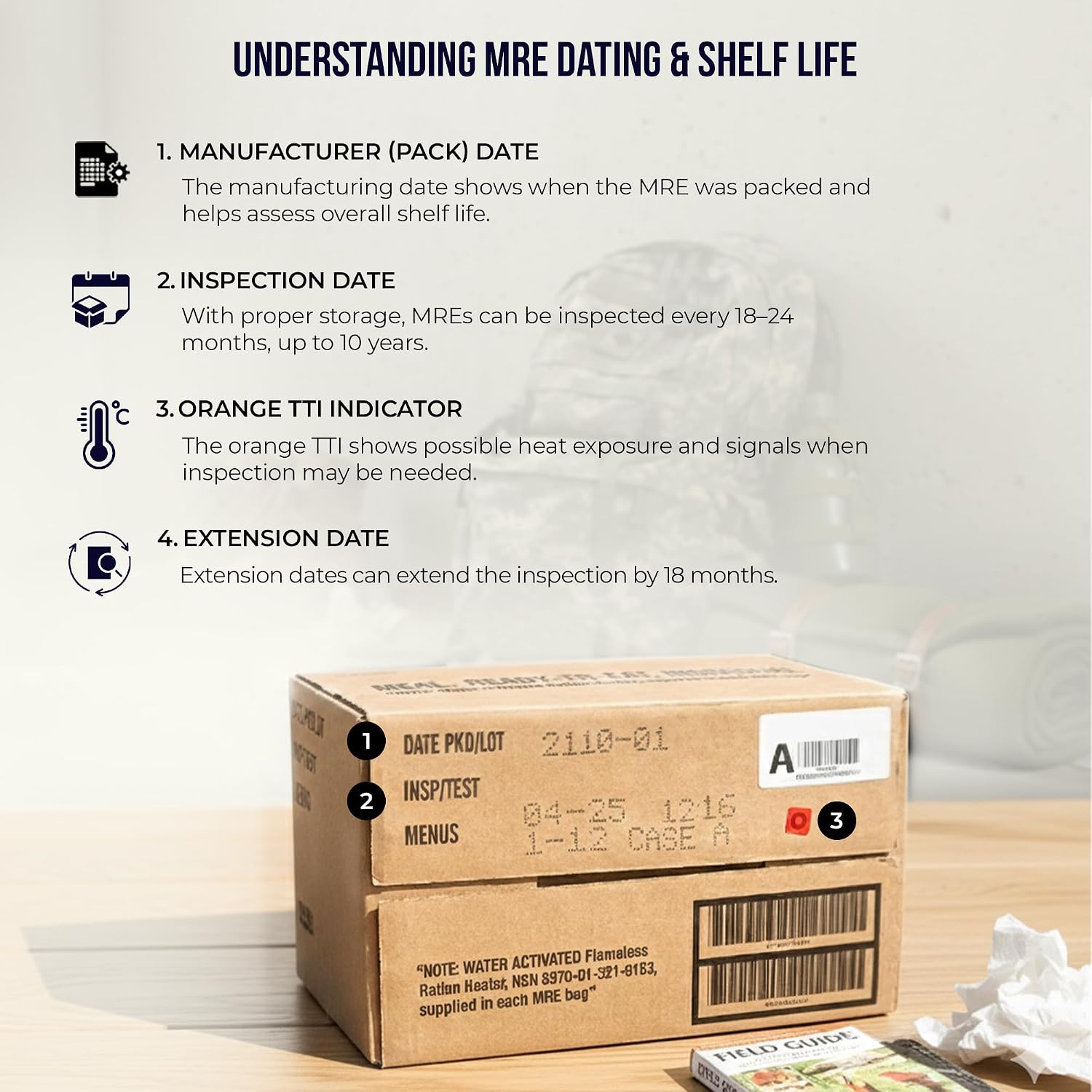
Here’s what it actually means: MREs are date-coded using a Julian date format stamped on each pouch (more on reading that below). The listing promise of “2026 or better” typically refers to the inspection or pack date, not an expiration date. One buyer who ordered from a “2026 or better” listing reported receiving meals with a 2023 pack date — and considered it acceptable — but flagged the ambiguity for other buyers. His experience illustrates the gap: a 2023 pack date with a 10-year shelf life at ideal storage conditions has plenty of usable life left, but it’s not what many buyers picture when they read “2026.”
U.S. Army Natick Laboratories’ published technical report on military ration shelf life establishes that MREs are rated for approximately 3 years at 80°F (27°C) or up to 10 years if stored consistently at 60°F (15°C). Real-world conditions — warehouse storage, summer shipping — almost always land somewhere between those poles. FEMA’s food storage guidance at ready.gov/food reinforces the same principle: temperature history matters more than any single date stamp.
The practical takeaway: When you see “inspection date 2026 or better,” ask the seller whether they mean the Julian pack date or a freshness guarantee. If you receive meals with a 2023 pack date, that’s not fraud — it may still be perfectly sound food — but you should verify your storage environment and not assume you have the full remaining shelf life the listing implied.
Reading Julian Date Codes: A 90-Second Skill Worth Having
Every MRE pouch is stamped with a Julian date code, typically a 4-digit number. The format is straightforward once you know the key:
- First digit: Last digit of the year (e.g., “3” = 2023)
- Last three digits: Day of the year (001 = January 1, 365 = December 31)
So a code reading 3274 means the 274th day of 2023 — October 1, 2023.
Outside Online’s outdoors nutrition feature on reading military MRE dates confirms this structure and notes that most civilian MRE repacks carry the original military date code, so the skill transfers regardless of the brand on the box. Some civilian resellers add a separate label; if the two dates differ, trust the original pouch stamp.
By the numbers:
| Storage temp | Estimated shelf life |
|---|---|
| 60°F (15°C) | ~10 years |
| 70°F (21°C) | ~5 years |
| 80°F (27°C) | ~3 years |
| 100°F (38°C) | ~1 year |
Source: U.S. Army Natick Laboratories shelf-life technical report
If your garage hits 90°F every July, a 2023-packed MRE stored there isn’t a 10-year food supply — it’s closer to a 2–3 year food supply. Plan accordingly.
Flameless Heater Reliability: What Owners Actually Report
The good news here is consistent. Across aggregated buyer reviews of civilian MRE cases, flameless heaters are the element that generates the least complaint. Buyers who purchased cases ranging from A and B menu varieties consistently report the heaters as reliable, with the standard activation process — add roughly one ounce of water to the FRH pouch, insert entrée, lean against a rock or hard surface at an angle — producing noticeable heat within 2–3 minutes and a genuinely warm meal by the 12-minute mark.
One owner who worked through an entire A-case and B-case described the process as “fun” — which sounds like damning with faint praise but actually tells you something useful: the heaters performed every single time across 24+ meals without a single failure. For a product you’re buying to use in a power outage or backcountry situation, that consistency matters more than the novelty.
The question that comes up in intermediate-level discussions is whether heaters degrade in storage. The chemistry involved is a magnesium-iron alloy reaction triggered by saltwater. As long as the FRH pouch remains sealed and undamaged, the reactive material stays inert. Owners who opened meals stored 1–2 years report no performance loss. The meaningful failure mode isn’t time — it’s physical damage to the pouch seal. If your storage involves rough handling or compression, inspect pouches before a trip.
One reviewer noted a creative secondary use: using the pinprick-and-squeeze method on the heater pouch to deliver a controlled stream of warm water for first-aid wound irrigation. This is an improvised technique, not a manufacturer recommendation, but it signals that experienced buyers are thinking about these components as multi-use tools. If you’re building a vehicle or backcountry kit, that flexibility has real value.
The Menu Reality: What You’ll Enjoy vs. What You’ll Just Eat
Entree variety is genuinely one of the MRE format’s competitive advantages. A full 12-meal A or B case gives you enough menu diversity that meals don’t feel repetitive over a 72-hour emergency scenario. Owners who rotated through full cases consistently mention variety as a highlight — and compared to a freeze-dried system where you’re often buying identical pouches in bulk, the MRE model distributes the “I’m tired of this” problem.
But menu enjoyment isn’t uniform, and reviewers are direct about which items disappoint. The Beef Patty entrée and Potatoes Au Gratin appear most often in negative mentions — the beef patty specifically for texture and the au gratin for an artificial flavor that becomes unpleasant at temperature. Neither is inedible in a genuine emergency, but if you’re building a rotation system or testing meals for a hiking trip, these are the entries to sample early so you know what you’re working with.
The menu items that generate consistent positive feedback include: chili with beans, chicken with noodles, and pasta-based entrées generally. Reviewers with extended backcountry use note that the sides — crackers, peanut butter, cheese spread — hold up well and fill caloric gaps between meals.
The hiking tradeoff is real: One reviewer who switched from freeze-dried to MREs on a multi-day hiking trip returned to freeze-dried specifically for weight and bulk reasons. A single MRE meal runs roughly 18–24 oz as packed, versus 3–4 oz for a freeze-dried pouch. Over three days of hiking, that weight difference is significant. MREs make more sense for vehicle-based, shelter-in-place, or basecamp scenarios than for technical backpacking where every ounce counts.
MREs vs. Freeze-Dried: The Cost-Per-Meal Comparison in 2026
Freeze-dried meal pricing has increased steadily through 2024–2026, with premium single-serving pouches from major brands now landing in the $10–$16 range per meal at full retail. Civilian MRE cases, by contrast, typically price out at $8–$12 per meal at the case level.
Backpacker Magazine’s feature comparing MRE and freeze-dried food notes that the cost comparison shifts depending on how you account for sides and caloric density. A freeze-dried entrée at $12 often requires supplementation to reach 1,200–1,500 calories; an MRE case-meal with its full accessory pack — crackers, peanut butter, dessert, drink mix — typically delivers 1,200+ calories without add-ons. When you cost it out per 1,000 calories rather than per meal, MREs frequently win at current freeze-dried pricing.
The flip side: freeze-dried requires water (which you may have filtered and stored), while MREs require almost none for preparation. In a water-scarce emergency, MREs win. In a scenario where you’ve invested in a Katadyn gravity filter and have reliable water access, freeze-dried’s weight and volume advantages reassert themselves.
The decision rule: If your primary scenario is shelter-in-place, vehicle kit, or 72-hour home emergency — MREs at current pricing are the better value per calorie, with the heater making them simpler to deploy. If you’re building a hiking-weight kit or a 30-day+ rotation system where bulk becomes a storage problem, freeze-dried systems make more logistical sense despite the higher per-meal cost.
Frequently Asked Questions
1. What does “inspection date 2026 or better” actually guarantee about freshness? It guarantees very little in absolute terms. This language typically refers to the Julian pack date on the pouch, not a freshness or best-by date in the consumer-food sense. A 2023-packed meal sold under a “2026 or better” listing is not mislabeled — the seller is describing the inspection year range — but you should verify the actual Julian code on arrival and calculate remaining shelf life against your storage temperature using the table above.
2. How do I read a Julian date code on an MRE pouch? Find the 4-digit stamp. The first digit is the last digit of the pack year (3 = 2023, 4 = 2024, 5 = 2025). The following three digits are the day of the year, from 001 (January 1) to 365 (December 31). A code of 4182 means the 182nd day of 2024 — July 1, 2024.
3. Are the flameless heaters reliable if the MRE has been stored for a year or two? Based on owner reports across multiple review cycles, yes — reliably so. The FRH chemistry stays inert until water activates it, so age alone doesn’t degrade performance. Physical damage to the pouch seal is the real failure mode to watch for. Inspect for compromised seals before any trip where you’re counting on the heater.
4. How do MREs compare to freeze-dried meals on cost-per-meal when freeze-dried prices keep rising? At May 2026 pricing, civilian MREs at the case level price out at roughly $8–$12 per full meal including sides, versus $10–$16 for premium freeze-dried entrées that typically require caloric supplementation. On a per-1,000-calorie basis, MREs currently hold the cost advantage in most purchasing scenarios.
5. Can I use MRE heaters for anything other than heating food? Improvised uses are documented among experienced buyers — including using the pinprick-and-squeeze method to deliver a controlled stream of warm water for wound irrigation. The manufacturer rates FRH pouches for food heating only. Any other use is improvised and untested, but the approach is noted in buyer communities as a creative option in a genuine emergency.
6. Which MRE entrees should I expect to actually enjoy vs. just tolerate? Pasta dishes, chili with beans, and chicken with noodles consistently receive positive reviews. The Beef Patty and Potatoes Au Gratin entrées are the most frequently cited disappointments across buyer reviews. Side components — crackers, peanut butter packets, cheese spread — get uniformly good marks and are often called out as the best parts of the meal. If you’re evaluating a case before a planned event, open a Beef Patty meal first so you know where your floor is.