MREs — short for Meals, Ready-to-Eat — are the same self-contained field rations issued to U.S. military personnel since the 1980s. Each sealed brown pouch contains a full entrée, sides, a flameless chemical heater (on most variants), and a spread of snacks, all designed to require zero cooking equipment and survive rough handling. If you’ve started building a 72-hour emergency kit or you’re stocking a vehicle for backcountry travel, MREs show up fast on any short-list because they’re filling, require no water to prepare, and have a long shelf life. But the buying experience is genuinely confusing: date codes printed in military Julian format, the difference between “inspection date” and “expiration date,” variable case contents, and wide weight comparisons against freeze-dried alternatives all generate real questions. This guide cuts through that confusion with the math, the tradeoffs, and a clear decision rule at the end.
| EDITOR'S PICK2026 Inspection MRE | Mid-tierWornick Sopacko | Budget pick2026 Inspection MRE | |
|---|---|---|---|
| Quantity | 24 meals | — | 12 meals |
| Heater | ✓ | — | ✓ |
| Inspection | 2026 | 2025 or newer | 2026 |
| Pack | A & B case | — | A or B case |
| Brand | 2026 | Wornick | 2026 |
| Type | Freeze dried | MRE | Freeze dried |
| Price | $97.99 | $94.99 | $53.00 |
| See on Amazon → | See on Amazon → | See on Amazon → |
Decoding What You Actually Receive: Date Codes, Cases, and Lot Variation
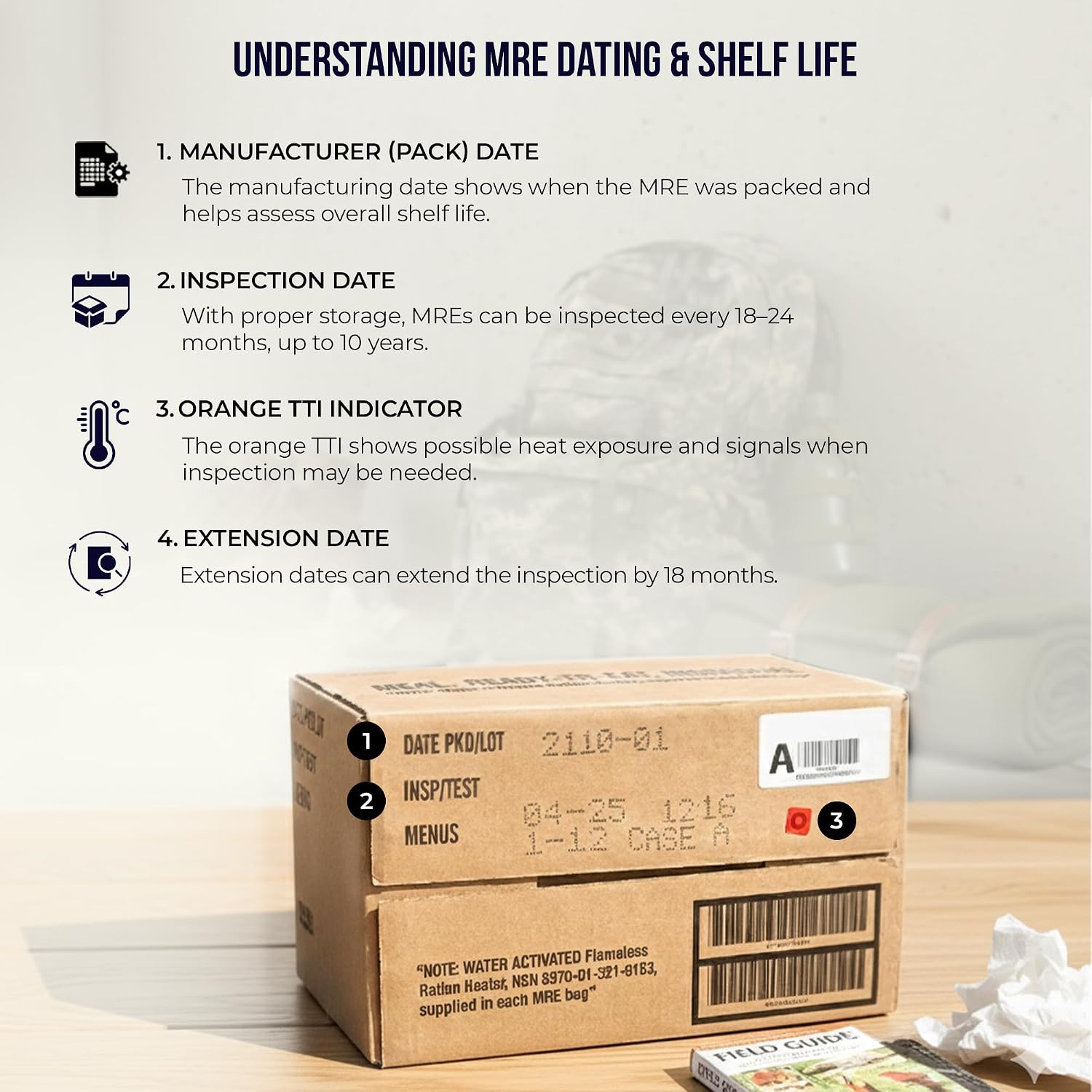
The first thing most buyers notice when their case arrives is a stamped code that looks like nothing in consumer grocery experience. Military MREs use a Julian date code — a four-digit number where the first digit is the last digit of the production year and the remaining three digits are the day of the year. So a stamp reading 3274 means the 274th day of 2023, which is October 1, 2023. Buyers who decode this (and several candid reviewers have posted exactly this math online) often find their meals were manufactured a year or two before delivery — which is completely normal and within spec.
What trips buyers up is the separate inspection date printed alongside. Per U.S. Army Natick Laboratories’ Operational Rations of the Department of Defense (2022 edition), the “inspection date” is not an expiration date. It’s the recommended date by which a unit should inspect the rations for quality degradation — after which the meals may still be safe and palatable, but cannot be officially certified for military issue without re-inspection. For civilian buyers, the practical read is: inspection date equals the conservative “best quality by” window. Real-world shelf life at optimal storage temperatures (around 60°F) extends well beyond that — Natick’s own time-temperature tolerance research puts 10-year storage as achievable under cool, stable conditions.
One buyer who ordered in early March 2026 received delivery in three days with exactly the stated inspection date on the box — no ambiguity, no stale product. That kind of direct-to-consumer experience has become more common as authorized distributors tighten their fulfillment pipelines. But it’s not universal. Buying from non-authorized surplus channels still carries real variance.
By the numbers:
| Storage Temp | Estimated Shelf Life (Natick data) |
|---|---|
| 120°F (vehicle trunk in summer) | ~1 month |
| 80°F (warm garage) | ~3 years |
| 60°F (climate-controlled storage) | 5–10 years |
| 50°F (cool basement) | Approaching 10+ years |
The temperature column is where most civilian buyers lose shelf life without realizing it. A case stored in a hot garage through three Arizona summers may technically be within its printed inspection date and still be degraded.
Flameless Heaters: How They Work and When They Don’t
The flameless ration heater (FRH) is one of the genuinely clever pieces of field engineering in a standard MRE. It’s a pad of magnesium iron alloy sealed in a bag; you add a small amount of water (a few tablespoons), slide the entrée pouch inside, lean it against a rock or boot, and exothermic reaction does the rest. The reaction generates enough heat to warm the entrée to palatable temperature in about 12–15 minutes — no fire, no stove, no electricity.
Across aggregated buyer reviews from multiple MRE case purchases, flameless heaters are consistently flagged as working flawlessly. This is worth noting because it’s not obvious it would be true — the pads can degrade if moisture infiltrates the outer packaging. The fact that reviewers specifically call out reliable heater performance as a meaningful quality signal suggests they went in skeptical and were reassured. Field & Stream’s 2024 survival food analysis noted similar findings from readers who evaluated military surplus rations in field conditions.
What to do if one fails: Every MRE also contains a sealed entrée pouch that is fully edible cold — no heater required. Cold MREs are a real experience (see the FAQ below), but they are not dangerous or unusable. Carrying a small backup — a Bic lighter and a metal cup, or a compact backpacking stove — resolves any heater failure immediately. For vehicle kits and base camps, this is a non-issue. For on-foot travel where stove weight matters, the heater reliability track record from buyer reports is genuinely reassuring.
Variety, Palatability, and the Honest Entrée Breakdown
This is where MRE research gets genuinely useful — and where candid buyer reviews diverge from manufacturer marketing copy.
One particularly thorough buyer worked through both an A-case (12 meals, menus 1–12) and a B-case (12 meals, menus 13–24) and documented his reactions at the entrée level. The pattern that emerges from his account and from Backpacker Magazine’s 2023 MRE-versus-freeze-dried comparison is consistent:
Strong performers across buyer reports:
- Chili with beans — high caloric density, flavors hold up well
- Chicken fajita — reviewed favorably in multiple accounts
- Chocolate chip cookie — singled out repeatedly as genuinely good; one buyer called it excellent without qualification
- Cheese spread with crackers — consistent utility as a snack component
Entrées that require effort:
- Beef patty with potatoes au gratin — the buyer who ate through both cases noted this one “required effort to finish.” The texture combination under field conditions generates the most complaints across aggregated reviews.
- Maple sausage — palatable but divisive on flavor intensity
- Veggie burger — reviewers are split; caloric density is lower than meat-based alternatives
The honest summary: about two-thirds of the menu rotation earns genuine positive marks. The bottom third ranges from neutral to effortful. For a 72-hour kit, that’s acceptable — you’re not building a restaurant rotation. For longer-duration storage or extended travel, the entrée variance becomes a real quality-of-life factor worth planning around.
MREs vs. Freeze-Dried: The Weight and Taste Tradeoff That Actually Decides Things
This is the central decision frame for any intermediate buyer who has looked at both categories.
A buyer who took MREs and freeze-dried meals on the same multi-day hiking trip with his sons drew the clearest line in print: MREs offer more variety and are cheaper; freeze-dried taste better. He recommends mixing both — and that recommendation holds up analytically.
Here’s why the math matters:
A single MRE weighs approximately 18–24 ounces (510–680 grams) fully packaged, depending on the menu. A single freeze-dried meal pouch (Mountain House, Backpacker’s Pantry, etc.) weighs approximately 4–6 ounces (113–170 grams) before water addition. For a 72-hour kit requiring 3 meals per day, that’s roughly:
- MRE-only route: 9 meals × ~20 oz average = ~11.25 lbs of food weight
- Freeze-dried only route: 9 meals × ~5 oz average = ~2.8 lbs of food weight
FEMA’s emergency food guidance (ready.gov, “Food and Water in an Emergency”) notes that caloric density and portability are both legitimate planning factors, and recommends matching food type to the likely emergency scenario. That framing is directly useful here:
- Vehicle kit or home cache: MRE weight is irrelevant. Go MREs for variety and the no-water-needed advantage.
- On-foot 72-hour kit: Freeze-dried wins on weight, decisively. Consumer Reports’ 2024 emergency food storage overview reached the same conclusion for evacuation-on-foot scenarios.
- Mixed kit: MREs for the first 24 hours (hot meal, no stove setup needed), freeze-dried for days two and three. This is the practical synthesis.
The taste gap is real but contextual. Freeze-dried meals — particularly the premium lines — consistently outperform MREs on palatability in calm conditions. But MREs were designed for stress, fatigue, and appetite suppression under load. The chocolate chip cookie doesn’t need to be gourmet. It needs to get eaten.
Frequently Asked Questions
How do I decode the Julian date code on an MRE to find the actual manufacture date?
Find the four-digit stamp on the case or individual pouch. The first digit is the last digit of the production year (3 = 2023, 4 = 2024, etc.). The next three digits are the day of the year (001 = January 1, 365 = December 31). So 3274 = the 274th day of 2023 = October 1, 2023. A simple Julian date calendar or a search for “Julian day of year calendar” will let you convert any three-digit day number to a month-and-date.
What does “2026 inspection date” really mean — is that the expiration date or something different?
It is not an expiration date. Per U.S. Army Natick Laboratories’ ration documentation, the inspection date is the point at which military units are directed to formally assess ration condition before continued issue. For civilian buyers, treat it as a conservative “peak quality” window. Meals stored below 60°F routinely remain safe and palatable well past inspection dates; meals stored in hot conditions may degrade before the printed date. Temperature management matters more than the stamp.
Are the flameless heaters in surplus MREs reliable, and what do I do if one fails?
Across buyer accounts reviewed for this article, flameless heaters in properly sealed MRE cases are consistently reported as working correctly — even in lots manufactured two or three years before purchase. The failure mode is moisture infiltration through a compromised outer bag. If you receive a case with visibly damaged heater packaging, treat those heaters as suspect. If a heater fails in the field, the entrée is fully edible cold (see below). A small backup heat source — even just hot water poured carefully — can warm the pouch without the chemical heater.
How do MREs compare in weight to freeze-dried pouches for a 72-hour bug-out bag?
A single MRE averages 18–24 ounces fully packaged. A single freeze-dried meal pouch averages 4–6 ounces before adding water. Over nine meals (three days), that’s roughly 11 pounds for an MRE-only kit versus under 3 pounds for freeze-dried. Backpacker Magazine’s 2023 comparison puts this gap plainly: MREs are vehicle food, not on-foot food. If you’re planning to move on foot for more than a few hours, freeze-dried or calorie bars win on weight. If your kit lives in a truck or a closet, MRE weight is a non-factor.
Which MRE entrées are consistently good and which ones do most buyers dislike?
Consistently positive: chili with beans, chicken fajita, the chocolate chip cookie, and cheese spread with crackers. Most buyers find roughly two-thirds of the 24-menu rotation genuinely acceptable or good. The entrées that generate the most complaints are beef patty with potatoes au gratin (texture issues under field conditions) and some of the lower-calorie vegetarian options. If you can buy individual menus rather than full random cases, it’s worth skipping menu 9 (beef patty) based on buyer consensus.
Can MREs be eaten cold without the flameless heater if I don’t want to use it?
Yes — every component is fully cooked and commercially processed before packaging. Cold MREs are safe to eat. The honest assessment from buyers is that cold entrées are noticeably less appealing than heated ones, particularly the meat-based mains, which can congeal. Accessory items — crackers, peanut butter, cookies, candy — are unaffected by temperature and are often consumed cold by choice. In a no-heat scenario, the snack components carry more of the eating experience than you’d expect.
The Decision Rule
If your kit lives in a vehicle, a closet, or a cache that doesn’t move: MREs are a strong buy. The weight is irrelevant, the no-water-required heating is a genuine advantage in power-out scenarios, and the variety across 24 menus outpaces most freeze-dried line-ups at a lower per-meal cost.
If you’re building an on-foot evacuation bag: freeze-dried wins on weight, decisively. MREs will wear you out before the emergency does.
If you’re planning any trip — backcountry, family camping, extended field time — where you’ll have pack weight constraints but want hot meals: mix both. One or two MREs for the first night (no stove setup, maximum calories fast) and freeze-dried for subsequent days is the combination that buyers who’ve actually done both consistently land on. The chocolate chip cookie alone is worth the extra ounces.