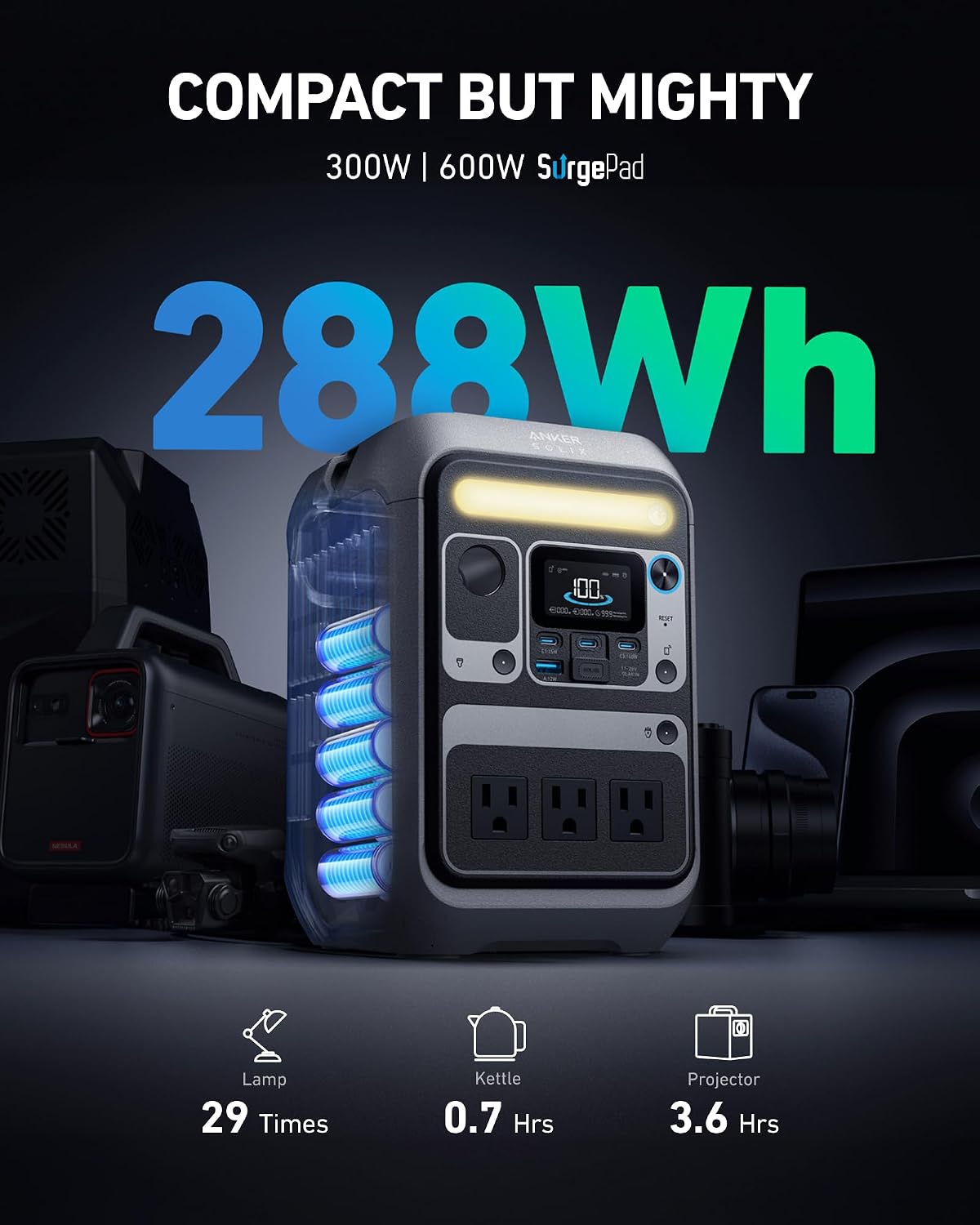
A portable power station is essentially a very large rechargeable battery with a built-in inverter — that last part being what converts stored energy into the standard wall-socket electricity your devices expect. Unlike a gas generator, it runs silently, produces no fumes, and can live inside your home or vehicle. The catch is that capacity and output vary wildly across products, from palm-sized 250-watt-hour (Wh) units barely enough to charge a phone bank, to rolling 3,000 Wh systems that can run a refrigerator through a two-day outage. Buying too small means your gear goes dark when it matters most; buying too large means you’ve spent $1,200 on a unit that never gets used at full capacity. This guide walks through the math and the tradeoffs for three real living situations — apartments, whole-house setups, and overlanding vehicles — so you can match the station to your actual load before you buy.
The Math That Drives Every Decision
Before comparing brands, you need one number: your critical load in watt-hours. This is the sum of every device you’d need to power during an outage, multiplied by how many hours you’d run it.
Quick load estimate, 72-hour scenario:
| Device | Watts | Hours/day | 72-hr Wh |
|---|---|---|---|
| Phone × 2 | 10 | 3 | 2,160 |
| LED lamp | 10 | 6 | 4,320 |
| Mini fridge | 60 | 24 | 12,960 |
| CPAP (no heat) | 30 | 8 | 7,200 |
| Laptop | 45 | 4 | 6,480 |
| Total | ~33,000 Wh |
That table is where most first-time buyers get a shock: a 72-hour full-comfort load for even a modest apartment approaches 33 kWh — more than any single consumer power station can hold. The realistic answer is triage, not replacement: choose which loads are truly non-negotiable, then size to those.
Per Popular Mechanics’ January 2026 breakdown of home backup power calculations, the fridge alone accounts for roughly 40% of a typical 72-hour emergency load, which is why it’s the single best benchmark for sizing. If you can keep food cold and one lighting circuit live, you’ve covered the majority of outage risk.
Two other numbers matter almost as much as capacity:
- Continuous output (watts): This is how much power the station can push at once. A 1,000 Wh station with a 600W inverter can’t run a standard 700W microwave — full stop.
- Surge rating: Motors (refrigerators, sump pumps) draw 2–3× their running wattage on startup. If the spec sheet doesn’t list a surge rating, assume the unit will trip or throttle on motor loads.
Consumer Reports’ 2025 portable power station guide specifically flags the surge-rating gap as one of the most commonly overlooked specs, noting that real-world tripped units often failed not on sustained load but on the initial motor startup spike.
Scenario 1: Apartment Dwellers and the 72-Hour Kit Mindset
The apartment constraint isn’t capacity — it’s space, portability, and recharge access. You likely don’t have a driveway for a solar array, can’t run a generator on a balcony (most lease agreements and fire codes prohibit it), and need a unit you can carry in one trip if you evacuate.
The practical ceiling for most apartments is 500–1,000 Wh with a continuous output of at least 600W AC.
At this range, you’re covering:
- Phone and laptop charging through a 72-hour outage
- LED lighting for one or two rooms
- A CPAP machine at no-heat setting (roughly 30–45W continuous)
- Short bursts on a small appliance — not sustained refrigerator operation
FEMA’s emergency supply kit guidance at ready.gov emphasizes that medical devices like CPAP are a priority power load for households that depend on them — the agency recommends identifying backup power before an emergency, not during.
What the market looks like here (May 2026): Units like the Goal Zero Yeti 500X and the Bluetti EB55 sit in the 500–537 Wh range with street prices around $400–$550. The EcoFlow River 2 Pro (768 Wh) has been a frequent deal-tracker flag at the $400–$450 range during sales events. Wirecutter’s March 2026 update calls the River 2 Pro “the most versatile mid-size option” for exactly this use case, citing its 800W AC output and sub-eight-pound weight as the combination that makes apartment carry realistic.
The tradeoff to name explicitly: Smaller lithium iron phosphate (LFP) batteries — the chemistry now standard on most mid-tier stations — are rated for 3,000–3,500 charge cycles before capacity degrades to 80%. That’s a meaningful longevity advantage over the older NMC chemistry. But LFP is heavier per watt-hour, so the portability math gets tighter as capacity climbs. A 1,000 Wh LFP unit from EcoFlow or Bluetti typically weighs 22–30 lbs — manageable for one person but worth factoring if elevator access is uncertain during an emergency.
If X, then Y — apartment decision rule: If your only non-negotiable loads are phones, lighting, and a CPAP, a 500–768 Wh unit with 800W+ continuous output is your range. If you want to add a mini-fridge (typically 45–80W running, 150–200W surge), step up to 1,000–1,200 Wh minimum and verify the surge rating exceeds 200W before buying.
Scenario 2: Suburban Whole-House Systems
Whole-house preparedness changes the math entirely. You’re no longer triaging — you’re trying to sustain a refrigerator, a chest freezer, well pump (if applicable), medical equipment, and possibly an electric range or HVAC for a multi-day grid outage. A single portable station can anchor this system, but it almost certainly needs a solar charging path to be useful beyond day one.
The practical entry point for a whole-house backup role is 2,000 Wh with 2,000W+ continuous output. The aspirational benchmark most dedicated preppers work toward is 3,000–5,000 Wh with expandable battery modules.
At this tier, the Goal Zero Yeti Pro 4000 (3,600 Wh base, expandable to 12 kWh with add-on tanks) and the EcoFlow Delta Pro (3,600 Wh base, 7,200 Wh with dual unit) are the names reviewers consistently return to. Outside Online’s April 2026 overlanding and base-camp power roundup noted that the Delta Pro’s 3,600W AC output is enough to run a standard household refrigerator, chest freezer, and several lighting circuits simultaneously — a combination that meaningfully separates it from the 2,000W-class units.
Solar compatibility is where this gets complicated. Most whole-house stations accept solar input, but the voltage windows and connector types vary in ways that cause real-world mismatches. The EcoFlow Delta Pro accepts up to 1,600W of solar at 11–150V DC via an XT60 connector; the Goal Zero Yeti Pro 4000 uses a proprietary Anderson Powerpole-style connection rated for a different voltage window. Running mismatched panels — for example, connecting three 200W panels wired in series that push 120V into a station rated for 60V max input — can trip the MPPT controller or, in worst cases, damage the unit.
By the numbers — solar sizing for a whole-house anchor station:
- 3,600 Wh station at 50% usable depth = 1,800 Wh available before recharge
- A standard 200W panel produces roughly 800–1,000 Wh per day in good sun (5 peak sun hours)
- To recharge 1,800 Wh in one day: minimum 2–3 panels (400–600W array)
- Most whole-house stations accept 800–1,600W solar input maximum — check before buying panels
Consumer Reports’ 2025 guide flags solar throughput throttling as a frequently underreported limitation: several stations in the 2,000 Wh class are rated for solar input but cap it at 400W, which extends recharge time to 5+ hours in ideal conditions and 8–12 hours in real Pacific Northwest or Great Lakes winter sun.
If X, then Y — whole-house decision rule: If your critical loads include a refrigerator plus one additional motor load (freezer, sump pump, well pump), you need at minimum 2,000 Wh and a 3,000W+ surge rating. If you’re planning for multi-day outages without generator backup, pair a 3,600 Wh base station with at minimum a 400W solar array — and verify the solar input voltage matches your panel string configuration before purchasing either.
Scenario 3: Overlanders and Vehicle-Mounted Systems
The overlanding use case flips the whole-house logic: the priority isn’t raw capacity, it’s weight-to-output ratio and recharge flexibility in locations where a grid connection is weeks away.
Most overlanders running a serious build center on a 1,000–2,000 Wh station paired with roof-mounted or portable panels and a DC-DC charger that pulls from the vehicle’s alternator while driving. The goal is a closed-loop system that starts each day with a full or near-full station regardless of the previous night’s draw.
Outside Online’s April 2026 roundup consistently cited the EcoFlow Delta 2 (1,024 Wh) and the BioLite BaseCharge 1500 (1,521 Wh) as the volume leaders in this segment, with reviewers noting the BioLite’s integrated MPPT controller as a compatibility advantage when mixing panel brands — a common situation for overlanders who add panels incrementally.
The vehicle charging angle adds a layer most buying guides understate: a standard alternator produces 13.8–14.4V DC, which is below the absorption voltage most LFP stations want for a full charge. A quality DC-DC (battery-to-battery) charger steps this up to the correct charge profile; without one, you’re trickle-charging through a cigarette-lighter port at 10–15W, which won’t meaningfully recharge a 1,500 Wh station on a two-hour drive.
If X, then Y — overlanding decision rule: If your vehicle has an aftermarket dual-battery setup or a dedicated house battery, pair it with a DC-DC charger rated at 20–40A for meaningful daytime recharge. If you’re running off a single factory alternator, budget for a DC-DC charger ($150–$300) before adding a large station — otherwise your solar panels carry the full recharge burden, which may not be enough in tree canopy or shoulder-season sun.
The Decision Framework, Consolidated
The right power station isn’t the one with the most impressive spec sheet — it’s the one sized to your critical load, compatible with your recharge source, and physically suited to your living situation. Run your own load estimate using the watt-hour math above, then apply these rules:
- Apartment, evacuation-ready: 500–1,000 Wh, 800W+ continuous, LFP chemistry, under 25 lbs
- Suburban whole-house anchor: 3,000–3,600 Wh base, 2,000W+ continuous, solar input 800W+, verify voltage window before pairing panels
- Overlanding closed loop: 1,000–1,500 Wh, integrated MPPT, budget separately for a DC-DC charger if vehicle charging is part of the plan
Every segment has a premium ceiling worth knowing: the Goal Zero Yeti Pro ecosystem and EcoFlow Delta Pro with Smart Home Panel integration represent what serious preppers scale toward when they’re ready to move beyond station-only backup into partial-circuit coverage. Those aren’t the starting point — but they’re worth understanding as the benchmark against which every mid-tier purchase is measured.