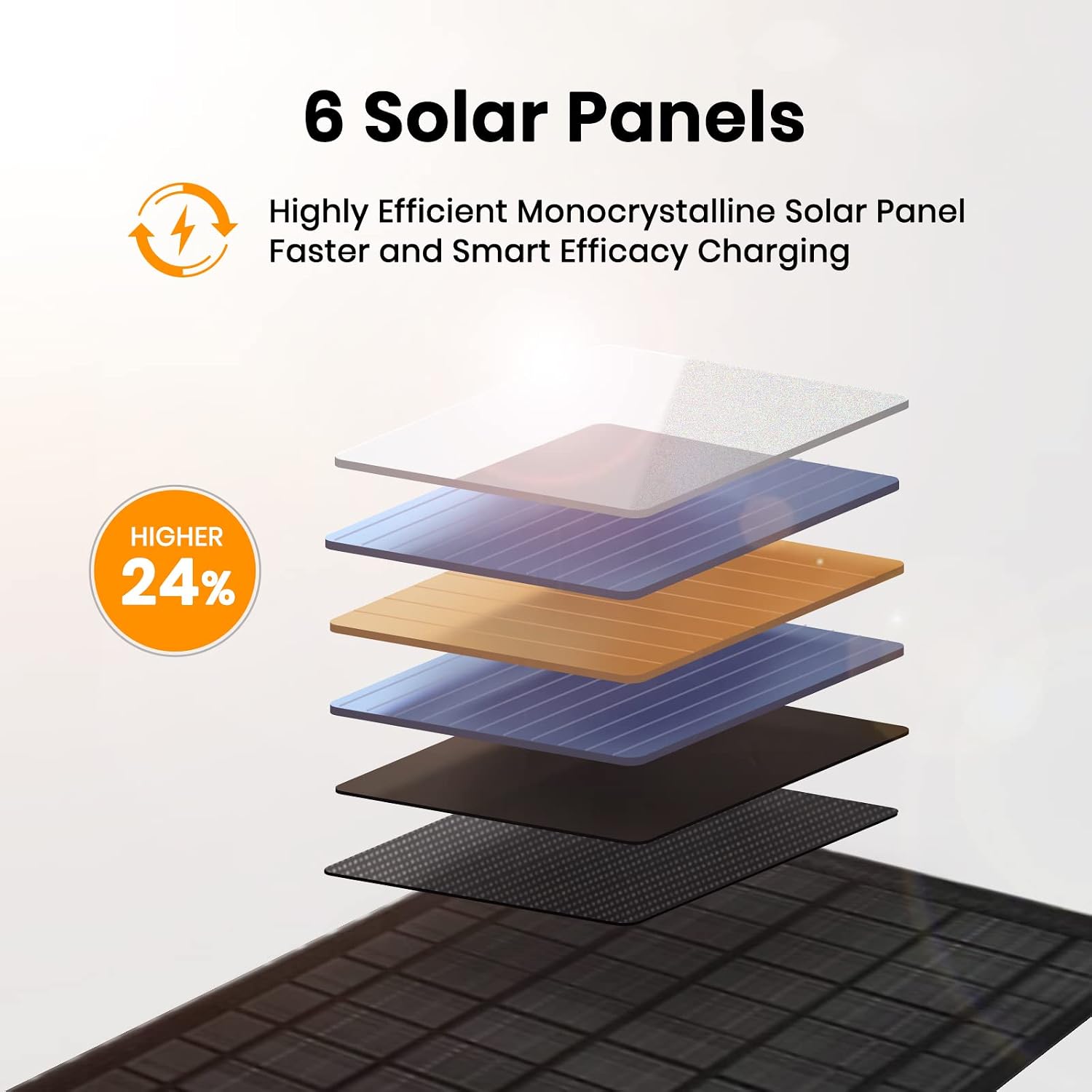
A portable solar panel is simply a foldable or rigid array of photovoltaic cells — devices that convert sunlight directly into electricity — that you can carry in a pack or strap to a vehicle. A power station is a battery in a box: it stores that electricity so you can run a phone, a medical device, or a lamp at any hour. Together they form a self-contained charging loop that keeps working when the utility grid doesn’t. Matching them correctly matters more than most buyers expect. The wrong pairing can mean a full day of Florida sun produces barely enough charge to run a phone, while the right pairing can keep a CPAP machine and a laptop running through a multi-day outage. This guide walks through the real-world math, the connector traps, and the form-factor tradeoffs — so you can make a confident decision before you’re standing in a hardware store during a storm watch.
| EDITOR'S PICKSOKIOVOLA N-Type 16BB 200W Port… | Mid-tierRenogy 200W Portable Solar Panel | Budget pickFlexSolar 40W Foldable Solar Pa… | |
|---|---|---|---|
| Rated power | 200W | 200W | 40W |
| Efficiency | 25% | — | — |
| Waterproofing | IP68 | IP65 | Waterproof (unspecified) |
| USB outputs | — | — | USB-C and USB-A |
| Panel tech | N-Type 16BB | — | — |
| Price | $179.99 | $174.94 | $53.99 |
| See on Amazon → | See on Amazon → | See on Amazon → |
Why “Rated Watts” Is the Starting Point, Not the Answer
Every panel ships with a rated wattage — the number the manufacturer measured under ideal laboratory conditions called Standard Test Conditions (STC): 1,000 watts of irradiance per square meter, a cell temperature of 25°C, and a specific light spectrum. Real rooftops, driveways, and tailgates don’t deliver STC. Clouds diffuse irradiance. Panel temperature climbs well above 25°C on a summer hood. Your angle to the sun changes by the hour.
The practical rule across aggregated buyer reviews is 80–95% of rated spec in good conditions. FlexSolar’s 40W panel, for example, measured by one reviewer at 30–35W — and that reviewer called it a success, because 32W sustained over six hours of decent sun is a meaningful number. At the high end, a 400W kickstand panel in direct Florida sun logged 300–370W in a published owner account. The gap between rated and real is consistent enough that you should plan around 85% of rated wattage as your working estimate.
By the numbers — what that 85% rule means in practice:
| Rated Panel | Working Estimate | Hours to fill a 300Wh station | Hours to fill a 1,000Wh station |
|---|---|---|---|
| 40W | ~34W | ~9 hrs | ~30 hrs |
| 100W | ~85W | ~3.5 hrs | ~12 hrs |
| 200W | ~170W | ~1.75 hrs | ~6 hrs |
| 400W | ~340W | ~55 min | ~3 hrs |
These estimates assume no conversion losses and no throttling — two factors covered next.
The Throttling Problem: When Your Station Rejects Free Power
Here’s the counterintuitive finding that catches intermediate buyers off guard: power stations have a maximum solar input rating, and they will silently cap incoming wattage at that ceiling even if your panel can deliver more.
The Anker SOLIX C1000 Gen 2, a 1,056Wh station popular for running CPAP and laptop workloads, has a published max solar input of 600W. Pair it with a single 200W Renogy panel — a common choice among owners running it for exactly those CPAP and laptop AI workloads — and the station accepts essentially all of the panel’s output. But pair two 400W panels in series, and you’ve exceeded the ceiling; the station throttles back and you’ve bought wattage you can’t use.
The more dramatic version of this problem appears at the small-station end. One kayak camper’s published account describes discovering that their compact power station was throttling solar input to a trickle-charge rate — slow enough that plugging a phone directly into the panel’s USB-A output charged faster than routing through the station. That’s not a defective panel or a defective station; it’s a mismatch between the station’s maximum solar input spec and the panel’s output. If your station’s solar input ceiling is lower than the panel’s output, check whether direct USB charging from the panel bypasses that ceiling for small loads. For phones and small devices, it often does.
Practical decision rule: look up your station’s “max solar input” in watts before sizing a panel. Then confirm the panel’s open-circuit voltage (Voc) falls within the station’s acceptable voltage window. Most stations published in 2024–2026 accept 12–30V or 12–60V; some high-capacity units go to 150V. A panel with a Voc that exceeds the station’s maximum voltage can damage the charge controller. REI’s solar panel buying guide flags this as one of the most common compatibility errors buyers make.
Form Factor Tradeoffs: Foldable vs. Rigid vs. Blanket
Foldable panels — the briefcase-style units from BioLite, Goal Zero, Jackery, and others — are the default choice for apartment kits and vehicle emergency bags. They fold flat, often include a kickstand or hanging loops, and most ship with a mix of MC4 connectors (the industry-standard waterproof push-lock connector used in permanent solar installations) and proprietary DC barrel plugs or Anderson Powerpole adapters. Wirecutter’s portable solar panel review notes that foldable panels in the 100W class are the most broadly compatible option across mainstream power station brands.
Rigid kickstand panels in the 200–400W range, like those in the Renogy lineup, produce more consistent output per dollar of panel cost because monocrystalline cells on a rigid aluminum frame hold their angle better and dissipate heat more effectively. The 400W kickstand format reviewed by owners in Florida sun consistently posted 300–370W — the high end of the 85% rule — because rigid panels stay cooler than folded fabric. Trade-off: they’re large, heavy, and impractical for anything that isn’t a vehicle, garage, or fixed base camp.
Flexible blanket panels represent the third category — and carry the most significant durability flag in current owner data. A Renogy 400W blanket owner reported total failure after approximately six uses. That’s a single reviewer’s experience, not a statistically validated failure rate, but it’s notable enough to present as a real risk when evaluating flexible panels for emergency-use contexts where you need the panel to work exactly when conditions are worst. Flexible panels make sense for applications where rigid mounting is impossible — curved van roofs, kayak decks — but for a primary emergency charging panel, rigid or foldable monocrystalline units carry less durability risk based on current aggregated owner data.
Long-run durability at the budget end: HQST panels have a meaningful owner data point working in their favor. One reviewer who owns ten HQST panels reported older arrays still performing after decades of outdoor use. Popular Mechanics’ solar generator coverage notes that HQST consistently punches above its price class on longevity relative to rated spec. For buyers who want a panel that will sit in a garage for years and still work when retrieved, that long-term track record matters.
Connector Types and the Adapter Problem
Most portable panels ship with MC4 connectors on the panel side, because MC4 is the weatherproof standard used in permanent residential solar. The problem: most consumer power stations don’t have MC4 input ports. They use proprietary DC barrel jacks (Goal Zero’s 8mm barrel, Jackery’s round pin, Bluetti’s aviation-style connector, EcoFlow’s loop connector) or XT60 plugs.
Every major panel brand sells adapter cables, and most panels include at least one proprietary-to-MC4 adapter in the box. But the adapter question has a second layer: polarity and pin diameter. An MC4-to-DC barrel adapter that fits your station’s port physically can still be wired for reverse polarity, which at minimum blows a fuse and at worst damages the charge controller. The fix is to verify adapter compatibility against your specific station model before you’re in the field, not during an outage.
Outside Online’s 2025 power station guide recommends keeping a labeled zip-lock bag with your panel’s adapter cable and a note of the station model it was verified against — a simple system that prevents a common field error.
Sizing Decision Framework by Station Tier
Under 300Wh stations (apartment emergency kit, go-bag): A 40–60W foldable panel is a realistic match. Owners report that a full clear day — six to eight hours — produces enough charge to get from 20% to 80% on a 300Wh station. Expect 9–11 hours for a full charge from flat. Direct USB charging from the panel for phones is faster than routing through the station if the station’s solar input is throttled, so verify your station’s max solar input spec before assuming the station is the right path for every device.
300–600Wh stations (suburban family system, overlander base camp): The 100W foldable tier is the natural match. A 100W panel at 85% efficiency delivers roughly 85W sustained — enough to meaningfully recharge a mid-tier station in half a day, or to maintain balance with moderate device loads. Renogy’s 100W foldable is consistently cited in owner reviews as reliable for this use case.
1,000Wh+ stations (whole-house anchor, CPAP + laptop workloads): The Renogy 200W paired with the Anker SOLIX C1000 Gen 2 represents a well-documented real-world pairing: owners using it for CPAP overnight and laptop workloads through the day report that the 200W panel keeps pace with typical daily draw, with net positive charging during peak sun hours. For faster recovery after heavy discharge, a 400W rigid kickstand panel stays within the C1000 Gen 2’s 600W input ceiling.
Frequently Asked Questions
Can a 40W foldable solar panel meaningfully recharge a 300Wh power station during a full day of sun? Yes, but “meaningfully” requires calibrated expectations. At 85% efficiency and six hours of good sun, a 40W panel delivers roughly 34W × 6 hours = 204Wh — about two-thirds of a full charge on a 300Wh station. A full charge from flat takes closer to nine hours of usable sun. That’s a real and useful amount of charge for phones and LED lighting, but it won’t keep pace if you’re also running a fan or portable refrigerator simultaneously.
Do foldable solar panels work through a car windshield, or does the glass block too much UV? Modern automotive glass is specifically designed to block UV and a significant portion of the solar spectrum that photovoltaic cells use. The practical result is a loss of roughly 50–70% of available output compared to direct sun exposure. For emergency recharging, position the panel outside the vehicle — on the hood, roof, or propped against a door — not behind glass.
What connector type do most portable solar panels use, and how do you know if it matches your power station? The panel-side connector is almost universally MC4. The station-side connector is almost universally proprietary. Check your power station’s input port type in its spec sheet or user manual, then verify the adapter cable included with your panel — or purchase a verified adapter — before you need it. REI’s solar panel buying guide includes a connector-type reference for most major station brands.
Why would a power station accept solar input more slowly than its rated max solar input spec? Several reasons: the station’s battery management system may reduce input rate when the battery is near full or too cold; the panel’s voltage may fall slightly outside the station’s MPPT (maximum power point tracking) sweet spot; or the station may have a lower-tier charging mode triggered by a specific connector or input path. One documented case involved a compact station throttling all solar input to a slow charge rate regardless of panel wattage — a firmware behavior, not a hardware defect. When this happens, direct USB output from the panel may be faster for small loads.
How do you angle a foldable panel correctly when there is no kickstand included? The target angle is roughly equal to your latitude — so in the continental U.S., somewhere between 25° and 50° from horizontal, tilted toward true south. Without a kickstand, owners consistently report using a stuff sack, a water bottle, a trekking pole, or a folded sleeping pad wedged under the back edge. Even a rough angle improves output significantly over lying flat, because a flat panel at midday in summer receives light at a steep angle that reduces effective surface area.
Does rain or humidity permanently damage an IP65 or IP67 rated foldable solar panel? IP65 rating means the panel is protected against low-pressure water jets from any direction — adequate for rain and splashing. IP67 means it can be submerged briefly to one meter. Neither rating means the panel is designed for sustained submersion or pressure washing. Short of mechanical damage to lamination seals, rain and normal humidity should not cause permanent damage to a panel with a current IP65 or IP67 rating. Inspect panel seams and junction box seals annually if the panel is stored outdoors or used in consistently wet conditions.