A portable power station is a large rechargeable battery pack with AC outlets built in — useful for running a lamp during a campout or keeping a phone charged when the grid goes down. An uninterruptible power supply (UPS) is a different, more specific job: it must sense a power failure and switch to battery fast enough — typically within 20 milliseconds or less — that a desktop computer, home server, or medical device never notices the interruption. Most power stations are not advertised as UPS devices, and many cannot meet that standard. But a handful of newer models can, and owners are increasingly replacing dedicated APC or CyberPower units with them. This article breaks down which power stations actually qualify for UPS duty, what the critical specs mean in plain terms, and how to match the right unit to your specific devices.
Why Switchover Speed Is the Only Spec That Actually Matters for UPS Duty
When grid power drops, a device plugged into a UPS has a window — measured in milliseconds — before it loses power entirely. A desktop computer’s power supply typically holds its internal capacitors charged for somewhere between 16 and 33 milliseconds after input power disappears, per Intel’s published ATX specification documentation. If the UPS doesn’t hand off to battery within that window, the machine reboots or crashes. For a home server with a RAID array mid-write, that’s a data-integrity event. For a CPAP machine mid-cycle, it’s an alarm and a reset.
Traditional dedicated UPS units from brands like APC and CyberPower are engineered around this constraint: their online or line-interactive designs switch in under 8–12 milliseconds. Power stations are designed primarily for sustained runtime, not fast switching — which is why most never publish a switchover spec at all.
A few units do publish and defend a sub-20ms switchover time, and owner reports back it up. The comparison below walks through three distinct tiers: a compact UPS-optimized pick, a mid-tier pick with DC flexibility, and a high-capacity unit better suited to extended runtime than true UPS duty.
Comparing the Field: Three Tiers of UPS-Capable Power Stations
H3: Compact UPS-First Pick — BLUETTI Elite 30 V2
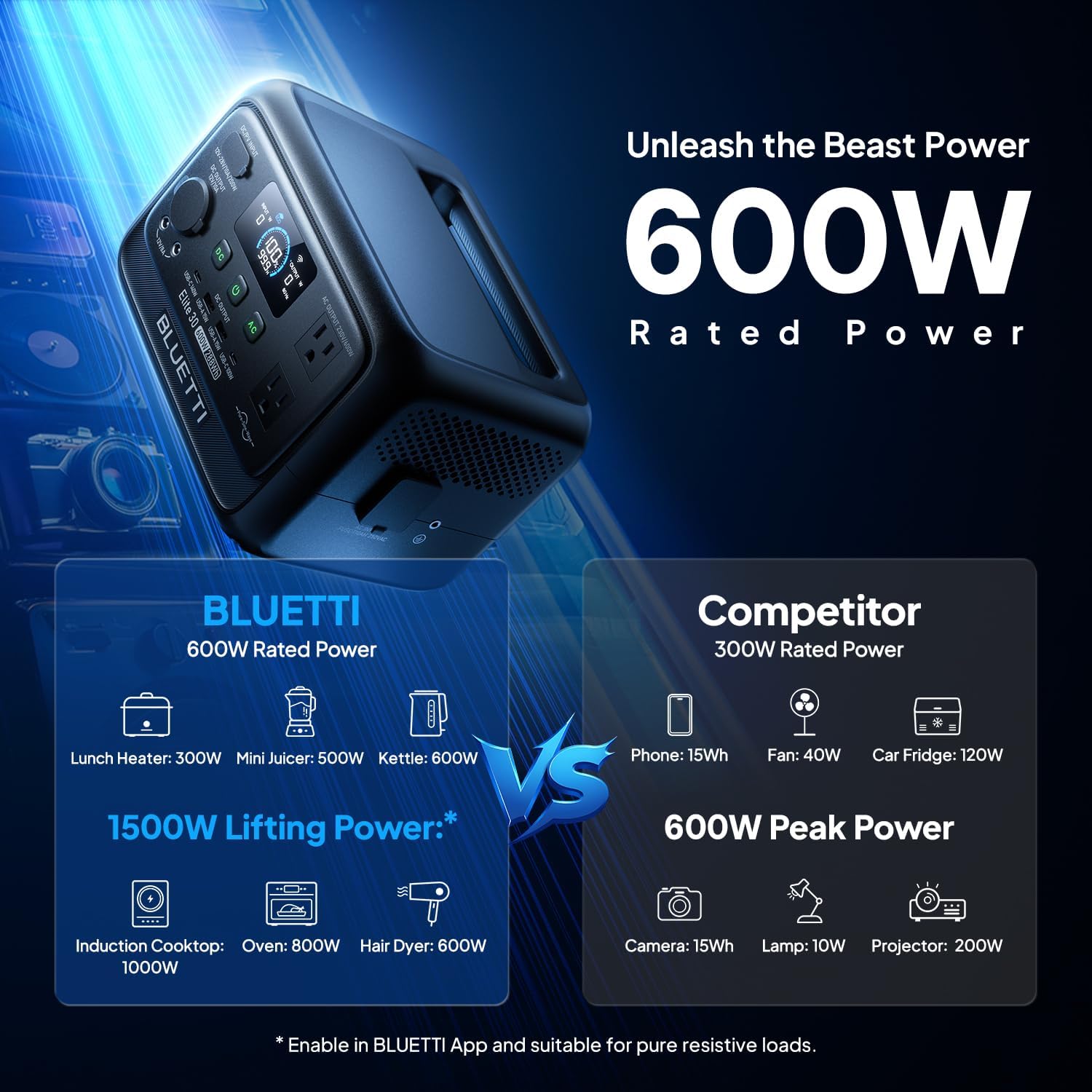
The BLUETTI Elite 30 V2 (288 Wh, 600W continuous AC output) has attracted an unusually specific cluster of owner reviews from people running it as a primary desktop UPS. Reviewers name exact connected devices — home servers, MacBook Pros, 24-inch monitors, ISP modems and routers — and report outage durations exceeding five hours in regions with unstable grids. One reviewer explicitly swapped out a four-year-old CyberPower CP1500PFCLCD for the Elite 30 V2, citing the BLUETTI’s combination of fast switchover, pure sine wave output, and the ability to top up via solar — something a conventional UPS cannot do. BLUETTI’s published spec for the Elite 30 V2 lists UPS mode switchover at under 20ms.
The unit uses LFP (lithium iron phosphate) chemistry, which matters for anyone planning permanent plug-in use. Consumer Reports’ 2025 Portable Power Stations Buying Guide notes that LFP chemistry typically supports 2,000–3,500 full charge cycles versus 500–1,000 for NMC (nickel manganese cobalt) chemistry — a gap that compounds quickly in a scenario where the battery is cycling daily. BLUETTI’s published documentation explicitly supports a UPS mode with active charge management, holding the battery at a partial state of charge when plugged in continuously rather than trickle-cycling it to 100%.
Best for: Desktop computers, iMacs, CPAP machines, home routers, and NAS devices where sub-20ms switchover is the hard requirement and solar recharge capability is a meaningful bonus.
Anker
$249.98
In stock on Amazon
Check price on AmazonH3: Mid-Tier DC-Flexible Pick — Anker SOLIX C300
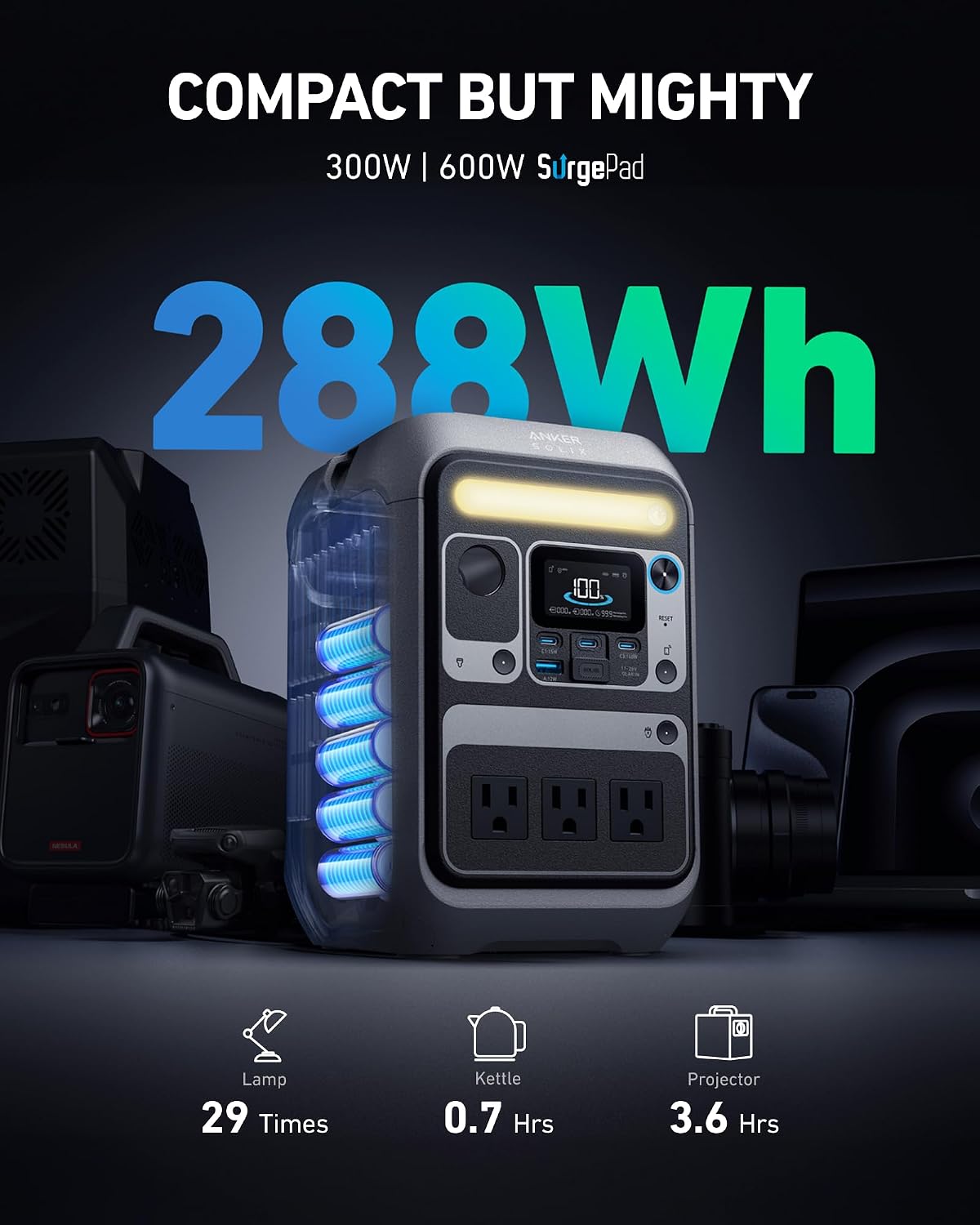
The Anker SOLIX C300 (288 Wh, 300W continuous AC output) draws detailed owner reports from users who needed to bridge generator cutover delays — including one licensed ham radio operator who tested the unit specifically against a 15-second Generac startup window without dropping a 21-inch iMac. The operator reported success. Anker’s published spec for the C300 lists switchover at under 30ms — slightly slower than the BLUETTI Elite 30 V2 on paper, but still within the functional window for most consumer electronics based on owner-reported outcomes.
The C300 DC variant is notable for buyers who need UPS function on AC-powered devices while simultaneously maintaining 12V or USB-C DC outputs for radio gear, networking equipment, or medical accessories. Like the Elite 30 V2, the SOLIX C300 uses LFP chemistry and explicitly supports pass-through with active battery management per Anker’s published documentation — meaning the battery is managed intelligently during continuous plug-in use rather than being subjected to constant micro-cycling.
The 30ms published switchover is the one asterisk. For a home server mid-write or a device with a tighter internal capacitor hold time, the Elite 30 V2’s sub-20ms spec provides more engineering margin. For consumer electronics, networking gear, and radio equipment, the SOLIX C300’s combination of DC flexibility and acceptable switchover makes it the more versatile tool.
Best for: Ham radio operators, networking setups, and users who need simultaneous AC and DC output during an outage, and who can accept a 30ms rather than sub-20ms handoff window.

FlexSolar
$85.49
In stock on Amazon
Check price on AmazonH3: High-Capacity Runtime Pick — EcoFlow DELTA 2 and Jackery 1000 v2
The EcoFlow DELTA 2 (1,024 Wh, 1,800W continuous AC output) and Jackery 1000 v2 (1,070 Wh, 1,500W continuous AC output) are both excellent power stations. Across hundreds of aggregated owner reviews, they consistently earn praise for output power and recharge speed. What they rarely attract — and what neither manufacturer prominently publishes — is discussion of switchover time or a dedicated UPS mode. That absence is informative: neither unit publishes a switchover spec, and neither manufacturer markets a dedicated UPS mode.
Wirecutter’s 2025 review of the best portable power stations, published by the New York Times Company, recommends both units highly for camping, van life, and emergency backup scenarios involving non-critical loads. Neither review positions them as desktop UPS replacements. That matches the engineering reality: without a published sub-20ms switchover, these units are not reliably tested for the millisecond-level handoff that a server or CPAP requires.
The EcoFlow DELTA 2 uses LFP chemistry; the Jackery 1000 v2 uses NMC chemistry, which is less tolerant of continuous plug-in cycling per Consumer Reports’ 2025 Buying Guide. Both units output pure sine wave AC, which clears the waveform quality bar — they simply don’t clear the switching speed bar for true UPS duty.
Best for: Extended-duration outage power for non-critical loads — lamps, phone charging, small appliances, and routers during outages where you don’t have a machine mid-write or a medical device that needs seamless power continuity.

EF LFP
$449.00
In stock on Amazon
Check price on AmazonDoes Pure Sine Wave Output Actually Matter?
Short answer: yes, for anything with a switched-mode power supply or a motor — and that covers most of what you’d want to protect.
A pure sine wave (PSW) output mimics the smooth, cyclical waveform of grid power. A modified sine wave (MSW) output, common in cheaper inverters and some older UPS units including certain APC Back-UPS models, delivers a stepped approximation. Popular Mechanics’ 2024 article “What Is a UPS Battery Backup?” explains that CPAP machines, laser printers, variable-speed motor loads, and high-efficiency power supplies in servers and workstations can all behave erratically — running hotter, triggering fault states, or outright refusing to power on — when fed a modified sine wave.
Every unit in this comparison outputs a pure sine wave. That’s now table stakes at this tier of the market. But it’s worth checking any unit priced under $200, where MSW output remains common. For CPAP machines specifically, ResMed and Philips both specify pure sine wave power in their published technical documentation — PSW is not optional for that use case.
Can You Leave a Power Station Plugged In Permanently Without Killing the Battery?
This question separates a power station used as an occasional emergency backup from one used as a permanent UPS replacement — and the answer depends on whether the unit supports a UPS mode that manages battery state intelligently.
Older power stations with simple pass-through charging subject the battery to constant charge/discharge micro-cycling, which accelerates degradation. Better-designed units manage this by holding the battery at a partial state of charge — typically 80–90% — when plugged in continuously, only topping to 100% when grid power drops.
Consumer Reports’ 2025 Portable Power Stations Buying Guide distinguishes between units with active charge management and those without, noting that the chemistry choice amplifies the difference: LFP units with smart charge management are substantially better candidates for permanent plug-in use than NMC units running simple pass-through. The BLUETTI Elite 30 V2 and Anker SOLIX C300 both qualify on LFP chemistry and documented charge management. The EcoFlow DELTA 2 uses LFP but does not publish a UPS mode. The Jackery 1000 v2 uses NMC, making it the least suitable of the four for permanent plug-in deployment.
Decision rule: Verify two things before committing a unit to permanent UPS duty — (a) that the manufacturer explicitly documents a UPS or pass-through mode with active battery management, and (b) that the unit uses LFP chemistry. Both conditions matter. Neither alone is sufficient.
Frequently Asked Questions
What switchover time do I need to protect a desktop computer or iMac?
For most consumer desktops and all-in-ones, a switchover time at or under 20ms is the practical target. The Anker SOLIX C300’s 30ms published spec sits at the edge of this window — owner reports suggest it works for consumer electronics, but the BLUETTI Elite 30 V2’s sub-20ms spec provides a larger margin. For enterprise servers or strict-uptime applications, a dedicated line-interactive UPS with sub-10ms switching remains the technically correct tool.
How long will a 288Wh unit run a modem, router, and laptop during an outage?
A typical cable modem draws 12–18W; a Wi-Fi router draws 8–15W; a MacBook Pro on light load draws 30–65W. At roughly 70W combined and 85% inverter efficiency, a 288Wh unit delivers approximately 3.5 hours of runtime. Add a 24-inch monitor at 25W and runtime drops to roughly 2.5 hours. FEMA’s Power Outage guidance, published on ready.gov, recommends planning for at least 72 hours of critical communications capability — meaning a much larger unit, a solar recharge path, or both for extended outages.
What’s the real difference between a power station in UPS mode and a dedicated UPS?
A dedicated UPS is engineered for one job: bridge a power gap for minutes. Its battery is sized for 10–30 minutes of runtime, its switching is optimized for sub-10ms handoff, and lower-tier models often output modified sine wave. A power station in UPS mode adds hours of runtime, solar recharge capability, DC output ports, and a substantially larger battery — historically at the cost of slower switching and less mature UPS firmware. The gap has narrowed with units like the Elite 30 V2 and SOLIX C300, but for pure switching speed and proven reliability in data-center or medical-grade applications, a dedicated UPS remains the engineering-correct answer.
Which units support pass-through charging while acting as a UPS?
The BLUETTI Elite 30 V2 and Anker SOLIX C300 both explicitly support simultaneous pass-through and UPS function per their published documentation. The EcoFlow DELTA 2 and Jackery 1000 v2 support pass-through charging but do not publish UPS mode specifications or switchover times, making their behavior during an actual power event less predictable for sensitive devices.
The Decision Framework
If your primary goal is UPS protection for a desktop, iMac, home server, or CPAP — with solar recharge capability as a secondary benefit — the BLUETTI Elite 30 V2 is the most defensible choice based on published specs and owner-reported outcomes. Its sub-20ms switchover, LFP chemistry, documented UPS mode, and the specificity of reviews citing exact devices and multi-hour outage durations make it the closest thing to a direct CyberPower replacement in this category.
The Anker SOLIX C300 is the better pick if you need simultaneous DC output flexibility — particularly for 12V ham radio equipment or networking gear — and can accept the 30ms switchover window that owner reports suggest works for consumer electronics.
If you already own an EcoFlow DELTA 2 or Jackery 1000 v2: use it as a runtime bridge for non-critical loads during normal outages, but don’t depend on it to protect a machine mid-write or a medical device without first verifying actual switchover behavior with your specific unit.
The practitioner’s rule: if you cannot find a published switchover time in the manufacturer’s spec sheet, assume the unit was not designed for UPS duty — and size your expectations accordingly.